January 8, 2019; Philadelphia Inquirer
As one of the nation’s oldest and largest religion-related nonprofits begins construction of a $60-million Faith and Liberty Discovery Center overlooking Independence Hall in Philadelphia, which is expected to draw 250,000 visits a year, is its future brightening? Or is it dimming, as it embraces a new policy that requires all employees via a written commitment to refrain from premarital sex and defines marriage as solely between a man and woman?
The American Bible Society (ABS), founded in 1816 to provide Biblical scripture to anyone who might want it and closely connected with founding fathers like John Jay, John Quincy Adams, and Francis Scott Key, has long been known for its ecumenism. Indeed, we can thank the ABS for the Bible that quietly rests in the top drawer of almost every hotel room in our country and for translating and distributing Bibles across the world “without doctrinal note or comment.”
Today, however, ABS is unquestionably an evangelical organization that now emphasizes “scripture engagement”; provides grants to organizations such as the Campus Crusade for Christ, the Lausanne Committee for World Evangelism, Liberty University and many evangelical missionary agencies; and, most recently, required all employees to sign an “Affirmation of Biblical Community” that effectively bars people in same-sex relationships and sexually active straight adults who are not married from working there. Announced in the spring of 2018 with an implementation deadline of January 1, 2019, this new policy to date has resulted in the resignation of nearly 20 percent of the ABS workforce.
Sign up for our free newsletters
Subscribe to NPQ's newsletters to have our top stories delivered directly to your inbox.
By signing up, you agree to our privacy policy and terms of use, and to receive messages from NPQ and our partners.
ABS’s clear embrace of exclusion sharply contrasts with the seeming new direction of the Southern Baptist Convention, America’s largest Protestant group, whose newly elected 45-year-old leader promises to lead the denomination down the path of repenting for the “failure to listen to and honor women and racial minorities [sic]” and to include them proportionately in leadership roles. This is a sign, according to observers, of the changing religious profile of young adults today: Nearly half of white evangelical Protestants under 30 say that their church should adopt modern beliefs and practices including cultural pluralism and tolerance for different personal behaviors, as compared to the 71 percent of white evangelicals over 65 who believe that their church should preserve its traditional beliefs and practices. With this new leadership, the Southern Baptist Convention appears to be listening to its younger members and responding to significant declines in the white evangelical Protestant population in the US.
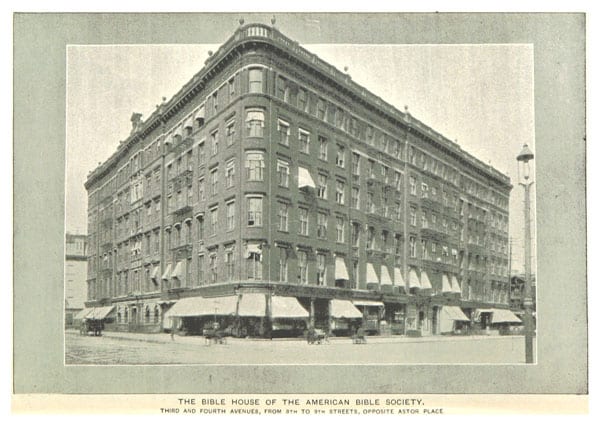
ABS’s shift from an ecumenical to an evangelical culture dates back to 2001 when it shed its written promise to publish the Bible “without doctrinal note or comment” and added “so that all may experience (the Bible’s) life-changing message” to its constitution. In addition to a mission shift, the 21st century ushered in a period of financial and organizational uncertainty for the nonprofit institution: overspending its budget by $250 million from 2002 to 2011, following four different presidents at the helm, and looking to spend $20 million in renovations at its New York City headquarters to meet city code. In 2013, it abruptly fired its president of seven months who wanted to build a $300-million ministry center on this high-priced real estate.
This unstable period seems to have ended with one president on board since 2014, the 2015 sale of the New York headquarters for $300 million, and the joint announcement with Philadelphia’s Mayor Nutter to relocate its headquarters to the city’s downtown Independence Mall. Scheduled to open in 2020, the new Faith and Liberty Discovery Center seems to have engaged a broad spectrum of historians, religious experts and legal scholars in its design and content (including a Pulitzer-prize winning author and the Librarian of Congress Emeritus), seeking broadly focus on the Bible’s influence on American life. The Center’s own website exhorts, “rather than a divided and polarized America, we anticipate a transformed America that is united in the self-discovery of faith, hope, and love. We expect a renewal of public spiritedness affirming and embracing the ideals of civility, gratitude, kindness, generosity, and selfless service by a people who are motivated to heroic action in their local communities and for the common good.”
But what path is this iconic American institution truly treading—engaging with America’s historic values of inclusion and independence in its new home in the City of Brotherly Love, or embracing an increasingly narrow view of Christianity and its message?—Debby Warren