logo logo
Donate
    • Membership
    • Donate
  • Social Justice
    • Racial Justice
    • Climate Justice
    • Disability Justice
    • Economic Justice
    • Food Justice
    • Health Justice
    • Immigration
    • LGBTQ+
  • Civic News
  • Nonprofit Leadership
    • Board Governance
    • Equity-Centered Management
    • Finances
    • Fundraising
    • Human Resources
    • Organizational Culture
    • Philanthropy
    • Power Dynamics
    • Strategic Planning
    • Technology
  • Columns
    • Ask Rhea!
    • Ask a Nonprofit Expert
    • Economy Remix
    • Gathering in Support of Democracy
    • Humans of Nonprofits
    • The Impact Algorithm
    • Living the Question
    • Nonprofit Hiring Trends & Tactics
    • Notes from the Frontlines
    • Parables of Earth
    • Re-imagining Philanthropy
    • State of the Movements
    • We Stood Up
    • The Unexpected Value of Volunteers
  • CONTENT TYPES
  • Leading Edge Membership
  • Newsletters
  • Webinars

California’s Gov. Brown Nixes Official Use of NFL’s Racial Epithet Nickname

Rick Cohen
October 13, 2015

change-the-mascot

October 11, 2015; Sacramento Bee

Give the California legislature and Governor Jerry Brown credit for taking an official stance against the racially derogatory epithet that is the strongly-defended name of Washington, D.C.’s National Football League franchise owned by internet mogul Daniel Snyder.

At the end of 2013, the Capitol News Service counted 62 high schools in 22 states that used the same epithet as the nickname for their teams, though that’s down from about 90 high schools a quarter-century earlier. Four schools in California were counted as using the name.

The legislation that Brown signed last week, Assembly Bill 30, prohibits high schools from adopting or using the name favored by Snyder and allowed by the NFL. Eleven years earlier, then-governor Arnold Schwarzenegger vetoed similar legislation, arguing that local school boards should control interscholastic policies. Brown and the legislature seem to believe that the use of racially derogatory epithets is a valid reason to override a school board in this instance.

The thinking from California that the Washington NFL team’s name might be objectionable seems to have escaped one of the major presidential candidates. Jeb Bush told radio host Hugh Hewitt—and we quote him for accuracy and completeness:

There was a big argument about the Washington Redskins, the Redskins being a pejorative term. I think “Washington” is a pejorative term, not the Redskins, so they’ll get through it, they’ll figure it out.”

It is debatable whether Bush’s unnecessary defense of the Washington NFL team name is related to the $100,000 donation team owner Daniel Snyder made earlier this year to the Right to Rise Super PAC that supports Bush’s presidential candidacy. The statement puts Bush in line with his competitor, Donald Trump, who earlier this month pronounced the name just fine. “I know Indians that are extremely proud of that name…They think it’s a positive,” he said. “Honestly, I don’t think they should change the name, unless the owner wanted to.”

Sign up for our free newsletters

Subscribe to NPQ's newsletters to have our top stories delivered directly to your inbox.

By signing up, you agree to our privacy policy and terms of use, and to receive messages from NPQ and our partners.

Trump, Bush, and Schwarzenegger might not be bothered by the name, but some high schools are rethinking the epithet as a nickname, along with the associated variety of derogatory mascots. The Goshen, Indiana school board voted to get rid of the name that the high school shared with the Washington NFL team as of 2016. Other schools seem a little confused by the controversy. In Tulsa, Oklahoma, Union High School seems to have decided to keep the name shared with the Washington NFL team, but reportedly has ditched its Native American mascot in favor of something called “Hyper.”

An earlier statement from Bush defended the name on another radio show: “I don’t think it should change it…. I don’t find it offensive. Native American tribes generally don’t find it offensive…. It’s a sport, for crying out loud. It’s a football team…I’m missing something here, I guess.”

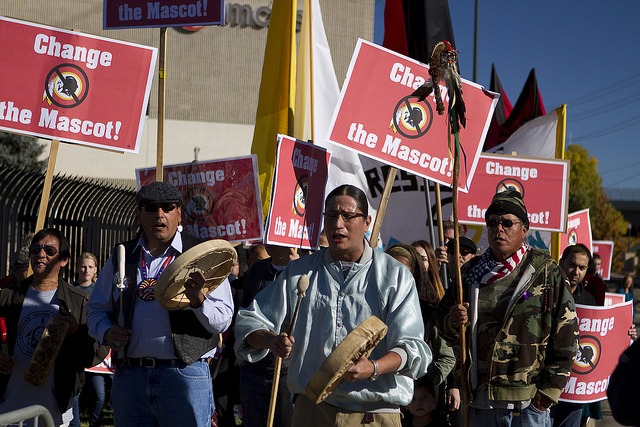
The Change the Mascot campaign against the name issued a sober statement in response:

Social science research has shown that the NFL’s promotion of the R-word racial slur has particularly serious effects on Native American children…

What is surprising is that in promoting the use of this slur, the governor somehow believes he speaks for Native Americans and can assert that Native American people do not find this slur offensive. He clearly is missing something. What is even more appalling is the governor’s declaration that because he personally doesn’t find this slur offensive, that makes it acceptable.

This should be a very simple open-and-shut issue in the 2016 campaign: No presidential candidate should be promoting this racial slur against Native Americans.

“Today is a huge victory for Native American Civil Rights, and I hope it paves the way for all other states to create similar laws,” commented Dakhkota Brown, a Native American youth, president of Native Education Raising Dedicated Students, credited with helping push the legislation through the California legislature. “Nobody’s team or school pride should ever outweigh someone’s cultural identity!” It would seem that California Governor Jerry Brown thinks, similar to the Change the Mascot campaign, that no governor should be promoting that racial slur either.—Rick Cohen


Our Voices Are Our Power.

Journalism, nonprofits, and multiracial democracy are under attack. At NPQ, we fight back by sharing stories and essential insights from nonprofit leaders and workers—and we pay every contributor.

Can you help us protect nonprofit voices?

Your support keeps truth alive when it matters most.
Every single dollar makes a difference.

Donate now
logo logo logo logo logo
About the author
Rick Cohen

Rick joined NPQ in 2006, after almost eight years as the executive director of the National Committee for Responsive Philanthropy (NCRP). Before that he played various roles as a community worker and advisor to others doing community work. He also worked in government. Cohen pursued investigative and analytical articles, advocated for increased philanthropic giving and access for disenfranchised constituencies, and promoted increased philanthropic and nonprofit accountability.

More about: Anti-RacismIndigenous CommunitiesNonprofit NewsPolicy
See comments

You might also like
What Is the SAVE America Act?
Marissa Martinez
Disability Groups Are Standing United for Trans Rights. That Hasn’t Always Been the Case.
Sara Luterman
New Student Loan Limits Could Threaten Diversity in Nursing and Public Health Programs
Lauren Nuttall
‘I’m Heartbroken’: Trans Kansans Reckon with Their Driver’s Licenses Being Invalidated
Sherman Smith and Morgan Chilson
After Years of Waiting, She Wanted to Start Gender-Affirming Care. Politics Interfered.
Orion Rummler
In the Face of Authoritarianism, Connection Is Resistance
EJ Juárez

Upcoming Webinars

Group Created with Sketch.
March 26, 2:00 pm ET

Learn Out Loud

How Every Philanthropy, Nonprofit, and Community Member Can Leverage Power in Our Fight Against ICE

Register
Group Created with Sketch.
April 23, 2:00 pm ET

Receiving & Giving Feedback

Essential Practices for Healthy Organizations and Communities

Register

    
You might also like
A crowd of people hold signs that read "Stop the SAVE Act", "End Voter Suppression" and "Defend Our Democracy"
What Is the SAVE America Act?
Marissa Martinez
A person at a march holds a sign with the blue, pink, and white trans flag that reads “We See You, We’ve Got You”
Disability Groups Are Standing United for Trans Rights. That...
Sara Luterman
Yellow CLOSED sign hanging in a dusty shop window, conveying themes of business failure, recession, and economic downturn.
Nonprofits in Limbo as Flipcause Bankruptcy Unfolds
Lauren Girardin

Like what you see?

Subscribe to the NPQ newsletter to have our top stories delivered directly to your inbox.

See our newsletters

By signing up, you agree to our privacy policy and terms of use, and to receive messages from NPQ and our partners.

  • About
  • Advertise
  • Careers
  • Contact
  • Copyright
  • Donate
  • Editorial Policy
  • Privacy Policy
  • Funders
  • Submissions

We are using cookies to give you the best experience on our website.


Nonprofit Quarterly | Civic News. Empowering Nonprofits. Advancing Justice.
Powered by  GDPR Cookie Compliance
Privacy Overview

This website uses cookies so that we can provide you with the best user experience possible. Cookie information is stored in your browser and performs functions such as recognising you when you return to our website and helping our team to understand which sections of the website you find most interesting and useful.

Strictly Necessary Cookies

Strictly Necessary Cookie should be enabled at all times so that we can save your preferences for cookie settings.