logo logo
Donate
    • Membership
    • Donate
  • Social Justice
    • Racial Justice
    • Climate Justice
    • Disability Justice
    • Economic Justice
    • Food Justice
    • Health Justice
    • Immigration
    • LGBTQ+
  • Civic News
  • Nonprofit Leadership
    • Board Governance
    • Equity-Centered Management
    • Finances
    • Fundraising
    • Human Resources
    • Organizational Culture
    • Philanthropy
    • Power Dynamics
    • Strategic Planning
    • Technology
  • Columns
    • Ask Rhea!
    • Ask a Nonprofit Expert
    • Gathering in Support of Democracy
    • Hope in the Dark
    • Humans of Nonprofits
    • Inside the States
    • In Defense of Civil Society
    • The Myth of Heroic Leadership
    • Notes from the Frontlines
    • Notes from the Long Arc
    • Reimagining Philanthropy
    • The Unexpected Value of Volunteers
    • We Stood Up
  • Newsletters
  • NPQ Online Events
    • Learn Out Loud
    • Leading Edge Webinars
    • Partner Events
    • On Demand
  • Leading Edge Membership

Why Pay Attention to Crowdfunded Journalism?

Ruth McCambridge
February 2, 2016

Journalism

NPQ has long covered the emergence and travails of nonprofit journalism sites. Though they are no longer subject to the kind of IRS scrutiny that blocked the tax exemptions of many for a few years, they now face the challenge of reliable revenue generation. Their business models are many and varied, depending on the publication, mission, and audience, and few can afford to eschew out of hand any creative addition to the revenue base.

But more and more, journalism is being pursued by individuals who are not necessarily associated with any media company, nonprofit or not. These pieces may take the form of articles, but they may also be documentaries, blogs, storytelling projects, or longer-form coverage. Who is the natural buyer for this variety of products? Well, in some cases, it is the interested crowd.

A new report about crowdfunded journalism has been released by the Pew Research Center, and even if you are not a journalist, it should be of interest. For one thing, the notion of who can act as a journalist and under whose auspices and with whose money is very much in transition; for another, journalism can be an essential tool for social change, as we mentioned last week in our coverage of the Chicago police misconduct database.

Sign up for our free newsletters

Subscribe to NPQ's newsletters to have our top stories delivered directly to your inbox.

By signing up, you agree to our privacy policy and terms of use, and to receive messages from NPQ and our partners.

Written by Nancy Vogt and Amy Mitchell, the report, “Crowdfunded Journalism: A Small but Growing Addition to Publicly Funded Journalism,” documents the growth of crowdfunded journalism since April 2009, when it first appeared as an option on Kickstarter and where it remains a relatively tiny but distinct and growing category of crowdfunded projects. It is worth mentioning that a few other journalism crowdfunding sites tried to start up in the years since 2009, but none have sustained independently. Indiegogo, the other major crowdfunding platform, does not have a specific category for journalism projects, so this report only covers the emerging landscape of crowdfunded journalism projects on Kickstarter.

Among the more interesting points covered in this very detailed report:

  • Among those proposing journalism projects on Kickstarter are individuals, independent groups, media organizations and institutions (such as a university or high school.) Projects by individuals made up 71 percent of those projects that were fully funded.
  • Media companies were much more likely to propose an expansion of something they were already doing than to propose a brand new initiative, while individuals and groups of individuals are about twice as likely to propose a startup than an expansion.
  • Journalism projects proposed on Kickstarter had a success rate (full funding or more) that was lower than most at 22 percent, second only to technology related projects, which stumbled in at a surprising 20 percent. Of course, the volume on the proposed tech projects was far higher, and where crowdfunding for journalism had raised $6.3 million, crowdfunding for technology projects raised $265.7 million.
  • In six years, 658 journalism projects have been fully funded on Kickstarter for the $6.3 million total, but the amount has grown significantly from year to year, from $49K the first year to $1.7 million in the first nine months of 2015. The number of people donating to these projects has grown also, from 792 in 2009 to 25,651 in 2015. Some of this is doubtlessly due to the rise in awareness of crowdfunding overall.

Despite the fact that the pool of money here is very small in comparison to the kind of money media is receiving from philanthropy both individual and institutional, there is a kind of beauty to the idea of the crowd helping to back its own information flows directly. Of course, this already happens through donations to nonprofit news sites and subscriptions, but this nontraditional alternative seems to be a natural part of the mix, and one that may prove in the long run to be very important to real freedom of the press.


The work isn’t done. Neither is our commitment.

The challenges facing nonprofits aren’t going away. Neither can the journalism that informs, connects, and amplifies the sector.

Help NPQ keep this work free and accessible.

Give Today
logo logo logo logo logo
About the author
Ruth McCambridge

Ruth is Editor Emerita of the Nonprofit Quarterly. Her background includes forty-five years of experience in nonprofits, primarily in organizations that mix grassroots community work with policy change. Beginning in the mid-1980s, Ruth spent a decade at the Boston Foundation, developing and implementing capacity building programs and advocating for grantmaking attention to constituent involvement.

More about:
See comments

Stuffing-1
You might also like
Las mujeres poderosas: How La Bajada’s women built a legacy of organizing
Jennie Trejo
My Way of Giving Back to the Universe
Lucille Contreras
Who gets to write America’s next 250 years? Lessons from reproductive justice
Nourbese Flint
What Lowndes County’s sanitation crisis reveals about America
Augustina Boateng
The invisible infrastructure of solidarity
Tria Mucyo Nkuruh
What do we mean when we talk about political education? Community organizations and the fight for a better democracy
Emily Blank

Upcoming Webinars

Group Created with Sketch.
December 3, 2:00 pm ET

After the Midterms

What’s Next for Nonprofits?

Register
Group Created with Sketch.
January 28, 2:00 pm ET

Democratic Staff Structures

Weaving Shared Leadership and Union Practice in Nonprofits

Register
You might also like
A pair of hands cups a handful of water from the surface of a lake of water. Below the hands, water ripples out.
What do we mean when we talk about political education?...
Emily Blank
A woman of color looks into the camera with a serious expression. She is sandwiched by a white female and Asian female coworker.
Why the good offers seem to go to others
Rhea Wong
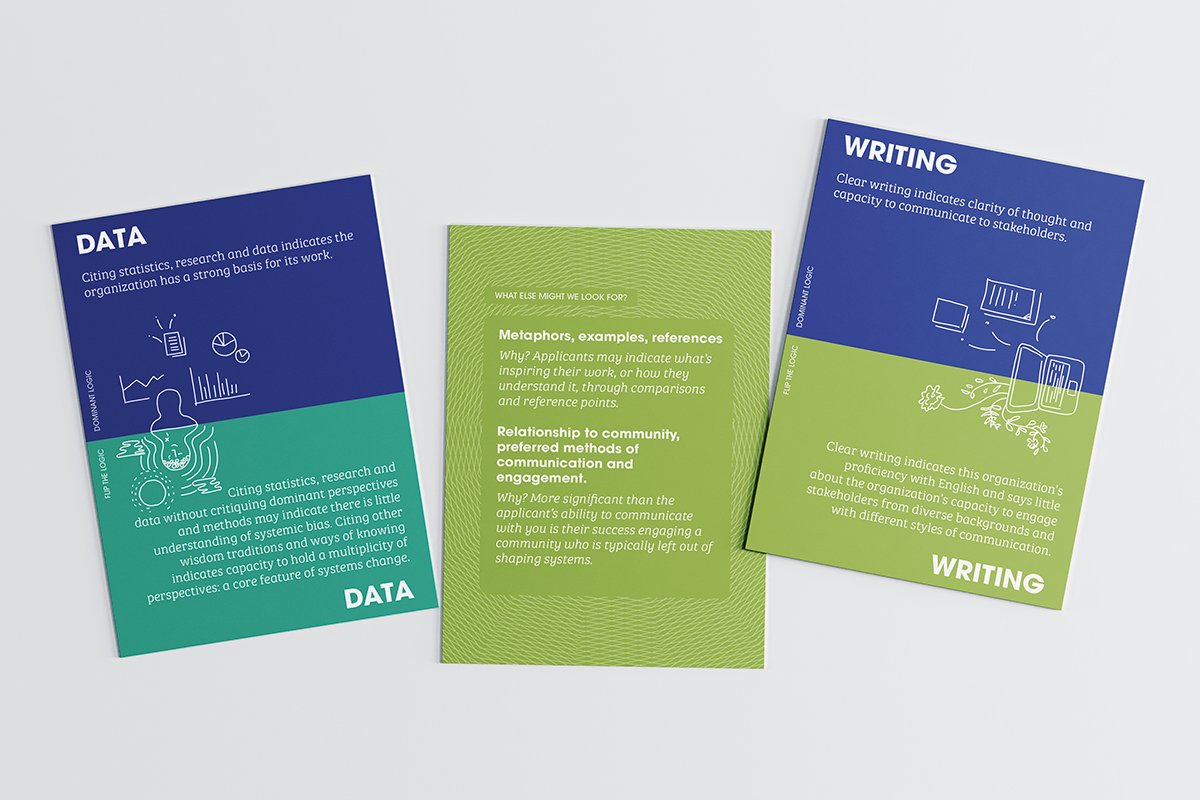
“Flippin’ Logics Cards” identify eight “dominant logics,” or recurring assumptions and ways of thinking that can shape how reviewers interpret an application.
Can a deck of cards interrupt bias in grantmaking?
Devyn Taylor

Like what you see?

Subscribe to the NPQ newsletter to have our top stories delivered directly to your inbox.

See our newsletters

By signing up, you agree to our privacy policy and terms of use, and to receive messages from NPQ and our partners.

  • About
  • Advertise
  • Careers
  • Contact
  • Copyright
  • Donate
  • Funders
  • Editorial Policy
  • Media Relations
  • Privacy Policy
  • Submissions

We are using cookies to give you the best experience on our website.


Nonprofit Quarterly | Civic News. Empowering Nonprofits. Advancing Justice.
Powered by  GDPR Cookie Compliance
Privacy Overview

This website uses cookies so that we can provide you with the best user experience possible. Cookie information is stored in your browser and performs functions such as recognising you when you return to our website and helping our team to understand which sections of the website you find most interesting and useful.

Strictly Necessary Cookies

Strictly Necessary Cookie should be enabled at all times so that we can save your preferences for cookie settings.