logo logo
giving banner
Donate
    • Membership
    • Donate
  • Social Justice
    • Racial Justice
    • Climate Justice
    • Disability Justice
    • Economic Justice
    • Food Justice
    • Health Justice
    • Immigration
    • LGBTQ+
  • Civic News
  • Nonprofit Leadership
    • Board Governance
    • Equity-Centered Management
    • Finances
    • Fundraising
    • Human Resources
    • Organizational Culture
    • Philanthropy
    • Power Dynamics
    • Strategic Planning
    • Technology
  • Columns
    • Ask Rhea!
    • Ask a Nonprofit Expert
    • Economy Remix
    • Gathering in Support of Democracy
    • Humans of Nonprofits
    • The Impact Algorithm
    • Living the Question
    • Nonprofit Hiring Trends & Tactics
    • Notes from the Frontlines
    • Parables of Earth
    • Re-imagining Philanthropy
    • State of the Movements
    • We Stood Up
    • The Unexpected Value of Volunteers
  • CONTENT TYPES
  • Leading Edge Membership
  • Newsletters
  • Webinars

Save the World in 2014: Don’t Go Shopping

Jennifer Amanda Jones
January 9, 2014


Ethos

January 8, 2014; Pacific Standard

Want to save the world? Just go shopping. If you walk down the aisle of your local grocery store or mall, you will likely see many different products linked to charity. If, by some strange chance, you did not put something “charitable” in your cart, do not worry. You will also be asked to donate at the register.

Cause marketing campaigns and social businesses such as TOMS Shoes, Ethos Water and Nika Water have proliferated in recent years. There is, of course, a lot of good that has come out of such endeavors. Awareness of diseases such as breast cancer and heart disease has increased dramatically, in part due to corporate sponsored advertising campaigns.

But how effective is cause marketing as a form of philanthropy?

Sign up for our free newsletters

Subscribe to NPQ's newsletters to have our top stories delivered directly to your inbox.

By signing up, you agree to our privacy policy and terms of use, and to receive messages from NPQ and our partners.

Such advertising leads many consumers to believe the “charitable choice” they need to make is which brand to buy. It is tempting to believe that choosing one brand over another is making a difference. After all, donating some money to some charity is better than not donating at all, right? It depends. As Casey Cep, a columnist for the Pacific Standard, writes, “The market has seduced us into believing that buying goods is doing good.”

This is a mistake. The charitable choice is: in what type of world do we want to live? If we want to live in a world where all children have access to shoes, we must recognize that giving away shoes will not get us closer to that goal. Instead, we must understand systemic causes to poverty and we must commit philanthropic dollars to long-term solutions.

It is, of course, easier to go shopping.

Angela Eikenberry has also written about what she calls the hidden costs of cause marketing. While there are some benefits to cause marketing, Eikenberry encourages us to consider the long-term challenges, including the fact that the market itself creates and propagates many of the social, physical, and environmental problems philanthropy seeks to correct.

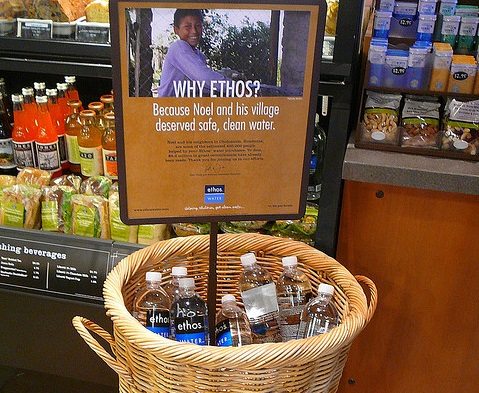
It seems corporate philanthropy may compound the market’s pre-existing externalities. TOMS Shoes, for example, has fallen under criticism for the displacing local shoemakers in the countries where it distributes free shoes. Critics have also suggested that Starbucks is unduly profiting off the philanthropy-driven markup on its Ethos Water brand. One rather incensed critic donated $100 to Charity: Water in lieu, he calculated, of purchasing 2,000 non-recycled, landfill-headed plastic Ethos Water bottles.

Cause marketing isn’t all bad, but as Cep reminds us, “Ethics don’t often scale well, so why outsource your charitable giving to a corporation?” Instead, she offers a New Year’s resolution that is simple but profound: Buy less; donate more dollars.—Jennifer Amanda Jones


Our Voices Are Our Power.

Journalism, nonprofits, and multiracial democracy are under attack. At NPQ, we fight back by sharing stories and essential insights from nonprofit leaders and workers—and we pay every contributor.

Can you help us protect nonprofit voices?

Your support keeps truth alive when it matters most.
Every single dollar makes a difference.

Donate now
logo logo logo logo logo
About the author
Jennifer Amanda Jones

Jennifer Amanda Jones, Ph.D. is the Assistant Professor of Nonprofit Management and Leadership at the University of Florida. Her research interests include nonprofit management, philanthropic giving, and social enterprise initiatives. She is a member of Nu Lambda Mu, the international honor society for nonprofit scholars. Prior to her academic career, Dr. Jones was involved in research projects benchmarking the nonprofit sector in San Diego and in the State of California. Additionally, Dr. Jones has spent more than 15 years working with nonprofit organizations of various types and sizes. She also served on the board of directors for a community foundation.

More about: Corporate Social ResponsibilityMarketingNonprofit NewsPhilanthropy
See comments

Call to action
You might also like
Making Sense of GivingTuesday 2025
Isaiah Thompson
Blocking Authoritarianism: Steps Nonprofits and Foundations Must Take
Saqib Bhatti
The Power of Direct Community Funding
Ana Valéria Araújo
Equitable Intermediaries: Power, Protection, Partnership
Frank Gargione and Andrea Granda
GivingTuesday: Mobilizing Grassroots Donors
Isaiah Thompson
Four Ways Philanthropy Can Support the Movement for a Third Reconstruction
Richard Besser and Carmen Rojas

Upcoming Webinars

Group Created with Sketch.
January 29th, 2:00 pm ET

Participatory Decision-making

When & How to Apply Inclusive Decision-making Methods

Register
Group Created with Sketch.
February 26th, 2:00 pm ET

Understanding Reduction in Force (RIF) Law

Clear Guidance for Values-centered Nonprofits

Register

    
You might also like
A red circle overlayed on a yellow background with three multi-colored dots on each side. In the center it reads, " Isaiah Thompson: Staff Picks for 2025"
Staff Picks for 2025: Isaiah Thompson
Isaiah Thompson
Staff Picks for 2025: Steve Dubb
Steve Dubb
A red circle overlayed on a yellow background with three multi-colored dots on each side. In the center it reads, "Alison Stine: Staff Picks for 2025"
Staff Picks for 2025: Alison Stine
Alison Stine

Like what you see?

Subscribe to the NPQ newsletter to have our top stories delivered directly to your inbox.

See our newsletters

By signing up, you agree to our privacy policy and terms of use, and to receive messages from NPQ and our partners.

  • About
  • Advertise
  • Careers
  • Contact
  • Copyright
  • Donate
  • Editorial Policy
  • Funders
  • Submissions

We are using cookies to give you the best experience on our website.


Nonprofit Quarterly | Civic News. Empowering Nonprofits. Advancing Justice.
Powered by  GDPR Cookie Compliance
Privacy Overview

This website uses cookies so that we can provide you with the best user experience possible. Cookie information is stored in your browser and performs functions such as recognising you when you return to our website and helping our team to understand which sections of the website you find most interesting and useful.

Strictly Necessary Cookies

Strictly Necessary Cookie should be enabled at all times so that we can save your preferences for cookie settings.