logo logo
Fund the truth. #Wethecivic giving banner
Donate
    • Membership
    • Donate
  • Social Justice
    • Racial Justice
    • Climate Justice
    • Disability Justice
    • Economic Justice
    • Food Justice
    • Health Justice
    • Immigration
    • LGBTQ+
  • Civic News
  • Nonprofit Leadership
    • Board Governance
    • Equity-Centered Management
    • Finances
    • Fundraising
    • Human Resources
    • Organizational Culture
    • Philanthropy
    • Power Dynamics
    • Strategic Planning
    • Technology
  • Columns
    • Ask Rhea!
    • Ask a Nonprofit Expert
    • Gathering in Support of Democracy
    • Hope in the Dark
    • Humans of Nonprofits
    • Inside the States
    • In Defense of Civil Society
    • The Myth of Heroic Leadership
    • The New Harvest Project
    • Notes from the Frontlines
    • Notes from the Long Arc
    • Reimagining Philanthropy
    • The Unexpected Value of Volunteers
    • We Stood Up
  • Newsletters
  • NPQ Online Events
    • Premium Webinars
    • Learn Out Loud
    • Partner Events
    • On Demand
  • Leading Edge Membership

Puerto Rican Lawmakers Say No to Paying the Salaries of Its Rulers

Cyndi Suarez
April 9, 2018
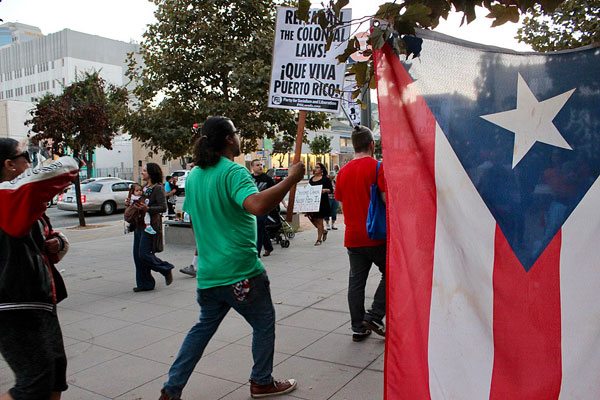
By Rudy Cardoso (IMG_7743) [CC BY 2.0], via Wikimedia Commons

April 5, 2018; El Nuevo Dia

Puerto Rican lawmakers are fighting back against the powers of the Fiscal Oversight Board (or La Junta, as Puerto Ricans call it) where they can—in budget appropriations. Last week, the Senate unanimously approved a measure by Independence Senator Juan Dalmau ordering a stop payment to the board for salary, operations, and professional services.

In essence, the legislature and the country is balking at paying the salary and operations of the board that rules over it. The board has a $60 million budget this year and has asked for an increase to $80 million a year, with $1.7 million of that going to salaries. Its executive director, Natalie Jaresko, makes $625,000 a year in a country where the average annual salary was $27,248 in 2017, according to the Bureau of Labor Statistics.

Constitutionalist lawyer Efren Rivera Ramos said, “The governor and the Legislature would have to challenge in the courts the power of Congress to grant that power to the Junta.” In other words, as he told local Puerto Rico paper El Nuevo Dia, “That would imply challenging the powers of Congress over Puerto Rico under the territorial clause.” In other words, this move by Puerto Rican legislators on the island challenges the legitimacy of the US’s rule over Puerto Rico.

Even Governor Ricardo Rosselló appears to have gained some fighting spirit. About the measure, he said, “Looking ahead, any alternative that is on the table and that we can use to defend the people of Puerto Rico, we will use it…the steps for the future are going to be defending.”

Sign up for our free newsletters

Subscribe to NPQ's newsletters to have our top stories delivered directly to your inbox.

By signing up, you agree to our privacy policy and terms of use, and to receive messages from NPQ and our partners.

The board did not respond to requests for comments, but, according to El Nuevo Dia, the president, Thomas Rivera Schatz, said that the message to the Legislature is, “That they understand that we do not bend and respond to the people who selected us.”

Sen. Dalmau said, in support of the measure, “On each occasion, the more the economic and fiscal crisis deepens, the greater the penalty on the part of the JSF, which proposes austerity and adjusting the belt and dismantling the public service and the university system; they operate as if they have no belt to adjust.”

Carlos “Johnny” Mendez, president of the House of Representatives, called the JSF the “most crude and cruel presentation of imperial power.”

As NPQ readers know, the context is the rebuilding effort after Hurricane Maria and issues of sovereignty and equity are paramount. Please see NPQ’s special reporting on the Puerto Rico recovery.—Cyndi Suarez


Our Voices Are Our Power.

Journalism, nonprofits, and multiracial democracy are under attack. At NPQ, we fight back by sharing stories and essential insights from nonprofit leaders and workers—and we pay every contributor.

Can you help us protect nonprofit voices?

Your support keeps truth alive when it matters most.
Every single dollar makes a difference.

Donate now
logo logo logo logo logo
About the author
Cyndi Suarez

Cyndi Suarez is the former president and editor-in-chief of NPQ (Nonprofit Quarterly). She is author of "The Power Manual: How to Master Complex Power Dynamics", in which she outlines a new theory and practice of liberatory power. Suarez has worked as a strategy and innovation consultant with a focus on networks and platforms for social movements. She has 20 years of experience in the nonprofit sector—in community-based, advocacy, organizing, consulting, infrastructure, and philanthropic organizations. She is passionate about elegant design and designing for power. Her studies were in feminist theory and organizational development for social change.

More about: Nonprofit NewsPolicyPuerto Rico
See comments

Sidebar-WTC
You might also like
They Wept Before the City Knew
Yahia Lababidi
A Letter to the World: From a Young Palestinian Man, To a World Where I and My City Will Be Eradicated
Yahia Lababidi and Mohammed Abu Lebda
We Did Not Come Here to Celebrate, We Came to Build
Linda Sarsour, Carmen Perez-Jordan and Saru Jayaraman
Thousands of Species Wait for Protection as Delays Grow Under Endangered Species Act
Rajeev Tyagi
Community Benefit Agreements: A Tool for Building Stronger Democracies
Sameera Fazili, Pronita Gupta and Doug Bloch
Custodians
Yahia Lababidi

Upcoming Webinars

Group Created with Sketch.
July 16, 2:00 pm ET

Readying for the 2026 Midterms

How 501(c)(3)s Can Educate and Advocate During this Election Season

Register
Group Created with Sketch.
August 13, 2:00 pm ET

Building Narrative Power for Equity and Solidarity

Register

    
You might also like
A cluster of blue, 6-petaled forget-me-not flowers, a symbol of rememberance and memory.
They Wept Before the City Knew
Yahia Lababidi
A bombed out building in the heart of Rafah, Palestine, where author Mohammed Abu Lebda is from.
A Letter to the World: From a Young Palestinian Man, To a...
Yahia Lababidi and Mohammed Abu Lebda
A stenciled graffiti reading, “What Next?” on a textured gray surface.
We Did Not Come Here to Celebrate, We Came to Build
Linda Sarsour, Carmen Perez-Jordan and Saru Jayaraman

Like what you see?

Subscribe to the NPQ newsletter to have our top stories delivered directly to your inbox.

See our newsletters

By signing up, you agree to our privacy policy and terms of use, and to receive messages from NPQ and our partners.

  • About
  • Advertise
  • Careers
  • Contact
  • Copyright
  • Donate
  • Funders
  • Editorial Policy
  • Media Relations
  • Privacy Policy
  • Submissions

We are using cookies to give you the best experience on our website.


Nonprofit Quarterly | Civic News. Empowering Nonprofits. Advancing Justice.
Powered by  GDPR Cookie Compliance
Privacy Overview

This website uses cookies so that we can provide you with the best user experience possible. Cookie information is stored in your browser and performs functions such as recognising you when you return to our website and helping our team to understand which sections of the website you find most interesting and useful.

Strictly Necessary Cookies

Strictly Necessary Cookie should be enabled at all times so that we can save your preferences for cookie settings.