logo logo
giving banner
Donate
    • Membership
    • Donate
  • Social Justice
    • Racial Justice
    • Climate Justice
    • Disability Justice
    • Economic Justice
    • Food Justice
    • Health Justice
    • Immigration
    • LGBTQ+
  • Civic News
  • Nonprofit Leadership
    • Board Governance
    • Equity-Centered Management
    • Finances
    • Fundraising
    • Human Resources
    • Organizational Culture
    • Philanthropy
    • Power Dynamics
    • Strategic Planning
    • Technology
  • Columns
    • Ask Rhea!
    • Ask a Nonprofit Expert
    • Economy Remix
    • Gathering in Support of Democracy
    • Humans of Nonprofits
    • The Impact Algorithm
    • Living the Question
    • Nonprofit Hiring Trends & Tactics
    • Notes from the Frontlines
    • Parables of Earth
    • Re-imagining Philanthropy
    • State of the Movements
    • We Stood Up
    • The Unexpected Value of Volunteers
  • CONTENT TYPES
  • Leading Edge Membership
  • Newsletters
  • Webinars

The Appalling and Racialized State of Maternal Health in the US

Ruth McCambridge
May 13, 2019
ElizabethForMA / Ayanna Pressley at the Unity Rally – Cambridge, MA

May 9, 2019; Washington Post

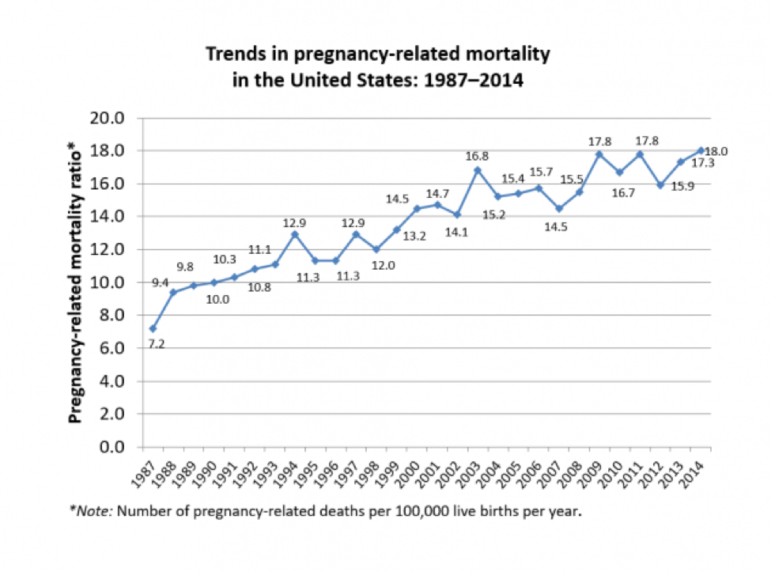
Happy Mother’s Day…or maybe not so much. The most recent statistics on maternal mortality in the United States show that women are now more than twice as likely to die from pregnancy-related causes than they were 32 years ago in 1987. In fact, the US has the highest maternal mortality rate in the developed world, and those rates have been rising to hit the rate of 18 pregnancy-related maternal deaths per 100,000 live births, per year.
Sign up for our free newsletters

Subscribe to NPQ's newsletters to have our top stories delivered directly to your inbox.

By signing up, you agree to our privacy policy and terms of use, and to receive messages from NPQ and our partners.

The Washington Post notes a lack of concern about mothers in the birthing process, seeing correlation in the fact that “several states with the strictest antiabortion laws have maternal mortality rates over twice the national average.” But race also plays a large role; Black women make up a disproportionate number of these mortalities, dying of pregnancy-related causes at three to four times the rate of white women. According to the CDC, Native American and Alaskan Native women are 2.5 times more likely to die from pregnancy-related complications than white women.

One of the results of new congressional leadership is there is finally strong movement on this issue. Last week, New Jersey Senator Cory Booker, with the support of Kamala Harris, Elizabeth Warren, and Massachusetts Rep. Ayanna Pressley, introduced the Healthy MOMMIES Act to the Senate and the House.

Pressley, one of fifty members of the new House’s Black Maternal Health Caucus, promotes the new bill as “a community-based, holistic approach to maternal care that recognizes current disparities in healthcare and critical environmental factors impacting communities,” adding, “Maternal justice is about ensuring that every mom-to-be is listened to and treated with dignity and respect during and after childbirth.”—Ruth McCambridge


Our Voices Are Our Power.

Journalism, nonprofits, and multiracial democracy are under attack. At NPQ, we fight back by sharing stories and essential insights from nonprofit leaders and workers—and we pay every contributor.

Can you help us protect nonprofit voices?

Your support keeps truth alive when it matters most.
Every single dollar makes a difference.

Donate now
logo logo logo logo logo
About the author
Ruth McCambridge

Ruth is Editor Emerita of the Nonprofit Quarterly. Her background includes forty-five years of experience in nonprofits, primarily in organizations that mix grassroots community work with policy change. Beginning in the mid-1980s, Ruth spent a decade at the Boston Foundation, developing and implementing capacity building programs and advocating for grantmaking attention to constituent involvement.

More about: Maternal HealthNonprofit NewsPolicy
See comments

You might also like
Nonprofits Can Help Fight Trump’s Persecution of Immigrants
Matthew Rozsa
Can the Fight Against AI Revitalize the US Labor Movement?
Ted Siefer
The Deadly Combination of Pregnancy and Rural Living in the United States
Janelle Carlson
Social Enterprise: Lessons from Down Under
Vicki Pozzebon
If Farm School NYC Closes, What Will the City Lose?
Farm School NYC and Iris M. Crawford
ICE Fears Put Pregnant Immigrants and Their Babies at Risk
Mel Leonor Barclay and Shefali Luthra

Upcoming Webinars

Group Created with Sketch.
February 26th, 2:00 pm ET

Understanding Reduction in Force (RIF) Law

Clear Guidance for Values-centered Nonprofits

Register
Group Created with Sketch.
March 19th, 2:00 pm ET

Open Board Search

How Casting a Wide Net Transforms Nonprofit Governance

Register

    
You might also like
A person’s hand holding up a sign that reads, “No Hate, No Fear: Immigrants are welcome here!”
Nonprofits Can Help Fight Trump’s Persecution of...
Matthew Rozsa
Senator Elizabeth Warren speaks into a microphone in front of a sign reading "We are the Supermajority" while an audience listens.
Supermajority, Group Organizing Women Around Politics, Is...
Jennifer Gerson
A black and white x-ray image of human lungs.
Can the Fight Against AI Revitalize the US Labor Movement?
Ted Siefer

Like what you see?

Subscribe to the NPQ newsletter to have our top stories delivered directly to your inbox.

See our newsletters

By signing up, you agree to our privacy policy and terms of use, and to receive messages from NPQ and our partners.

  • About
  • Advertise
  • Careers
  • Contact
  • Copyright
  • Donate
  • Editorial Policy
  • Funders
  • Submissions

We are using cookies to give you the best experience on our website.


Nonprofit Quarterly | Civic News. Empowering Nonprofits. Advancing Justice.
Powered by  GDPR Cookie Compliance
Privacy Overview

This website uses cookies so that we can provide you with the best user experience possible. Cookie information is stored in your browser and performs functions such as recognising you when you return to our website and helping our team to understand which sections of the website you find most interesting and useful.

Strictly Necessary Cookies

Strictly Necessary Cookie should be enabled at all times so that we can save your preferences for cookie settings.