logo logo
giving banner
Donate
    • Membership
    • Donate
  • Social Justice
    • Racial Justice
    • Climate Justice
    • Disability Justice
    • Economic Justice
    • Food Justice
    • Health Justice
    • Immigration
    • LGBTQ+
  • Civic News
  • Nonprofit Leadership
    • Board Governance
    • Equity-Centered Management
    • Finances
    • Fundraising
    • Human Resources
    • Organizational Culture
    • Philanthropy
    • Power Dynamics
    • Strategic Planning
    • Technology
  • Columns
    • Ask Rhea!
    • Ask a Nonprofit Expert
    • Economy Remix
    • Gathering in Support of Democracy
    • Humans of Nonprofits
    • The Impact Algorithm
    • Living the Question
    • Nonprofit Hiring Trends & Tactics
    • Notes from the Frontlines
    • Parables of Earth
    • Re-imagining Philanthropy
    • State of the Movements
    • We Stood Up
    • The Unexpected Value of Volunteers
  • CONTENT TYPES
  • Leading Edge Membership
  • Newsletters
  • Webinars

Little Free Libraries Take Root across an Array of Communities

Erin Shankie
February 11, 2013

LFL

February 4, 2013; Source: Staten Island Advance

The Staten Island Advocate reports that members of the Unitarian Church of Staten Island (UCSI) are continuing the church’s tradition of promoting a love of books and the free exchange of ideas by opening up a Little Free Library in the church’s front yard. The idea reportedly appealed to the church’s service project group because the UCSI building once housed the first public library on Staten Island. While the UCSI’s Little Free Library is the first on Staten Island, the idea has become a worldwide book-sharing and social movement.

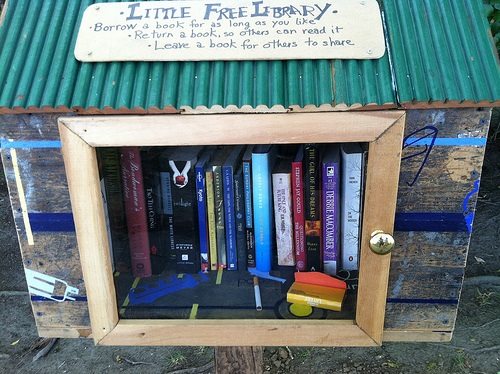
Little Free Libraries resemble a large birdhouse or mailbox, but surprisingly, they contain free books. Placed around neighborhoods, usually in volunteers’ front yards, the Little Free Library aims to inspire the community to share books, to promote literacy, and to further the love of reading. The program took off in 2009 when a former business consultant, Ted Bol, opened up a dispensary and invited those passing by to “take a book, return a book.” The program was a tribute to Bol’s mother, a teacher and book-lover.

Bol put up a miniature version of a one-room schoolhouse on a post outside his Hudson, Wisc. home and filled it with books, then invited his neighbors to borrow them. They loved it and began dropping by so often that it turned into a community gathering spot. Word quickly spread through Wisconsin and the founders formed a nonprofit group. Today, Little Free Libraries number in the thousands and have been spotted in at least 36 countries and as far away as Afghanistan.

Sign up for our free newsletters

Subscribe to NPQ's newsletters to have our top stories delivered directly to your inbox.

By signing up, you agree to our privacy policy and terms of use, and to receive messages from NPQ and our partners.

There are no due dates, late fees, or library cards required, and the doors are open every day of the week. Collections can be themed, including books for adults or children, or both. Fans of the effort describe the movement as a simple and beautiful way to connect with others. With their quirky designs, the boxes are fun and children love them, and they may be easier to access than getting to the library for some people. The idea is not meant to replace public libraries. Rather, it is intended to enhance a community’s library services as a further inducement to read and an effort to promote literacy. Participants have reported surprisingly few thefts or acts of vandalism.

Bol and a friend, Rick Brooks, run the project from a workshop in an industrial building near Hudson, a riverside community about 20 miles east of St. Paul, Minn. They build the boxes in a variety of styles, decorate them in a whimsical fashion, and offer them for sale on the group’s website, which also offers plans for building your own. The Little Free Libraries organization requires the participation of many volunteers to build the boxes, to host them, and to act as community stewards. Most of the nonprofit’s money comes from the sale of the pre-built little libraries, which cost from $250 to $600, and a $25 fee to register a library on the organization’s website. The AARP Foundation has also provided a $70,000 grant as part of a new program to provide book boxes for seniors. Bol and Brooks just recently began drawing paychecks after several years of working on the project as volunteers.

The idea has caught on in the education world and with larger social service organizations. In Minneapolis, school officials are aiming to put up about 100 boxes in neighborhoods where many kids don’t have books at home and Little Free Libraries is working with the Rotary Club and Books for Africa to use the book boxes in its literacy efforts in Ghana.

While there is little doubt the Little Free Library will be appreciated by Staten Islanders, community book exchanges also offer great promise to poverty-stricken American neighborhoods, Ghanaians, and isolated elderly Americans. In a technology-dominated world, Little Free Libraries offer a simple, free, and face-to-face ways to build social interactions, increase literacy, and encourage a love of books for communities of every stripe. –Kathleen Hughes


Our Voices Are Our Power.

Journalism, nonprofits, and multiracial democracy are under attack. At NPQ, we fight back by sharing stories and essential insights from nonprofit leaders and workers—and we pay every contributor.

Can you help us protect nonprofit voices?

Your support keeps truth alive when it matters most.
Every single dollar makes a difference.

Donate now
logo logo logo logo logo
About the author
Erin Shankie

Erin received her Bachelor’s degree in dietetics from Michigan State, her Master’s degree in education-instruction from Central Michigan University, and her graduate certificate in Leadership and Diversity Management in Sport from the University of Connecticut. In 2014, she founded ER Sports and Leadership, a company focused on creating leaders who embrace unique perspectives, set goals, and foster positive team culture. Her work includes diverse groups of individuals in both the nonprofit and for-profit sectors focused on working with teams to provide organizational development as well as build leadership and communication skills. Her other roles include working as Engagement Specialist with the YWCA of Greater Flint, Assistant Governor for Rotary Area 7 in District 6330, and a training coach at Genesys Athletic Club. She has been trained in Sports-Based Youth Development (SBYD), nonprofit leadership and facilitation, and is an ACE certified health coach. She has been a presenter for the Michigan Association for Health, Physical Education, Recreation and Dance (MAHPERD), the American Alliance for Health, Physical Education, Recreation and Dance (AAHPERD), the National Association for Health and Fitness, the Michigan Nonprofit Association, and was featured in Today's Dietitian magazine.

More about: Community OrganizingEducationNonprofit NewsPolicy
See comments

You might also like
Social Enterprise: Lessons from Down Under
Vicki Pozzebon
A National Network of Activists Pursuing “People’s Budgets” Gains Prominence
Celina Su
How People’s Budgets Advance Local Democracy: A Conversation with Celina Su
Steve Dubb and Celina Su
If Farm School NYC Closes, What Will the City Lose?
Farm School NYC and Iris M. Crawford
Trump Administration’s Gutting of Education Department Will Hurt Nonprofits
Lauren Girardin
School Drop-off and Pickup in the Age of ICE
Alison Stine

Upcoming Webinars

Group Created with Sketch.
January 29th, 2:00 pm ET

Participatory Decision-making

When & How to Apply Inclusive Decision-making Methods

Register
Group Created with Sketch.
February 26th, 2:00 pm ET

Understanding Reduction in Force (RIF) Law

Clear Guidance for Values-centered Nonprofits

Register

    
You might also like
A protest sign reading, “No Business on a dead planet”, emphasizing how the wellbeing of our planet is more important than profit.
Social Enterprise: Lessons from Down Under
Vicki Pozzebon
Budget Justice: On Building Grassroots Politics and Solidarities
A National Network of Activists Pursuing “People’s...
Celina Su
Budget Justice: On Building Grassroots Politics and Solidarities
How People’s Budgets Advance Local Democracy: A...
Steve Dubb and Celina Su

Like what you see?

Subscribe to the NPQ newsletter to have our top stories delivered directly to your inbox.

See our newsletters

By signing up, you agree to our privacy policy and terms of use, and to receive messages from NPQ and our partners.

  • About
  • Advertise
  • Careers
  • Contact
  • Copyright
  • Donate
  • Editorial Policy
  • Funders
  • Submissions

We are using cookies to give you the best experience on our website.


Nonprofit Quarterly | Civic News. Empowering Nonprofits. Advancing Justice.
Powered by  GDPR Cookie Compliance
Privacy Overview

This website uses cookies so that we can provide you with the best user experience possible. Cookie information is stored in your browser and performs functions such as recognising you when you return to our website and helping our team to understand which sections of the website you find most interesting and useful.

Strictly Necessary Cookies

Strictly Necessary Cookie should be enabled at all times so that we can save your preferences for cookie settings.