logo logo
giving banner
Donate
    • Membership
    • Donate
  • Social Justice
    • Racial Justice
    • Climate Justice
    • Disability Justice
    • Economic Justice
    • Food Justice
    • Health Justice
    • Immigration
    • LGBTQ+
  • Civic News
  • Nonprofit Leadership
    • Board Governance
    • Equity-Centered Management
    • Finances
    • Fundraising
    • Human Resources
    • Organizational Culture
    • Philanthropy
    • Power Dynamics
    • Strategic Planning
    • Technology
  • Columns
    • Ask Rhea!
    • Ask a Nonprofit Expert
    • Economy Remix
    • Gathering in Support of Democracy
    • Humans of Nonprofits
    • The Impact Algorithm
    • Living the Question
    • Nonprofit Hiring Trends & Tactics
    • Notes from the Frontlines
    • Parables of Earth
    • Re-imagining Philanthropy
    • State of the Movements
    • We Stood Up
    • The Unexpected Value of Volunteers
  • CONTENT TYPES
  • Leading Edge Membership
  • Newsletters
  • Webinars

Report Outlines Path toward Greater Gender Wealth Equality

Steve Dubb
March 21, 2019

March 20, 2019; Fast Company

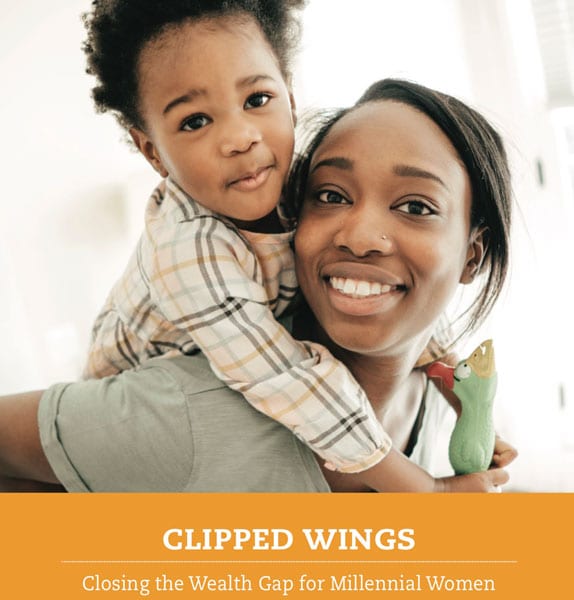
A new study co-published by the Asset Funders Network and the Closing the Women’s Wealth Gap Initiative examines the large gap in household wealth between households headed by men and households headed by women and suggests steps that nonprofits, philanthropy, and policy can take to close that gap.

The report, Clipped Wings, is written by Jhumpa Bhattacharya and Anne Price from the Insight Center for Community Economic Development (ICCED) and Fenaba Addo of the University of Wisconsin, Madison. In it, Bhattacharya and her colleagues take a detailed look at just how gendered wealth inequality in the US is and how new government policies and philanthropic practices could change those dynamics.

To do this, the report focuses on women born between 1980 and 1997, the so-called millennial generation. Bhattacharya, a report coauthor and vice president of programs and strategy at ICCED, notes that women from this generation face many challenges.

“Many of them entered the workforce during the Great Recession,” notes Eillie Anzilotti in Fast Company, and are “mired in an economic landscape of stagnant salaries and rising costs.”

Overall, the report finds that the median wealth of single Black women born between 1980 and 1997 is almost a third less than their single Black male counterparts. Among Latinas and white women, the gap is greater, but both have median wealth levels that are about 55 percent of their male counterparts. However, it should be noted that the median wealth of single white women in this generation is still greater than that of either Latinos or Black men.

Sign up for our free newsletters

Subscribe to NPQ's newsletters to have our top stories delivered directly to your inbox.

By signing up, you agree to our privacy policy and terms of use, and to receive messages from NPQ and our partners.

The report identifies the lack of paid leave as one key factor that perpetuates inequality. In 2017, 57 percent of mothers between the ages of 20 and 37 who had babies were unmarried. But US policies still presume that most households have two parents. Combine the challenges of single parenting with rising student debt and you have a recipe for deep wealth inequality.

“We’re seeing that tuition has risen at a skyrocketing rate along with more women and students of color attending college,” Bhattacharya says. “You can call me a conspiracy theorist, but there’s a connection there—as more women and people of color are using education as a stepping stone, it’s becoming increasingly difficult to actually gain wealth from it.”

Women graduate, the report notes, with an average of $20,263 in student debt. Anzilotti adds, “Debt is especially burdensome for black and Latinx students, who tend to have less intergenerational wealth and who consequently can access less financial support from their parents than their white peers.”

How to disrupt this pattern? Anzilotti summarizes some key report recommendations: “The US needs more comprehensive parental leave policies that take into account the needs of single mothers, and public assistance benefits that directly support single mothers….Student debt forgiveness and criminal justice reform—including ending money bail, which financially burdens many families—would also alleviate burdens.” The report also endorses a universal basic income floor to help women and people of color build wealth by providing greater income security.

In outlining places where funders and nonprofits could intervene, the report notes that “racial and gender wealth inequities…are key issues of our time” and hopes that philanthropy can help develop a framework for analysis and systemic change.

One philanthropic initiative the report highlights is a pilot cash guarantee program launched in 2018, which is giving “15 low-income Black female-headed households in Jackson, Michigan, a monthly cash benefit of $1,000 with no strings attached.” With participating families making an average of about $11,000 a year, this more than doubles their income. The project aims to “track and learn how families are spending their cash benefit, and aims to answer questions such as: If we offer families a little bit of breathing room, will they be able to dream about something a little bigger? If financial survival were not always top of mind, would community leadership and activism become a real possibility?”

In appendices, the report lists both challenges and potential solutions. Optimistically, the authors conclude that “the growing economic insecurity of this generation of women is not inevitable, nor is it irreversible.” To reverse these trends, the authors add, requires using a race/class/gender intersectional lens that “puts women at the center of future policy decisions and [reimagines] how our systems operate.”—Steve Dubb


Our Voices Are Our Power.

Journalism, nonprofits, and multiracial democracy are under attack. At NPQ, we fight back by sharing stories and essential insights from nonprofit leaders and workers—and we pay every contributor.

Can you help us protect nonprofit voices?

Your support keeps truth alive when it matters most.
Every single dollar makes a difference.

Donate now
logo logo logo logo logo
About the author
Steve Dubb

Steve Dubb is senior editor of economic justice at NPQ, where he writes articles (including NPQ’s Economy Remix column), moderates Remaking the Economy webinars, and works to cultivate voices from the field and help them reach a broader audience. In particular, he is always looking for stories that illustrate ways to build a more just economy—whether from the labor movement or from cooperatives and other forms of solidarity economy organizing—as well as articles that offer thoughtful and incisive critiques of capitalism. Prior to coming to NPQ in 2017, Steve worked with cooperatives and nonprofits for over two decades, including twelve years at The Democracy Collaborative and three years as executive director of NASCO (North American Students of Cooperation). In his work, Steve has authored, co-authored, and edited numerous reports; participated in and facilitated learning cohorts; designed community building strategies; and helped build the field of community wealth building. Most recently, Steve coedited (with Raymond Foxworth) Invisible No More: Voices from Native America (Island Press, 2023). Steve is also the lead author of Building Wealth: The Asset-Based Approach to Solving Social and Economic Problems (Aspen 2005) and coauthor (with Rita Hodges) of The Road Half Traveled: University Engagement at a Crossroads, published by MSU Press in 2012. In 2016, Steve curated and authored Conversations on Community Wealth Building, a collection of interviews of community builders that Steve had conducted over the previous decade.

More about: Gender and SexualityNonprofit NewsPolicy
See comments

You might also like
The Trans Athletes at the Center of Supreme Court Cases Don’t Fit Conservative Stereotypes
Kate Sosin
Women’s Rights Under Siege—but We’ve Come Too Far to Go Back
Ann Lehman
Can the Fight Against AI Revitalize the US Labor Movement?
Ted Siefer
On the Oracle Alice Wong, Disability, and Community
Alison Stine
The Deadly Combination of Pregnancy and Rural Living in the United States
Janelle Carlson
Navigating Conflict in Movement Spaces
Dean Spade

Upcoming Webinars

Group Created with Sketch.
February 26th, 2:00 pm ET

Understanding Reduction in Force (RIF) Law

Clear Guidance for Values-centered Nonprofits

Register
Group Created with Sketch.
March 19th, 2:00 pm ET

Open Board Search

How Casting a Wide Net Transforms Nonprofit Governance

Register

    
You might also like
The “Contemplation of Justice” statue by James Earle Fraser at the supreme court building.
The Trans Athletes at the Center of Supreme Court Cases...
Kate Sosin
Senator Elizabeth Warren speaks into a microphone in front of a sign reading "We are the Supermajority" while an audience listens.
Supermajority, Group Organizing Women Around Politics, Is...
Jennifer Gerson
A fragmented image of a woman’s profile, symbolizing how women’s rights and protections are under seige.
Women’s Rights Under Siege—but We’ve Come Too Far to...
Ann Lehman

Like what you see?

Subscribe to the NPQ newsletter to have our top stories delivered directly to your inbox.

See our newsletters

By signing up, you agree to our privacy policy and terms of use, and to receive messages from NPQ and our partners.

  • About
  • Advertise
  • Careers
  • Contact
  • Copyright
  • Donate
  • Editorial Policy
  • Funders
  • Submissions

We are using cookies to give you the best experience on our website.


Nonprofit Quarterly | Civic News. Empowering Nonprofits. Advancing Justice.
Powered by  GDPR Cookie Compliance
Privacy Overview

This website uses cookies so that we can provide you with the best user experience possible. Cookie information is stored in your browser and performs functions such as recognising you when you return to our website and helping our team to understand which sections of the website you find most interesting and useful.

Strictly Necessary Cookies

Strictly Necessary Cookie should be enabled at all times so that we can save your preferences for cookie settings.