
logo logo
giving banner
Donate
    • Membership
    • Donate
  • Social Justice
    • Racial Justice
    • Climate Justice
    • Disability Justice
    • Economic Justice
    • Food Justice
    • Health Justice
    • Immigration
    • LGBTQ+
  • Civic News
  • Nonprofit Leadership
    • Board Governance
    • Equity-Centered Management
    • Finances
    • Fundraising
    • Human Resources
    • Organizational Culture
    • Philanthropy
    • Power Dynamics
    • Strategic Planning
    • Technology
  • Columns
    • Ask Rhea!
    • Ask a Nonprofit Expert
    • Economy Remix
    • Gathering in Support of Democracy
    • Humans of Nonprofits
    • The Impact Algorithm
    • Living the Question
    • Nonprofit Hiring Trends & Tactics
    • Notes from the Frontlines
    • Parables of Earth
    • Re-imagining Philanthropy
    • State of the Movements
    • We Stood Up
    • The Unexpected Value of Volunteers
  • CONTENT TYPES
  • Leading Edge Membership
  • Newsletters
  • Webinars

China and India Make Progress on Climate while US Efforts Judged “Inadequate”

Cyndi Suarez
May 17, 2017
“Danger – Climate Change.” Credit: Environmental Illness Network

May 16, 2017; Inside Climate News

While Trump rolls back carbon emission controls, moving the U.S. away from reaching Paris Agreement targets, according to a new analysis by Climate Action Tracker, China and India look set to beat their goals. Both countries are cutting coal production and increasing renewable energy.
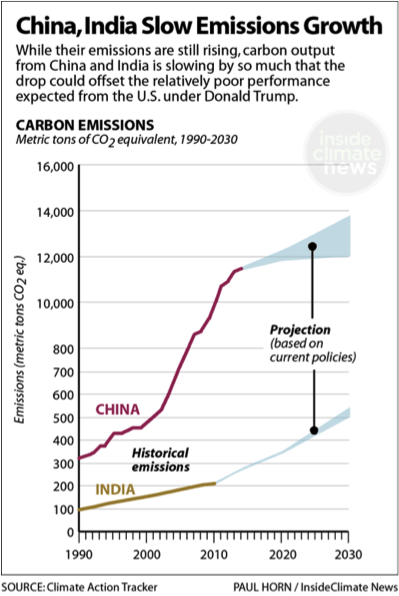
China, the U.S., and India are the top three carbon polluters, respectively. China and India’s reductions “are enough to outweigh the effect of Trump’s proposed rollback in U.S. climate policy, which is likely to put the nation on track to emit 400 million metric tons more than previously projected by 2030.”

In China, coal consumption has been in decline for the last three years. In Beijing, 100 new coal power plants, some already under construction, were cancelled. “The fast growth of renewable energy—and slowing energy demand—made the new plants unnecessary.”

China’s decision makes a big difference.

Cancellation of those plants, totaling 120 gigawatts of capacity, adds up to savings of about 750 million metric tons of carbon dioxide annually. That’s about equivalent to the amount that the United States cut its annual emissions from 2007 to 2015.

If this trend continues, Carbon Tracker says, “China is on track to achieve or surpass its goal to reduce its emissions intensity by 64 to 70 percent below its 2005 levels by 2030.”

In India, solar voltaic prices are at a historic low, making solar energy competitive. In fact, the growth of renewable energy is so fast that it is set to supply 40 percent of electricity-users, the 2030 goal, by 2022. India’s draft electricity plan has it reaching 57 percent renewable energy by 2027. Like China, India cancelled large-scale coal-fired power projects due to “cheaper renewable energy and slowing of demand growth.”

Sign up for our free newsletters

Subscribe to NPQ's newsletters to have our top stories delivered directly to your inbox.

By signing up, you agree to our privacy policy and terms of use, and to receive messages from NPQ and our partners.

India’s Paris climate pledge was to lower the emissions intensity of its GDP by 33 to 35 percent by 2030, below 2005 levels. Carbon Tracker projects that, with current policies, India will leap past that mark to a 42 to 45 percent cut in emissions intensity by 2030.

“Five years ago, the idea of either China or India stopping—or even slowing—coal use was considered an insurmountable hurdle, as coal-fired power plants were thought by many to be necessary to satisfy the energy demands of these countries,” said Bill Hare, CEO of Climate Analytics, one of the research consortium members.

[…]

The cuts in energy demand in China and India are significant because their economies are growing at 7 percent annually, significantly faster than the world average of 2.7 percent (and U.S. GDP growth of 2.6 percent), according to the World Bank.

The White House website describes Trump’s climate plan this way.

For too long, we’ve been held back by burdensome regulations on our energy industry. President Trump is committed to eliminating harmful and unnecessary policies such as the Climate Action Plan and the Waters of the U.S. rule. Lifting these restrictions will greatly help American workers, increasing wages by more than $30 billion over the next 7 years.

[…]

The Trump Administration is also committed to clean coal technology, and to reviving America’s coal industry, which has been hurting for too long.

Carbon Tracker rated both China and India’s climate plans as “medium” because emissions are still on track to grow. Trump’s climate plan would downgrade the U.S. from “medium” to “inadequate.” The Paris Agreement seeks to keep “a global temperature rise this century well below 2 degrees Celsius above pre-industrial levels and to pursue efforts to limit the temperature increase even further to 1.5 degrees Celsius,” and these policies don’t get us there.—Cyndi Suarez


Our Voices Are Our Power.

Journalism, nonprofits, and multiracial democracy are under attack. At NPQ, we fight back by sharing stories and essential insights from nonprofit leaders and workers—and we pay every contributor.

Can you help us protect nonprofit voices?

Your support keeps truth alive when it matters most.
Every single dollar makes a difference.

Donate now
logo logo logo logo logo
About the author
Cyndi Suarez

Cyndi Suarez is the former president and editor-in-chief of NPQ (Nonprofit Quarterly). She is author of "The Power Manual: How to Master Complex Power Dynamics", in which she outlines a new theory and practice of liberatory power. Suarez has worked as a strategy and innovation consultant with a focus on networks and platforms for social movements. She has 20 years of experience in the nonprofit sector—in community-based, advocacy, organizing, consulting, infrastructure, and philanthropic organizations. She is passionate about elegant design and designing for power. Her studies were in feminist theory and organizational development for social change.

More about: Climate ChangeNonprofit NewsPolicy
See comments

Call to action
You might also like
Climate Conservationists Push for People to Live with Nature Rather Than Against It
Anmol Irfan
Social Enterprise: Lessons from Down Under
Vicki Pozzebon
If Farm School NYC Closes, What Will the City Lose?
Farm School NYC and Iris M. Crawford
How New York City Mayor-Elect Mamdani Is Bridging Climate Preparedness to Kitchen Table Concerns
Rajeev Tyagi
Lessons from Survivors: Climate Disaster Advice for Nonprofits
Cinnamon Janzer
The New COVID Vaccine Rules Leave Parents with More Questions Than Answers
Barbara Rodriquez

Upcoming Webinars

Group Created with Sketch.
January 29th, 2:00 pm ET

Participatory Decision-making

When & How to Apply Inclusive Decision-making Methods

Register
Group Created with Sketch.
February 26th, 2:00 pm ET

Understanding Reduction in Force (RIF) Law

Clear Guidance for Values-centered Nonprofits

Register

    
You might also like
A patch of mushrooms and ferns growing from a mirrored model of a human head, symbolizing how people and nature exist together.
Climate Conservationists Push for People to Live with Nature...
Anmol Irfan
A protest sign reading, “No Business on a dead planet”, emphasizing how the wellbeing of our planet is more important than profit.
Social Enterprise: Lessons from Down Under
Vicki Pozzebon
Participants growing garlic at the Farm School NYC. 2025.
If Farm School NYC Closes, What Will the City Lose?
Farm School NYC and Iris M. Crawford

Like what you see?

Subscribe to the NPQ newsletter to have our top stories delivered directly to your inbox.

See our newsletters

By signing up, you agree to our privacy policy and terms of use, and to receive messages from NPQ and our partners.

  • About
  • Advertise
  • Careers
  • Contact
  • Copyright
  • Donate
  • Editorial Policy
  • Funders
  • Submissions

We are using cookies to give you the best experience on our website.


Nonprofit Quarterly | Civic News. Empowering Nonprofits. Advancing Justice.
Powered by  GDPR Cookie Compliance
Privacy Overview

This website uses cookies so that we can provide you with the best user experience possible. Cookie information is stored in your browser and performs functions such as recognising you when you return to our website and helping our team to understand which sections of the website you find most interesting and useful.

Strictly Necessary Cookies

Strictly Necessary Cookie should be enabled at all times so that we can save your preferences for cookie settings.