logo logo
giving banner
Donate
    • Membership
    • Donate
  • Social Justice
    • Racial Justice
    • Climate Justice
    • Disability Justice
    • Economic Justice
    • Food Justice
    • Health Justice
    • Immigration
    • LGBTQ+
  • Civic News
  • Nonprofit Leadership
    • Board Governance
    • Equity-Centered Management
    • Finances
    • Fundraising
    • Human Resources
    • Organizational Culture
    • Philanthropy
    • Power Dynamics
    • Strategic Planning
    • Technology
  • Columns
    • Ask Rhea!
    • Ask a Nonprofit Expert
    • Economy Remix
    • Gathering in Support of Democracy
    • Humans of Nonprofits
    • The Impact Algorithm
    • Living the Question
    • Nonprofit Hiring Trends & Tactics
    • Notes from the Frontlines
    • Parables of Earth
    • Re-imagining Philanthropy
    • State of the Movements
    • We Stood Up
    • The Unexpected Value of Volunteers
  • CONTENT TYPES
  • Leading Edge Membership
  • Newsletters
  • Webinars

Will Federal Disaster Recovery Money be Diverted to Fund Mexican Border Wall?

Steve Dubb
January 14, 2019
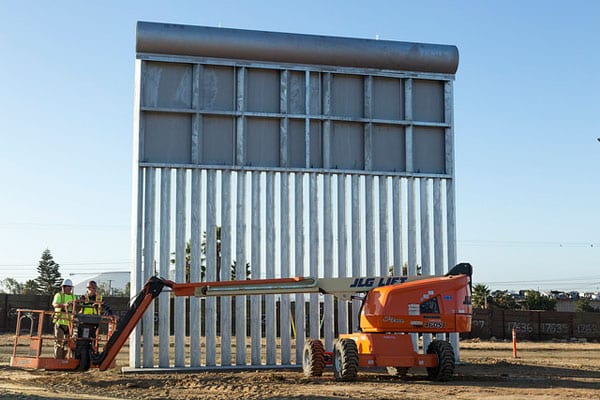
“Border Wall Prototype Construction.” Photo by: Mani Albrecht

January 10, 2019; NBC News, Washington Post, and CNN

As is widely known, President Trump has said he might declare a national emergency to get around congressional opposition to paying for fences along the US-Mexican border. Of course, any such declaration is highly likely to get tied up in the courts. But, if these legal hurdles were surmounted, what programs would get cut to pay for the alleged “emergency”?

According to Courtney Kube and Julia Ainsley of NBC News, a possible, albeit horrible, answer has been found. In the “you can’t make this up” department, apparently the money would be diverted from existing disaster funding. In a sick and ironic twist, “emergency” funding for the wall would be diverted from funding dedicated to addressing actual national emergencies.

At CNN, Tammy Kupperman, Priscilla Alvarez, and Barbara Starr fill in some details:

Congress appropriated $14 billion in supplemental funds to repair infrastructure in areas of the country hardest hit by disasters including hurricanes, like Hurricane Maria which slammed Puerto Rico in 2017 and resulted in the deaths of nearly 3,000 people.

Sign up for our free newsletters

Subscribe to NPQ's newsletters to have our top stories delivered directly to your inbox.

By signing up, you agree to our privacy policy and terms of use, and to receive messages from NPQ and our partners.

In anticipation of a national emergency declaration, the official tells CNN that the Pentagon was asked to provide lists of unspent funds including those earmarked for civil works projects that are part of disaster recovery in Puerto Rico, Texas, California, Florida, and elsewhere. The official said the funds were only recently received. There is more than $13 billion not yet physically spent on the infrastructure repair projects, but that have been promised to these communities.

For instance, more than $2 billion planned for projects in Puerto Rico has not yet been spent. More than $4.5 billion for projects in Texas, including those related to 2017’s Hurricane Harvey, has also not been spent.

As Kube and Ainsley note, the Army Corps funds projects across the country. They add that, “under an emergency declaration, the president could take the money from these civil works projects and use it to build the border wall.” The Washington Post similarly reports that Army Corps money is used for “flood control projects in areas affected by recent natural disasters, including the Texas coastline inundated by Hurricane Harvey and parts of Puerto Rico battered by Hurricane Maria.”

Kube and Ainsley add that, “Under the proposal…Trump could dip into the $2.4 billion allocated to projects in California, including flood prevention and protection projects along the Yuba River Basin and the Folsom Dam, as well as the $2.5 billion set aside for reconstruction projects in Puerto Rico, which is still recovering from Hurricane Maria.”

Rep. Nydia Velázquez (D-NY) was one of many to respond: “It would be beyond appalling for the president to take money from places like Puerto Rico that have suffered enormous catastrophes, costing thousands of American citizens lives, in order to pay for Donald Trump’s foolish, offensive and hateful wall.” In Houston, newly inaugurated Harris County Judge Lina Hidalgo said to local television station ABC13, “This shouldn’t even be a possibility. These communities have been promised this work.”—Steve Dubb


Our Voices Are Our Power.

Journalism, nonprofits, and multiracial democracy are under attack. At NPQ, we fight back by sharing stories and essential insights from nonprofit leaders and workers—and we pay every contributor.

Can you help us protect nonprofit voices?

Your support keeps truth alive when it matters most.
Every single dollar makes a difference.

Donate now
logo logo logo logo logo
About the author
Steve Dubb

Steve Dubb is senior editor of economic justice at NPQ, where he writes articles (including NPQ’s Economy Remix column), moderates Remaking the Economy webinars, and works to cultivate voices from the field and help them reach a broader audience. In particular, he is always looking for stories that illustrate ways to build a more just economy—whether from the labor movement or from cooperatives and other forms of solidarity economy organizing—as well as articles that offer thoughtful and incisive critiques of capitalism. Prior to coming to NPQ in 2017, Steve worked with cooperatives and nonprofits for over two decades, including twelve years at The Democracy Collaborative and three years as executive director of NASCO (North American Students of Cooperation). In his work, Steve has authored, co-authored, and edited numerous reports; participated in and facilitated learning cohorts; designed community building strategies; and helped build the field of community wealth building. Most recently, Steve coedited (with Raymond Foxworth) Invisible No More: Voices from Native America (Island Press, 2023). Steve is also the lead author of Building Wealth: The Asset-Based Approach to Solving Social and Economic Problems (Aspen 2005) and coauthor (with Rita Hodges) of The Road Half Traveled: University Engagement at a Crossroads, published by MSU Press in 2012. In 2016, Steve curated and authored Conversations on Community Wealth Building, a collection of interviews of community builders that Steve had conducted over the previous decade.

More about: Disasters and RecoveryNonprofit NewsPolicy
See comments

You might also like
Can the Fight Against AI Revitalize the US Labor Movement?
Ted Siefer
Social Enterprise: Lessons from Down Under
Vicki Pozzebon
If Farm School NYC Closes, What Will the City Lose?
Farm School NYC and Iris M. Crawford
The New COVID Vaccine Rules Leave Parents with More Questions Than Answers
Barbara Rodriquez
The Protective Visas That May Never Come
Mel Leonor Barclay
Moving Beyond a Buzzword: Making “Resilience” Real
Laurie Mazur

Upcoming Webinars

Group Created with Sketch.
January 29th, 2:00 pm ET

Participatory Decision-making

When & How to Apply Inclusive Decision-making Methods

Register
Group Created with Sketch.
February 26th, 2:00 pm ET

Understanding Reduction in Force (RIF) Law

Clear Guidance for Values-centered Nonprofits

Register

    
You might also like
Senator Elizabeth Warren speaks into a microphone in front of a sign reading "We are the Supermajority" while an audience listens.
Supermajority, Group Organizing Women Around Politics, Is...
Jennifer Gerson
A black and white x-ray image of human lungs.
Can the Fight Against AI Revitalize the US Labor Movement?
Ted Siefer
A red circle overlayed on a yellow background with three multi-colored dots on each side. In the center it reads, " Isaiah Thompson: Staff Picks for 2025"
Staff Picks for 2025: Isaiah Thompson
Isaiah Thompson

Like what you see?

Subscribe to the NPQ newsletter to have our top stories delivered directly to your inbox.

See our newsletters

By signing up, you agree to our privacy policy and terms of use, and to receive messages from NPQ and our partners.

  • About
  • Advertise
  • Careers
  • Contact
  • Copyright
  • Donate
  • Editorial Policy
  • Funders
  • Submissions

We are using cookies to give you the best experience on our website.


Nonprofit Quarterly | Civic News. Empowering Nonprofits. Advancing Justice.
Powered by  GDPR Cookie Compliance
Privacy Overview

This website uses cookies so that we can provide you with the best user experience possible. Cookie information is stored in your browser and performs functions such as recognising you when you return to our website and helping our team to understand which sections of the website you find most interesting and useful.

Strictly Necessary Cookies

Strictly Necessary Cookie should be enabled at all times so that we can save your preferences for cookie settings.