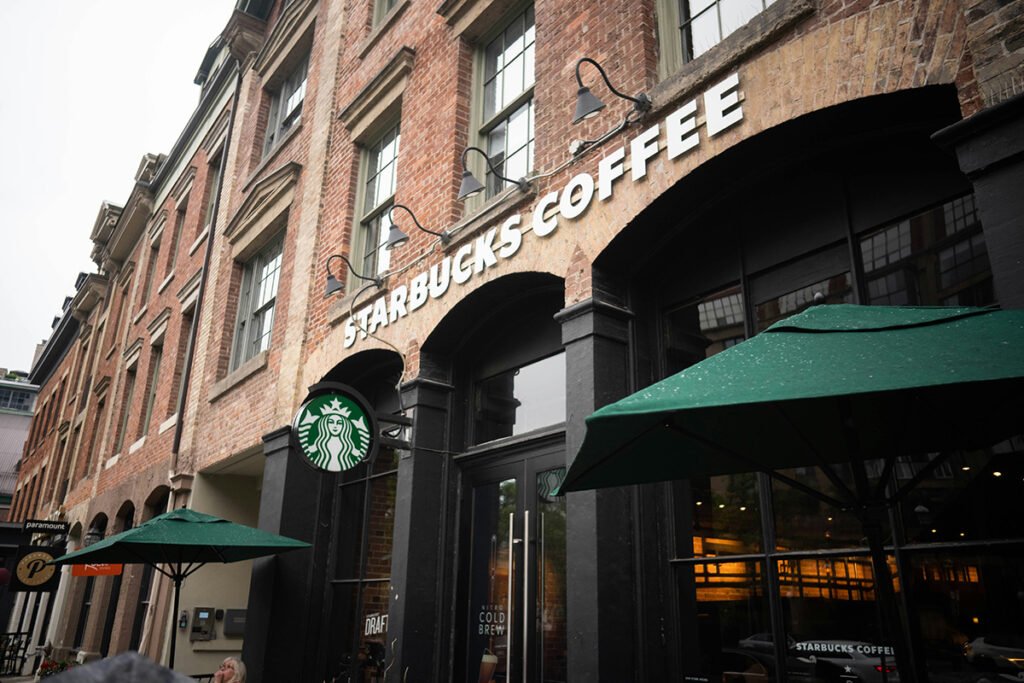
On November 13, Starbucks workers in over 40 cities across the nation walked out of their cafes and took to the streets. The initial walkout involved over 1,000 workers at 65 stores. The strike may grow. Nationwide, over 11,000 Starbucks workers at over 550 stores, about 4 percent of total employees nationally, have voted to join the union, Starbucks Workers United. The union reported that 92 percent of its members voted to authorize the strike earlier in the month.
Why go on strike? Workers are demanding a fair contract, they say. Back in February 2024, company management and the union agreed to a framework that was supposed to speed negotiations for a collective bargaining agreement. Now, 21 months later, that first contract still does not exist.
The union accuses Starbucks CEO Brian Niccol and management of stonewalling.
Baristas’ demands include higher pay, better hours to improve understaffing, and the resolution of over 700 charges of unfair labor practices.
In 2024, the Starbucks CEO pocketed $95.8 million…[while] the firm’s median pay rose just 4.2 percent in real terms to $14,674.
“We want better hours, so stores are properly staffed, and workers can qualify for the benefits Starbucks brags about,” Pittsburgh-based barista Dachi Spoltore said in a November 13 press call. “We want more take-home pay because our healthcare, our rent, our groceries, they keep getting more and more expensive while our wages aren’t keeping up.”
What’s at Stake?
Labor relations at Starbucks offer a window into how neoliberal capitalism functions to extract wealth from workers while enriching executives. A report by the Institute for Policy Studies titled Executive Excess 2025, which tracks the growing gap between chief executive and worker pay at the 100 largest low-wage corporations, reported, “The Starbucks pay gap hit 6,666 to 1 last year, the Low-Wage 100’s widest spread by far. In 2024, the Starbucks CEO pocketed $95.8 million. Over the past six years, amid worker discontent fueling union-organizing drives at hundreds of Starbucks stores, the firm’s median pay rose just 4.2 percent in real terms to $14,674. Only seven S&P 500 firms have lower median pay.”
At the press event, Spoltore painted a picture of management excess, even as baristas struggle to get by. “ The company spent $81 million on a glitzy conference just for managers in Las Vegas this summer,” Spoltore said. “The math just isn’t adding up. Starbucks has spent millions and millions on its executives and managers, but they’re refusing to finalize a fair contract that would take less than either of those expenses.”
Diego Franco, a barista in Chicago, said on the press call that he can’t pay his mother’s medical bills on his current salary. “The reality is I make $17 an hour, and I live paycheck to paycheck. I can’t sustain myself on that.”
Franco also noted that shifts that used to be staffed by six people are now down to three workers. “We’re told to smile more, to run faster, to write messages on cups, and somehow to keep up with a constant changing of policies and constantly being understaffed,” he added.
The ongoing strike is not the first strike that Starbucks Workers United has led since its inception, but it is the largest. The current action had workers grab their picket signs as Starbucks celebrated its annual Red Cup Day sales promotion to kick off the holiday season. Red Cup Day is typically one of Starbucks’ biggest sales days of the year.
“The math just isn’t adding up. Starbucks has spent millions and millions on its executives and managers, but they’re refusing to finalize a fair contract.”
A Four-Year Struggle
In 2021, Starbucks Worker United formed amid a pandemic that extolled essential workers, even as they continued to be undercompensated.
Sign up for our free newsletters
Subscribe to NPQ's newsletters to have our top stories delivered directly to your inbox.
By signing up, you agree to our privacy policy and terms of use, and to receive messages from NPQ and our partners.
Victoria Conklin, who worked at the first unionized Starbucks in Buffalo, NY, told Spectrum News in 2022 that she was originally anti-union, but pandemic-era policies made her switch to the union side. “It was always only a matter of time before…Gen Z started holding corporations accountable to its workers,” she noted.
Starbucks Workers United has grown from one store in 2021 to over 550 today. This happened despite the fact that the barista role is often considered a temporary job, a job type that has been traditionally more difficult to unionize. Yet, the union takes note of that and incorporates it into its organizing.
“At my store, we experienced pretty high turnover and baristas who were once here—who were very strong and very active union members—have left, have been fired, and now we have new hires,” Franco said on the press call. “And so, the conversation starts and it’s reminding them that we are deserving of more.”
When I spoke with Ana Martinez, a member of the union, in 2023—seven months after a vote to unionize at her Long Island workplace in Lynbrook, NY—she noted that the company had not adequately responded to her colleagues’ demands, like getting transportation pay when employees need to sub at other stores that are not very accessible by bike. A Starbucks representative said that the company tried to set up meetings but the union “failed to respond to or confirm any bargaining session proposed by the company.” Martinez disputed that, following a pattern of employees who say Starbucks is avoiding meeting them at the bargaining table.
A Framework to Nowhere?
In April 2024, two months after a national framework agreement was signed by union and management, contract bargaining began. Union representatives told NPQ that they met with executives for hundreds of hours, racking up 33 tentative agreements to improve workplace conditions, but Starbucks said no when the union presented proposals to increase wages and benefits in September 2024.
Starbucks Workers United has also asked customers to refrain from buying coffee from Starbucks until their demands are met.
Instead, the company brought forth what Starbucks Workers United called an “unserious” package that did not raise wages in the first contract year. Nor, union representatives said, did the contract adequately address staffing concerns.
“We’ve been very clear—when the union is ready to come back, we’re ready to talk,” Starbucks spokesperson Jaci Anderson said in an emailed statement.
Union president Lynne Fox, who serves on the executive board of the Service Employees International Union (SEIU), with which the Starbucks union is affiliated, and who has been involved in the labor movement for decades, said in the press call, “ I have never seen an employer act with such reckless disregard for breaking labor laws over and over again.”
Building Pressure
Union members have elected hundreds of strike captains across their unionized locations to drive their effort. Starbucks Workers United has also asked customers to refrain from buying coffee from Starbucks until their demands are met.
A retail union strike provides much more visibility for the labor movement than a strike from a union that is not so public facing. Starbucks Workers United recognizes “that this movement has been a galvanizing movement for labor in the US and really across the globe,” Michelle Eisen, a former barista at the first unionized store in Buffalo, said in the press call. “From the onset we’ve seen many, many, many union campaigns spring up from the energy that has come from this campaign.”