
Truth to Power is a regular series of conversations with writers about the promises and pitfalls of movements for social justice. From the roots of racial capitalism to the psychic toll of poverty, from resource wars to popular uprisings, the interviews in this column focus on how to write about the myriad causes of oppression and the organized desire for a better world.
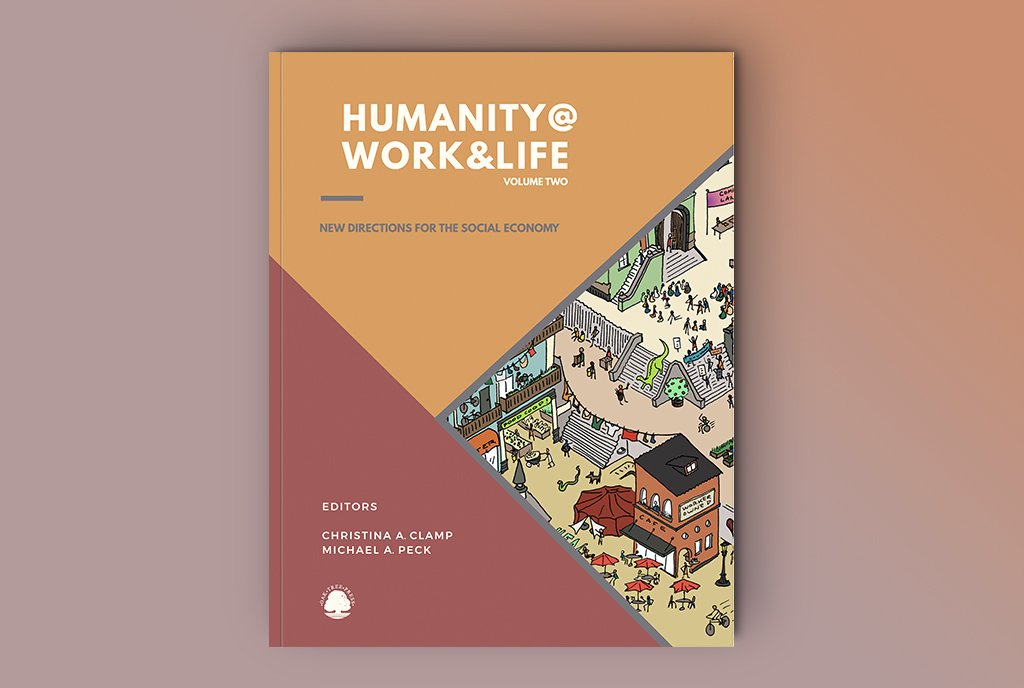
This installment accompanies an excerpt from a new book, coedited by Christina Clamp, called Humanity@Work&Life Volume Two: New Directions for the Social Economy.
This interview has been edited for length and clarity.
Steve Dubb: This is the second volume of the Humanity@Work&Life project that you have coedited. Could you describe that project?
Christina Clamp: We really wanted to pick up on some places where we thought information was missing. We are also in a different place than when we started on Volume 1. Volume 2 is more a thought piece looking forward rather than a look at how Mondragón [cooperative corporation in the Basque region of Spain] has been informative to other folks around the world.
In terms of the authors, when you look at the list of contributors to the book, it’s an international group and a group that has been working on the theme of the social economy.
SD: The subtitle of the current volume is “new directions for the social economy.” What is the social economy and how does it connect with the solidarity economy or, as it is often called internationally, the “social and solidarity economy”?
CC: My doctorate was in social economy back in the 1980s. Social economy is a broader term than social and solidarity economy that encompasses economic activities for social good. The phrase “social and solidarity economy” is a subset of that which emphasizes grassroots and transformational strategies for bringing about a more just and equitable economy in the world.
SD: What are some new directions that you cover in the book?
We took on the issue of immigration and a comparison of what is happening in the US around immigrants and how Spain and the Basque Country have handled it. This is something I wanted to see us handle.
Once when I was in Mondragón in the early 2000s I was at a bar with friends one evening. A newspaper was on the bar and a friend of mine pointed to an article about immigrants. He said, “This is a really hard one for us. We came so close to losing our language and losing our culture. And we worry about what immigrants coming in will do to preserve our ability to preserve our identity as Basques.”
When I was back there in December [2024], one of the people I interviewed for the book was telling me that it was so wonderful when you go to one of the coastal fishing communities and there are these children who are ethnic Senegalese who are rattling away in Basque, fully fluent. In the Basque Country, people have come to see that immigration and migrants are an asset, not a problem, which I thought was wonderful to see how things have evolved.
The Mondragón cooperatives came about out of a post-conflict environment after the Spanish Civil War.
Another challenging issue we undertook in the book is affordable housing, which is an issue not just in the United States but globally….That’s how that ended up coming into the mix.
SD: You have spent decades researching Mondragón, the world’s largest worker cooperative network. Could you explain how it was developed and the role it plays today in advancing a solidarity economy?
CC: The Mondragón cooperatives came about out of a post-conflict environment after the Spanish Civil War. It was the 1940s. Many men had either fled into exile, because the Basques had not aligned themselves with the Franco coup d’état. It was tough. Tuberculosis was rampant in the area. Many households were struggling financially.
There were five young men who worked in the company that was at the time the only major employer in the small town of Mondragón [where the initial co-ops would be formed]. They were part of a pastoral youth group at the local church, working with a priest who had encountered some Catholic social action thinking about social justice and encouraged his students to develop skills to start a business in the community that would be a cooperative. They did this working with paraffin heaters. They actually were a good example of industrial espionage. They bought a paraffin heater, figured out how to deconstruct it and reconstruct it, and started their own business.
They were able to get a lot of financial support for the startup by distributing cans around the community where people could put donations. That was their very humble beginning. By 1960, they had started a bank. They had a food co-op. And by the time I first visited there in 1982, they had a well-established industrial group primarily working in appliances and subcontracting to five major auto companies.
They had developed a system that really sought to create equality within the group. At that time, the ratio for lowest-to-highest paid was one to three. Today, it is a one-to-six ratio.
The bank had become a development bank that supported efforts to create new and spin-off co-ops. There was always the concern that small would be better. But by the 1990s, they realized they needed some centralization. Some of the co-ops became much larger. And they aggressively moved to international markets, not to take jobs overseas but to ensure they would have a competitive edge and to preserve what they had created in the Basque Country.
Today, Mondragón is the largest cooperative group in the world.…They have 92 cooperatives at latest count with over 85,000 workers. Not everyone is a member. They recognize when they are involved in business activities overseas, it doesn’t work to extend membership to people in those overseas operations, but they usually look for ways to create an analogous form of engagement for workers in those work settings.
SD: In the book you describe and share the founding document of the Arizmendiarrieta Social Economy Think Tank. Why was this think tank formed in 2025?
CC: The social economy is about 10 percent of the European economy. Mondragón decided it was time to become a player in both research and knowledge sharing related to economic activities in the social economy.
This is a new venture. Currently it has 1.5 full-time equivalent staff. It is still in the process of pulling together its funding base. It has support from the Spanish government, the Basque government, the Catalán provincial government, and I believe they have support from the European Union. They rolled out the initiative in January. In May, they had an initial meeting in San Sebastian.
The effort has three pillars: First, the think tank itself, which is committed to reducing inequality and promoting inclusion of people with diverse capacities. Second, a foresight institute that explores future scenarios. Third, a social lab that is scaling successful experiences and pioneering new ones—looking at best practices and how to best to make use of those in promoting the kinds of change we are looking for in the world.
If you don’t create a financial structure that allows for ownership transfer across generations…you end up having to sell the business outright.
SD: You include an entire chapter in the book on “indivisible reserves.” What are indivisible reserves, and why are they such an important part of worker cooperative development?
CC: My first introduction to the problem of not having indivisible reserves was learning about the plywood cooperatives in Oregon and the waste management cooperatives in the Bay Area in California. [These co-ops were so profitable that new workers couldn’t afford to buy in and retiring workers sold their shares to outside investors].
[These examples show that] if you don’t create a financial structure that allows for ownership transfer across generations in a way that preserves affordability for new people coming in as workers, then ultimately in order for people to get what they think is their fair share in a classic capitalist sense, you end up having to sell the business outright rather than transferring it in pieces to new workers as they come into the group.
It is not dissimilar from the problem that you see for housing cooperatives. If you don’t build in reserves, then at some point when you need to major repairs on the property; you’re going to price people out of their homes because they cannot afford it. This happens in condominiums as well.
So indivisible reserves are something that anyone who has dealt with condos or housing co-ops can appreciate why this is important for the sustainability and the resilience of a cooperative.
The one group that I knew of firsthand that has grappled with this is Equal Exchange, based in West Bridgewater, MA. For a long time in the early years, they had relied on family members and friends to put money into a form of preferred stock. And in a good year people might see a capital gain of 5 percent on their preferred stock. But the workers had retained control of voting rights in the co-op.
At Mondragón in the early years the indivisible reserves were really about creating insurance against the downturns in business cycles. But they have come to see that it is not just about having a cushion for rainy days but also being able to use reserves in support of growing their co-ops and other co-ops.
Sign up for our free newsletters
Subscribe to NPQ's newsletters to have our top stories delivered directly to your inbox.
By signing up, you agree to our privacy policy and terms of use, and to receive messages from NPQ and our partners.
SD: How does it work mechanically?
CC: One thing that Mondragón did was create internal capital accounts tied to specific members. Those accounts have allocations. So, if it is a profitable year, money goes into the account. If it is a financially bad year, workers can decide to contribute to from their internal capital account to help cover the losses. In Mondragón’s case, they have also created rainy day funds. Part of the asset value of the firm is not allocated to individual members.
Of the current [UN Sustainable Development] goals, only about 17 percent are on track.
The formula will vary co-op to co-op. You might do 60 percent held in individual accounts and 40 percent in reserves, for instance.
SD: The United Nations Sustainable Development Goals (SDGs) are supposed to be achieved by 2030, but all indications are that the world will fall far short in many areas. In the book, you include a chapter on developing a vision for international goals after 2030. What do you think these goals should look like and why?
CC: According to my friend and colleague Ilcheong Yi, the likelihood is that the UN will rework the SDGs somewhat, so that it refreshes them. There might be some additional goals.
Of the current goals, only about 17 percent are on track, one-third have made minimal or moderate progress; others have stalled or regressed. Clearly, the COVID pandemic hurt. The different conflicts in the world have contributed to regressing and losing ground.
Yi has worked with a group of scholars to look at the different metrics that have been used and have essentially come up with a sustainable development app to measure sustainable development performance indicators (SDPIs). This project is rooted in the recognition that a lot of ESG [environmental, social and governance factors] activity has lent itself to cherry-picking and greenwashing. We might look for a product that is fair trade, but you need to look at not just the product itself, but the supply chain behind it.
The idea with the SDPIs is you’re dealing with not just looking at a snapshot of the moment but looking at the context in which that moment is being measured. It’s a two-tier approach. It’s not a perfect solution. There is still a risk of cherry-picking but it is a metric intended to do trend analysis and not just a one-off snapshot of performance.
It is easy for people to see the stranger as a threat when in fact we need to recognize, as Spain is seeing, that immigrants can be of benefit to all of us.
There are 61 metrics in the SDPI tool. In terms of how to approach this for groups, I think it can work as an application in a banking setting, in a manufacturing setting. For Cabot Creamery, another co-op piloting the measures, it was working well for them as an agricultural co-op. Not every one of the metrics will be relevant to everyone. And that is where the cherry-picking concern comes in. Hopefully people will see it as an opportunity to act with integrity in improving their engagement around sustainable development goals.
SD: As you detail, Spain has become a haven for immigration in a world that has grown increasingly hostile to immigrants. What do you think or hope people might take from the Spanish experience that could apply in the United States?
CC: What I would hope is that people in their own reckoning with what immigration represents can come to see that immigrants have been valuable to our wealth and wellbeing in community and as a nation. When we treat immigrants as a threat, then we are not dealing honestly of how important immigrants have been to the US economy.
It is easy for people to see the stranger as a threat when in fact we need to recognize, as Spain is seeing, that immigrants can be of benefit to all of us in our communities.
SD: The last chapter looks at the role of cooperatives in healthcare and housing. What are some of the contributions that cooperatives can make in these two areas in the United States today?
CC: The book shares healthcare co-op examples that the Service Employees International Union (SEIU) has been involved with, both with caregiving co-ops, home health aides, and LPNs (licensed practical nurses).
This is a very effective way to preserve jobs for people in places where the healthcare sector has changed staffing in hospitals. There was a shift in the nursing field: In order to continue to work in hospitals, nurses had to have an RN (registered nursing degree). This was really displacing nurses who only had an LPN….The example in the chapter talks about creating cooperatives of LPNs that provide home-based services in a way that is economic viable.
On housing, the book looks at the affordable housing crisis, with a specific focus on housing cooperatives. A prominent example of this is New York City, which is home to 50 percent of affordable housing co-ops in the United States.
A substantial part of it comes out of the work that Urban Homesteading Assistance Board (UHAB) has done with what had been abandoned city-owned properties, and the urban homesteaders in the 1960s and 1970s who took those properties over for affordable housing. UHAB has continued to do that work in New York, but it has also expanded its efforts to other parts of the United States.
The strength of cooperatives is they are not government-owned or -controlled. They emerge often out of the grassroots.
That work has gotten the attention of folks in Europe….A lot of the challenge in the Basque Country, just like in the United States, is that young people are finding they can’t get a home where they grew up. So, they are having to commute further, live further away from their families. Culturally, that’s disturbing. They are looking for good examples. UHAB is a good example.
SD: The entire collection on humanizing the economy has at its backdrop a rising tide of authoritarianism. How can the cooperative, solidaristic, and mutualist forms of business that are outlined in the book help to address a national and international democratic deficit?
CC: To take one example, housing co-ops are not inherently partisan players of a given political perspective. They have often grown out of places where there has been market failure and have looked to address the needs of people in community.
Sara Horowitz, who contributed to the book and is author of Mutualism, points out that part of the strength of cooperatives is they are not government-owned or -controlled. They emerge often out of the grassroots, out of the desires of people in the community to address a need they see for themselves. In some instances, you can get government subsidies to help. But often it has been bootstrapped out of resources of the community itself, so it’s a model that can work well regardless of who is running the government.
The biggest challenges we reach in the United States, every so often I’ll hear someone say, “Aren’t co-ops communist?” To which, I will happily reply, “You know who the first cooperator in the United States was? Ben Franklin. He started the first mutual insurance company in Philadelphia.” I think it is a model that is truly all-American. That is why I think it is capable of weathering the changes in the political climate that we are in. That’s why I think it is an important model.
SD: Are there ways co-ops can actually be effective tools of resisting authoritarianism or building local democratic practice?
CC: I really love Robert Putnam’s [political scientist and author of Bowling Alone] work on this. When we think about social capital, it is about creating bonds and binding networks where you are able to build trust.
In some instances that has been faith-based. A lot of credit unions got started in this country out of congregations. When we think of food cooperatives, often it is when people are looking for healthier food options into their community, especially the food coops that got started in the 1960s or 1970s.
The way I think about it is need doesn’t necessarily fall into a partisan bucket. Why did credit unions in the United States get started? Because Edward Filene said he wanted working-class consumers to buy in his stores. The conventional banks weren’t interested in the average working Joe. The credit unions that got their start in Europe and Quebec were a model that he saw that could work well. And it did.
It’s a model [for local democratic practice] if you can think in terms of what networks people are connecting with and how those networks can work to help people help themselves.
We have a problem in this country that people have decided there are two camps and there is this huge chasm between them. The reality is when you look at the average person in this country, we are not that different than each other. We have fallen into a bad pattern of who we are silencing and who we are trusting. I would wager that anyone who sees themselves as a MAGA person is just as concerned about affordable housing as I have been, so I think cooperatives are a vehicle by which we can bridge that chasm.