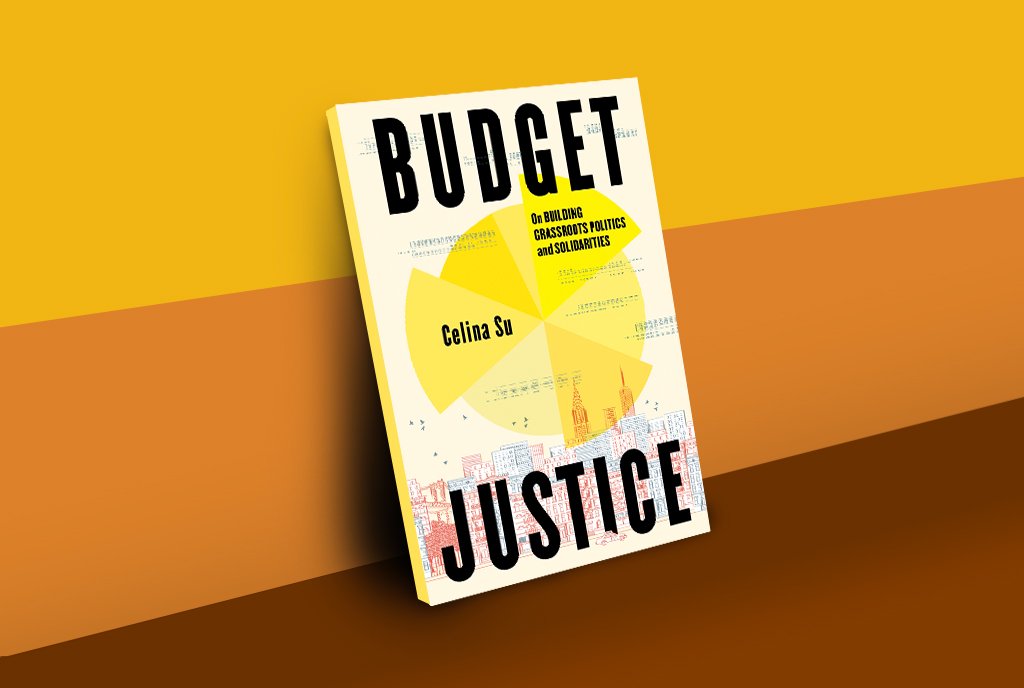
This excerpt originally appeared in Budget Justice: On Building Grassroots Politics and Solidarities (Princeton University Press, 2025) by Celina Su. Reprinted here with permission.
This excerpt accompanies an interview with Su by NPQ’s Steve Dubb.
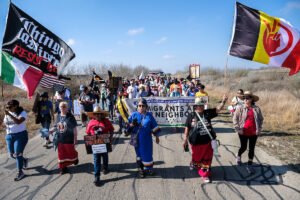
While no perfect model PB [participatory budgeting] exists, it remains imperative to examine whether a specific PB process has mobilizing or delimiting effects. The national Black Lives Matter protests led to a new wave of PB around the country—one that centers power analyses and racial justice in newly explicit ways. In several cities—such as Nashville, Seattle, and Raleigh—local governments have established PB processes, but community groups continue to advocate for more robust versions. In those cases, PB has helped communities to articulate alternative budgets contrary to the status quo—as part of an emerging and significant movement of people’s budgets around the country.
These people’s budgets feel like a movement because active campaigns using this terminology have emerged, without central coordination, in over a dozen cities—and not just in large, coastal ones like Seattle, Los Angeles, New York, and Philadelphia. I read about people’s budgets in Norman, Ypsilanti, Sacramento, Nashville, Raleigh, and Cleveland. The exact names of their campaigns vary a bit; some call themselves solidarity budgets, for instance. But I was struck by how so many of them took off in a short span of time, during or after the pandemic, and how they articulate the sorts of #carenotcuts, divest-invest, or defund-refund framings at the heart of budget justice.
People’s budgets feel like a movement because active campaigns using this terminology have emerged, without central coordination, in over a dozen cities.
It feels no coincidence that most of these campaigns are led by grassroots coalitions that include both organizing and service groups, and that they aim to, as legal scholar Jocelyn Simonson writes, “bring together local community knowledge with large-scale thinking about government spending.”18 In other words, in addition to forwarding alternative policy or budget platforms, they pay attention to participatory democracy, helping everyday residents to forward their perspectives and have a say in policymaking. Most, if not all, of these cities also pursued PB or people’s assemblies…as part of their campaigns.
Two of the campaigns I have found especially inspiring so far hail from Nashville and Seattle, partly because they insist on the radical spirit of PB to engage structural changes in city budgets. For years, starting in 2016, a group called Metro Nashville tried to bring PB to the city. In a campaign, it emphasized residents’ identities as taxpayers and how the process might work.19 Then, in 2020, the historic uprisings after the police murder of Floyd brought a record number of Nashvillians to hearings about the city budget, including a marathon one that lasted through the night until dawn.20 A new coalition called the Nashville People’s Budget Coalition launched that summer to analyze the mayor’s proposed budget and demand PB for the city. Unlike previous efforts to initiate PB in Nashville, the new campaign explicitly cited PB as part of a larger strategy to divest from policing and invest in social services.21
Two of the campaigns I have found especially inspiring so far hail from Nashville and Seattle.
In 2021, the mayor put aside $1 million for PB processes to be spent on infrastructure in the historically underserved and Black neighborhoods, Bordeaux and North Nashville. The mayor renewed the same process in 2022. In 2023, the mayor expanded the process to involve $10 million to be spent around the city. But the Nashville People’s Budget Coalition continues to push for a more substantive PB process—one that explicitly divests from policing while investing in education and housing. It hosted a “radial proposal writing party,” for instance, to help residents develop ambitious proposals despite “inadequate funding, inaccessibility, & burdensome control by the mayor’s office,” and “build momentum toward a PB process true to its radical roots.”22 And the Black Nashville Assembly, another project founded in 2020, has been combining calls for participatory democracy with people’s assemblies, issue-based campaigns, and political education. As the assembly put it, “The participatory democracy that we are talking about is unlike anything we’ve seen in Nashville because it fundamentally changes the power dynamics between our communities and elected officials.”23
In Settle, the city government started a small, citywide, youth-focused PB process with $700,000 in 2015.24 In 2020, a statement signed by seventy-five local organizations demanded a solidarity budget—one that not only allowed residents to articulate potential projects for the city but also affirmed that any money divested from the police be allocated by a robust PB process led by Black Seattleites, and that the city reject an austerity approach overall.25 In 2022, the Solidarity Budget Coalition continued to advocate for a 50 percent reduction in the police department’s budget, especially by eliminating 240 “ghost cop” positions, which the Seattle Police Department stated would remain unfilled for years. The coalition helped the city to secure the elimination of 80 such ghost cop positions, as well as over $1 million for eviction prevention and defense, and over $3 million for climate resilience hubs. These wins relied on revenues from a new JumpStart Seattle corporate tax.26
Grassroots groups in these cities articulate [participatory budgeting] as a way for citizens to become engaged in larger struggles for budget justice.
The Seattle Solidarity Budget’s demands articulated both policy goals and constituent programs, with price tags attached. For example, it demanded a “budget to end deaths of homeless people,” with a moratorium on sweeps, improved harm reduction practices, a $20 million investment into community-based responses to public safety, five mobile pit stops, and nine recreation vehicle safe lots. Beyond a “budget to live,” the coalition articulated a dream “budget to thrive,” asking that the city double its commitment to PB from $30 to $60 million, and that this commitment increase each year until it reaches $200 million.
I especially admire these two cities’ campaigns because of how they meld community budget priorities with participatory democratic practices. Grassroots groups in these cities articulate PB as a way for citizens to become engaged in larger struggles for budget justice.
Sign up for our free newsletters
Subscribe to NPQ's newsletters to have our top stories delivered directly to your inbox.
By signing up, you agree to our privacy policy and terms of use, and to receive messages from NPQ and our partners.
These campaigns constitute a movement by citizens nationwide—as individuals or members of organizations—to forward alternative visions for city budgets and understand how budgets get made in the first place. They also pointedly suggest how, when combined with ideas and logics for invested spaces along with larger struggles for people’s budgets, PB cannot be easily defanged by local governments or the participation industrial complex.
18. Jocelyn Simmons, Radical Acts of Justice (New Press, 2023), 135
19. Metro Nashville Community Budgeting (PB Nashville), “Facebook discussion, n.d., https://www.facebook.com/groups/PBNashville.
20. Yihyun Jeong, “Public Sends Resounding Message in Marathon Nashville Council Hearing: Defund Police,” Tennessean, March 6, 2020, https://www.tennessean.com/story/news/politics/2020/06/03/nashville-council-hears-defunding-police-message-marathon-meeting/3129715001.
21. “2020 Campaign,” Nashville People’s Budget Coalition, n.d., https://nashvillepeoplesbudget.org/2020-campaign.
22. Participatory Budgeting | Radical Proposal Writing Party, Nashville People’s Budget Coalition, May 22, 2023, https://nashvillepeoplesbudget.org/2023-campaign.
23. “About,” Black Nashville Assembly (BNA), n.d., https://www.blacknashvilleassembly.org/about-4
24. Seattle Department of Neighborhoods, “City Begins Participatory Budgeting Initiative “Youth Voice, Youth Choice” with Public Idea Assemblies,” Front Porch, January 21, 2016, https://frontporch.seattle.gov/2016/01/21/city-begins-participatory-budgeting-initiative-youth-voice-youth-choice-with-public-idea-assemblies.
25. Towards a Solidarity Budget: A Statement of Joint Principles for the 2021 Seattle City Budget Process,” n.d., https://docs.google.com/document/d/1cmi91IQ78xqjUVWsEA8DQWdjtpi2DLkE9uP8aNIq48c.
26. “Solidarity Budget Wins Elimination of 80 “Ghost Cops” from City Budget, Protects Investments in Community Well-Being,” November 30, 2022, https://docs.google.com/document/d/1fQ6EgLVC1h3bApvnpr-M1ISxvx_UJR5QYa70f8kH1y0