
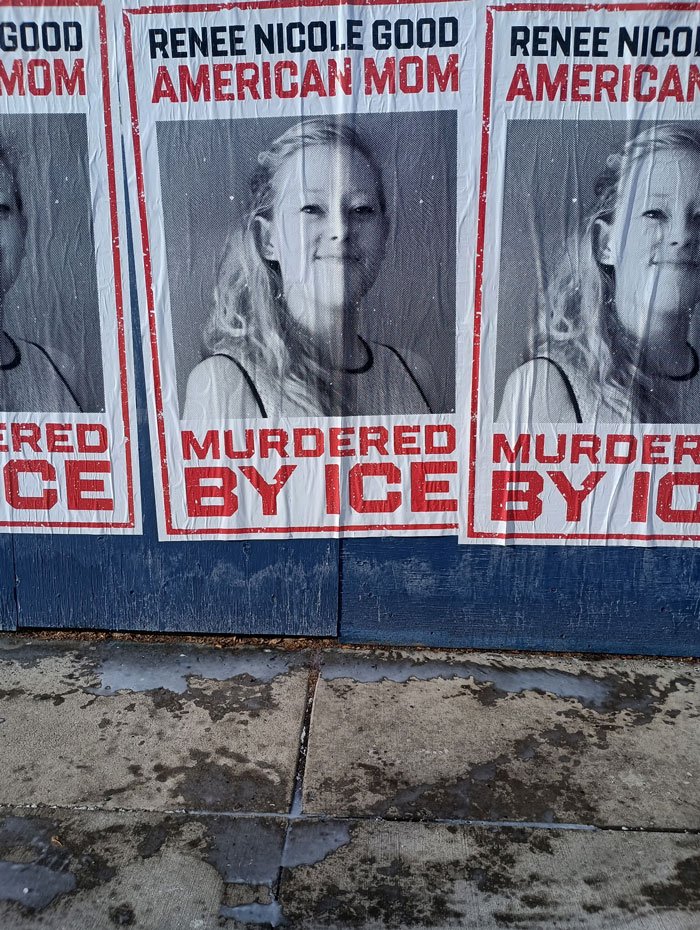
Since the murder of Renee Macklin Good by an ICE agent on January 7, 2025, in Minneapolis, MN, more than 3,000 agents have swarmed the city.
ICE has escalated violence against immigrants, activists, legal observers, and passersby in the city: threatening “obstructors,” conducting violent arrests, and arbitrarily using chemical irritants that have sent families to the hospital.
The federal agency is also refusing to allow state representatives access to those in detention or the missing detained.
In the aftermath of Good’s murder and increasing protests, the federal government threatened to cut off SNAP and other USDA funding to the state of Minnesota, and has opened investigations into Governor Tim Walz and Minneapolis Mayor Jacob Frey.
The deepening schism between the state and the Trump administration has heightened tensions; it has also mobilized Minnesotans.
ICE Out of Minnesota
Minnesotans have helped raise over a million dollars for Good’s family, delivered more than 12,000 boxes of groceries to families in hiding, moved to remote learning to protect students, and towed cars home for free when drivers have been detained.
Minnesotans continue to be taken. Many of them, like Nasra Ahmed, who was detained for two days, are US citizens. Some, like the members of the Oglala Sioux Tribe, remain missing after being abducted by ICE.
In response to the continued influx of ICE into Minneapolis, Kat Rohn, director of OutFront Minnesota, the state’s largest LGBTQ+ advocacy organization, noted, “There may be 3,000 of them here but there are a hell of a lot more of us.”
Indeed, Minnesotans are organizing. The first attempt for restaurant workers to organize against ICE had to be rescheduled because over 3,000 people—including this writer—attempted to log on to a call with space for 300. A general strike, ICE Out of Minnesota: Day of Truth & Freedom, is scheduled for Friday, January 23, and is spearheaded by multiple groups, including the nonprofits Faith in Minnesota and TakeAction Minnesota.
The strike includes a march in downtown Minneapolis and calls for a “unified statewide pause in daily economic activity,” meaning no work (except for emergency services), no school, and no consumer spending. A social media event page for the strike read: “We will gather with family, neighbors, and community to show Minnesota’s moral heart and economic power.”
The strike’s list of demands:
- ICE must leave Minnesota now
- The officer who killed Renee Good must be held legally accountable
- No additional federal funding for ICE
If the Fourth Amendment Businesses idea gains momentum or if the general strike spreads, ICE may find its operations hampered nationally.
Fourth Amendment Businesses
A trip through Minneapolis right now reveals many closed businesses due to ICE’s presence and anti-ICE protests. City council members have requested an eviction moratorium as more and more people are unable to pay their bills due to the economic disruption caused by ICE.
Many of the strikers see this as a way to defend the ideas of democracy or anti-authoritarianism more broadly.
Sign up for our free newsletters
Subscribe to NPQ's newsletters to have our top stories delivered directly to your inbox.
By signing up, you agree to our privacy policy and terms of use, and to receive messages from NPQ and our partners.
This has led to a growing movement for Minnesota businesses to become “Fourth Amendment Businesses” by posting signage indicating that ICE is not permitted on their property without a warrant and due cause. Under the Fourth Amendment of the US Constitution, unreasonable search and seizure are prohibited on a property without warrants issued by a judge or magistrate, justified by probable cause supported by oath or affirmation, and particularly describing the place to be searched and the people or things to be seized.
Because Minnesota is also home to large national and multinational corporations like Walmart, Target, and Home Depot, if the Fourth Amendment Businesses idea gains momentum or if the general strike spreads, ICE may find its operations hampered nationally.
All three of the corporations listed above have been condemned for collaborating with ICE and are on a boycott list with ICE Out of Minnesota. In addition, recent detentions of Target employees while at work have spurred a direct action in which people order from Target online and then cancel their orders.
Fighting for Democracy
While the immediate aim of the general strike is to get ICE out of Minnesota, many of the strikers see this as a way to defend the ideas of democracy or anti-authoritarianism more broadly.
The Minnesotan collective Monarca, for example, pointed out in an online presentation that while democracies are usually stable, with only a 2 to 3 percent chance of backsliding, of those that have regressed, nearly 70 percent fell to authoritarian rule. Those that did not had a strong civil resistance movement and national trade union participation—both of which the ICE Out of Minnesota strike aims to start building.
“It’s going to take a while to overcome the impact of all this.”
Indeed, the effort has spilled over into neighboring states with people in Saint Croix County, WI, just outside of Minneapolis, intending to join the strike, and others planning actions elsewhere in Wisconsin and Iowa.
The forecast for the night of the march in downtown Minneapolis calls for a low of -16. Nevertheless, many people are still planning to attend in their snow pants and winter boots.
In the meantime, activists like Seth Goodspeed of OutFront Minnesota, noted that those looking to help should “continue to follow the direction of the community in community giving, and finding maybe a way, a plan, forward for the next five years.” As he told NPQ, “It’s going to take a while to overcome the impact of all this.”
For More on This Topic:
Why It Matters that Renee Nicole Macklin Good Was a Poet