logo logo
giving banner
Donate
    • Membership
    • Donate
  • Social Justice
    • Racial Justice
    • Climate Justice
    • Disability Justice
    • Economic Justice
    • Food Justice
    • Health Justice
    • Immigration
    • LGBTQ+
  • Civic News
  • Nonprofit Leadership
    • Board Governance
    • Equity-Centered Management
    • Finances
    • Fundraising
    • Human Resources
    • Organizational Culture
    • Philanthropy
    • Power Dynamics
    • Strategic Planning
    • Technology
  • Columns
    • Ask Rhea!
    • Ask a Nonprofit Expert
    • Economy Remix
    • Gathering in Support of Democracy
    • Humans of Nonprofits
    • The Impact Algorithm
    • Living the Question
    • Nonprofit Hiring Trends & Tactics
    • Notes from the Frontlines
    • Parables of Earth
    • Re-imagining Philanthropy
    • State of the Movements
    • We Stood Up
    • The Unexpected Value of Volunteers
  • CONTENT TYPES
  • Leading Edge Membership
  • Newsletters
  • Webinars

Deaths from Maria in Puerto Rico Rise above 1,000 as Response Remains Slow

Nancy Young
December 20, 2017
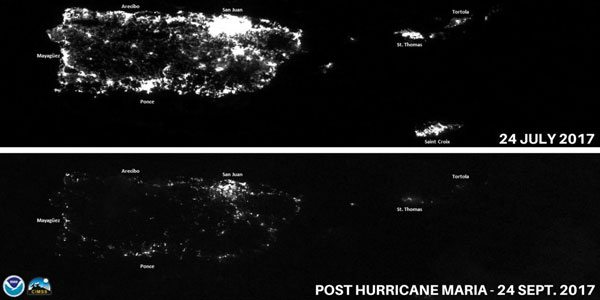
By NOAA [Public domain], via Wikimedia Commons

December 18, 2017; New York Times and New England Cable News

Unfortunately, manmade disasters often follow natural ones. One of the latest examples can be found in the US government’s response to Puerto Rico after Hurricane Maria did catastrophic damage to the island in September. A new report by the nonprofit Refugees International (RI) has found that two months after the hurricane hit, the emergency response by both US federal and local officials in Puerto Rico has left many of the island’s 3.4 million residents still living in unsafe conditions and unable to access help, even when the help is nominally there.

“There was a failure of leadership and a failure to appreciate the magnitude of the situation and the need for extraordinary action by US officials,” Eric Schwartz, president of Refugees International, said in an interview with the Associated Press. “These people are our fellow Americans. The response of the federal authorities should have been and should be much stronger than it was and much stronger than it is.”

In the confusion, even the number of people who died as a result of the hurricane is under serious question; many say the official number of 64 is far too low and doesn’t reflect the fact that a thousand more people than usual died during the 42 days following the storm. The New York Times reported on Monday that the method of counting the dead is under official review.

Much of that difference comes from deaths that might not have been caused by the hurricane itself but came in its aftermath, when people were unable to get medical care because hospitals weren’t functioning or when life-saving equipment such as oxygen machines didn’t work because of electricity blackouts. For example, the New York Times reported there was a 50 percent increase in recorded deaths from sepsis, a severe infection that’s often an indicator of delayed medical care or poor living conditions, in the weeks following the hurricane.

Sign up for our free newsletters

Subscribe to NPQ's newsletters to have our top stories delivered directly to your inbox.

By signing up, you agree to our privacy policy and terms of use, and to receive messages from NPQ and our partners.

“Everyone is here to help, but there is an epic leadership void,” an aid worker was quoted as saying in the RI report, “Keeping Faith With Our Fellow Americans: Meeting the Urgent Needs of Hurricane Maria Survivors in Puerto Rico.”

One thing that has dogged the US federal government response to Puerto Rico is the apparent confusion about responsibility. Is Puerto Rico part of the US? Certainly, but it’s not really clear that that federal officials (or most Americans) knew that in the early days after Hurricane Maria. This left the island in a no-man’s land—and, ironically, unable to access the generally superior, quicker, and better coordinated responses the US gives to foreign countries hit by natural disasters. Instead, the US government followed FEMA’s response blueprint—only much delayed and with less success than in similarly hard-hit places like Texas following Hurricane Harvey and Florida following Hurricane Irma. FEMA’s reliance on coordinating with local authorities was not effective in this case, the report found. Puerto Rican resources—if Puerto Rico was a US state, it would be the poorest in the country—were quickly overwhelmed by the storm, and the late federal government response exacerbated the situation.

The report says the chaos of the early days essentially continues, with lack of coordination between local and federal authorities holding sway. Tarps are available, but few can actually seem to get them, leaving people living in homes with leaky roofs or none at all. FEMA disaster aid is available to homeowners, but the forms are confusing. One applicant reported his cell phone going dead because he was on hold for 20 minutes with FEMA—and he had no way to recharge it due to the lack of electricity.

NPQ has reported extensively on the effect of Hurricane Maria and its aftermath on Puerto Rico. The criticism of the response started in the earliest days following landfall. NPQ’s Cyndi Suarez is currently in Puerto Rico and will be reporting in early January on the role of the nonprofit sector there and how activists are seeking to fill the yawning gaps resulting from the public sector’s inadequate response.—Nancy Young


Our Voices Are Our Power.

Journalism, nonprofits, and multiracial democracy are under attack. At NPQ, we fight back by sharing stories and essential insights from nonprofit leaders and workers—and we pay every contributor.

Can you help us protect nonprofit voices?

Your support keeps truth alive when it matters most.
Every single dollar makes a difference.

Donate now
logo logo logo logo logo
About the author
Nancy Young

Nancy Young is an independent writer and editor who works with nonprofit groups who work in and for Haiti, primarily in the Cite Soleil section of Port-au-Prince and the Institute for Justice & Democracy in Haiti. Previously she was an editor and reporter at The Virginian-Pilot in Norfolk, VA.

More about: Disasters and RecoveryNonprofit NewsPolicyPuerto Rico
See comments

You might also like
Can the Fight Against AI Revitalize the US Labor Movement?
Ted Siefer
Social Enterprise: Lessons from Down Under
Vicki Pozzebon
If Farm School NYC Closes, What Will the City Lose?
Farm School NYC and Iris M. Crawford
How to Develop a Community Housing Vision for Puerto Rico
Alison Chopel, Orlando Velázquez Pérez, Belinés Ramos Negrón and Eduardo J. Rodríguez León
The New COVID Vaccine Rules Leave Parents with More Questions Than Answers
Barbara Rodriquez
The Protective Visas That May Never Come
Mel Leonor Barclay

Upcoming Webinars

Group Created with Sketch.
January 29th, 2:00 pm ET

Participatory Decision-making

When & How to Apply Inclusive Decision-making Methods

Register
Group Created with Sketch.
February 26th, 2:00 pm ET

Understanding Reduction in Force (RIF) Law

Clear Guidance for Values-centered Nonprofits

Register

    
You might also like
Senator Elizabeth Warren speaks into a microphone in front of a sign reading "We are the Supermajority" while an audience listens.
Supermajority, Group Organizing Women Around Politics, Is...
Jennifer Gerson
A black and white x-ray image of human lungs.
Can the Fight Against AI Revitalize the US Labor Movement?
Ted Siefer
A red circle overlayed on a yellow background with three multi-colored dots on each side. In the center it reads, " Isaiah Thompson: Staff Picks for 2025"
Staff Picks for 2025: Isaiah Thompson
Isaiah Thompson

Like what you see?

Subscribe to the NPQ newsletter to have our top stories delivered directly to your inbox.

See our newsletters

By signing up, you agree to our privacy policy and terms of use, and to receive messages from NPQ and our partners.

  • About
  • Advertise
  • Careers
  • Contact
  • Copyright
  • Donate
  • Editorial Policy
  • Funders
  • Submissions

We are using cookies to give you the best experience on our website.


Nonprofit Quarterly | Civic News. Empowering Nonprofits. Advancing Justice.
Powered by  GDPR Cookie Compliance
Privacy Overview

This website uses cookies so that we can provide you with the best user experience possible. Cookie information is stored in your browser and performs functions such as recognising you when you return to our website and helping our team to understand which sections of the website you find most interesting and useful.

Strictly Necessary Cookies

Strictly Necessary Cookie should be enabled at all times so that we can save your preferences for cookie settings.