Truth to Power is a regular series of conversations with writers about the promises and pitfalls of movements for social justice. From the roots of racial capitalism to the psychic toll of poverty, from resource wars to popular uprisings, the interviews in this column focus on how to write about the myriad causes of oppression and the organized desire for a better world.
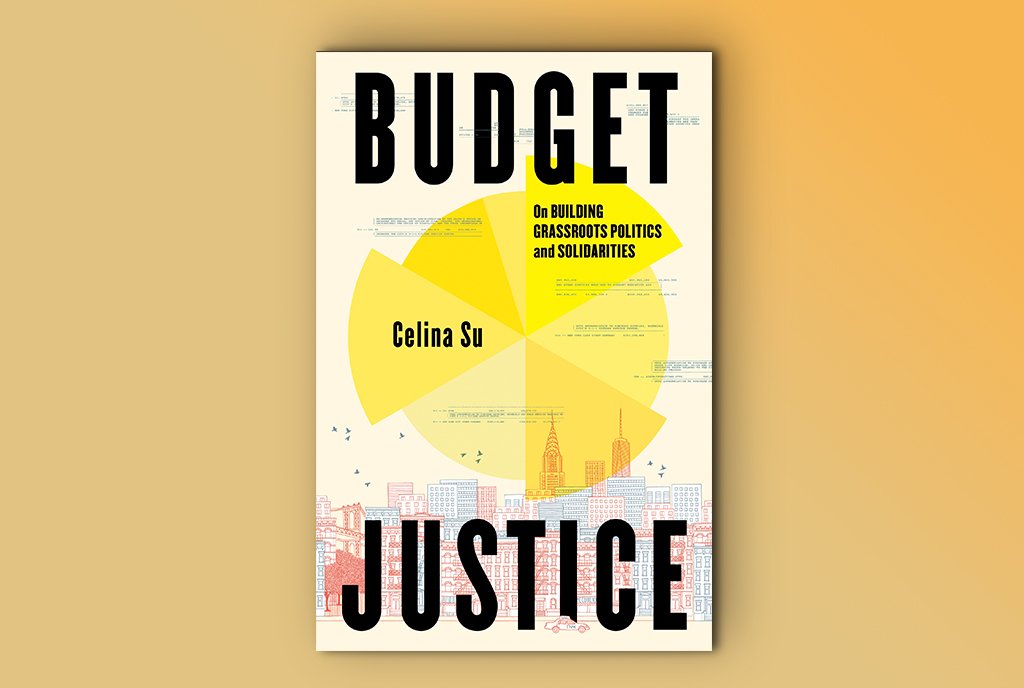
This installment accompanies an excerpt from Celina Su’s new book Budget Justice: On Building Grassroots Politics and Solidarities.
This interview has been edited for length and clarity.
Steve Dubb: What led you to write Budget Justice—and how would you define the term?
Celina Su: I define budget justice as giving everyday residents, especially those from historically marginalized communities, the resources and power to address their needs. What led me to write Budget Justice was seeing this very term on so many placards during the 2020 uprisings and protests. That really struck me, because to me talk about budgets is usually done by policy wonks, and I hadn’t seen it as a popular term before.
I had been studying participatory budgeting, which is a process in which everyday residents, rather than elected officials, help allocate public funds—but I hadn’t been paying attention to the budget part of participatory budgeting so much as the participation part. And those protests helped me to really look at city budgets as sites of contestation.
SD: In the book’s first chapter, you call for a “new sort of democracy.” What does that look like?
CS: Well, I don’t think this new sort of democracy is for me alone to decide. I’m not that sort of political theorist. But to me, it was helpful to remember US democracy as not democracy writ large, but a certain form of liberal representative democracy. Liberal as in focusing on the values of liberalism coming from the Scottish Enlightenment, with a focus on the rule of law, procedures, and individuals. And we see this in how the main symbol of American democracy is regular elections and the vote, which we do alone in ballot booths.
It’s not like I want our votes to not be secret, but outside of “I voted” stickers, there aren’t necessarily structured ways in which we’re thinking collectively. And so much of the news coverage is on horse-race dynamics in a mostly winner-takes-all system.
This gets to finding representatives that hopefully reflect people’s interests, needs, and wishes. By contrast, there are different models around the world that are more participatory and deliberative, in which everyday folks help to at least set some policy priorities that shape the institutions that govern their lives.
SD: I noticed that in your response you focused less on institutional rules and more on deliberation and participation. Why?
“Oftentimes, our democratic institutions are only as meaningful as their practice.”
CS: Through my research on participatory budgeting, I’ve seen its travels take it from a project really oriented to justice for poor people to one that ends up forwarding different values. It is partly this research that makes me wary of fetishization of institutional design. I’m not saying that institutional design doesn’t matter, but even within the case study that I have spent the most time with, in New York City, I see different local political actors potentially weaponize the same institutional design to really forward different power dynamics. This made me think about how, oftentimes, our democratic institutions are only as meaningful as their practice.
SD: These days, there is talk of a politics of abundance, but you rightly point out that the dominant mode of municipal politics in the United States has actually been austerity. What does this austerity look like, and what have been its effects?
CS: I think that this is where I hope that readers of the book can draw upon their own personal experiences. To me, paying attention to city budgets, this austerity looks like perennial talk of how funds are limited and policymakers have no choice but to make cuts. Their hands are tied. There are fiscal cliffs.
I mention these to perhaps trigger people’s memories, for them to question themselves as to whether certain themes come up, and whether certain phrases come up again and again and begin to sound familiar, until they become so normalized as to be unquestioned.
Working in a public institution, the City University of New York [CUNY], this looks like a lack of replacements of faculty when faculty retire or leave, alongside a shrinking budget, even for contingent adjunct faculty. An emphasis on student enrollment without attention to larger political-economic forces. Pressure to cut classes many weeks before the registration deadline, when students are saving up money for registration. Rising tuitions. Delayed maintenance. An emphasis on outcomes assessment that really, perhaps, reflects a certain narrow slice of institutional prerogatives more than learning. An overriding of faculty governance.
I could go on. Other folks might think about what austerity looks like in the institutions, and on the neighborhood level, that they’re most familiar with.
SD: A phrase that I really appreciated in your book was “actually existing neoliberalism.” Could you explain how you understand actually existing neoliberalism to operate?
CS: These insights are from other scholars that I build upon, and especially the analyses of movement folks, community members, the neighbors that I interviewed who participated in participatory budgeting, and also my students at CUNY.
Actually existing neoliberalism, as I understand it, is not so much about a shrinking of government, as much as a shifting of resources, because we are subjected to new electronic portals and consultant contracts to often ironically figure out what efficient cost-cutting would look like—new security contracts, so-called accountability measures, and sometimes overt surveillance.
At the same time, as we walk around our neighborhoods, we also see new developments that they say will include “affordable” housing—in quotes as they are not really affordable. Or those units never get built.
“Actually existing neoliberalism…is not so much about a shrinking of government, as much as a shifting of resources.”
Near where I live, in [Brooklyn], the Atlantic Yards Pacific Park Development displaced many families. Developers had promised over 800 affordable housing units, yet almost none of them have been built.
SD: Large city budgets are often opaque. But Los Angeles, you note, makes its budget far more understandable to Angelenos than the New York City budget is for New Yorkers. What does Los Angeles do differently and why is that difference important?
CS: Los Angeles makes it easier through what’s called a Sankey diagram that shows the flows of money that go towards the city coffers. The Los Angeles example is still incomplete. But it makes it a little bit more likely that we can see where money comes from and where it goes.
One other thing that Los Angeles seemed to do well was make it easy to look at how the different city agencies were doing in terms of services that were understandable to the average resident, like what percentage of people eligible for SNAP (Supplemental Nutritional Assistance Program) benefits are receiving them, or what’s the wait time for getting off a housing lottery waitlist.
In New York, we have these different measures, but they’re not presented in a legible form together with the budget.
A lot of cities don’t make their budgets really accessible to folks. This doesn’t have to be opaque and technical.
SD: If I were a public budget activist in some city other than Los Angeles or New York, where would I go to assess how my city’s doing and change practices?
CS: I would look up just the city budget and poke around government websites. There are different names for these offices in different cities, but that’s what I basically did, and I started to look for what are called popular budget reports to try to find basic breakdowns of where city funds are going, and if possible, to find numbers that compare this year’s budget to last year’s budget.
I’d look for budgets for similar-sized cities, if possible, just to get a sense of what was happening. I would also look for images, because maybe they have pie charts and bar graphs that make it a little bit easier to have a sense of what’s going on.
I have found that even at this basic level, cities vary greatly, and a lot of cities don’t make their budgets really accessible to folks. This doesn’t have to be opaque and technical.
I really believe that everyday folks should be able to access materials that lay out the plans that govern their lives. This opacity is, at least in part, antidemocratic.
SD: You write about “the right to the city.” It’s a common phrase, even the name of a national housing justice nonprofit. What do you mean by the phrase, and what kinds of policies and politics does pursuit of a right to the city entail?
CS: I think the national Right to the City alliance is focusing on housing. Everyday folks including working-class and middle-income folks should have the ability to live in the cities that they helped to create.
The second way I think of the right to the city is in helping to make decisions and engage in practices that shape the city.
So, I draw not only from folks like Henri Lefebvre, but also from James Boggs and others who have talked about how everyday neighbors should be able to live in the city and help to make the city.
SD: In your book, you write about participatory budgeting. But as you detail, not all forms of participatory budgeting are the same. How does practice vary from place to place?
CS: Participatory budgeting started at the city level in Porto Alegre, Brazil, in 1989, where everyday residents helped to allocate public funds.
Sign up for our free newsletters
Subscribe to NPQ's newsletters to have our top stories delivered directly to your inbox.
By signing up, you agree to our privacy policy and terms of use, and to receive messages from NPQ and our partners.
Variations include the extent to which local government emphasizes the deliberative aspects of participatory budgeting, what funds are used, whether decisions are advisory or binding, what the themes are, and how it’s organized.
In the context of New York City, and in many processes around the United States, folks come together for neighborhood assemblies each autumn and pitch ideas about what they think their neighborhoods need and what the local government could spend its funds on. Over the winter, volunteers help to vet and further develop certain ideas. In the spring there’s a vote, and then the projects that win the most votes get funded and implemented.
Even within New York City, there are lots of different processes, because the longer-running New York City process, PBNYC, is run by individual city council districts. So, some have focused on themes like climate change, and some emphasize neighbors working to develop projects together.
People are very willing to spend time and engage civically and politically if they feel like they can make a difference.
Those are the main variations. In Brazil, they originally focused on infrastructural projects, and that’s often the case in the United States as well, partly because it’s a one-time expenditure, whereas programming would require ongoing funding for staffing.
SD: Could you dig into how participatory budgeting stays meaningful and does not degenerate into what you call the “participatory industrial complex”?
CS: First off, you need adequate funds. It can’t be just a cute side exercise, which it certainly was not in Brazil, where it even helped to lower infant mortality. It can’t be a place where people let off steam—and then feel like they’re not really making a difference in budget priorities, because, if that happens, they might even get further alienated.
People are very willing to spend time and engage civically and politically if they feel like they can make a difference. But they become disenchanted if they feel like they spent all this time and energy on smaller projects that didn’t then help to inform larger priorities. So, there has got to be a way for folks without winning projects to think about how to continue to advocate for their needs.
The participatory budget process is not a completely separate process, but one that helps to inform other budget conversations in the city. There have to be enough funds so that people really feel like what they helped to create is meaningful. And there needs to be greater outreach resources and facilitation focused on the collective and deliberative aspects of the process. City staff are most used to get-out-the-vote efforts, so they end up focusing on helping people to vote at the end of the process, but that’s not the most interesting or meaningful part.
Going back to the budget part of the equation, the New York City case shows that participatory budgeting can be captured by different political actors in a context of austerity.
So, in some instances, there were city agencies that went to local assemblies, and instead of asking local folks what they felt they needed—where the dangerous intersections were, which programs would make the most impact on their lives—they had already done the research to present local residents with hyperlocal projects that they wanted to do but couldn’t complete because of budget cuts.
They said, “These are incredible funding opportunities that will give you bang for your buck. Instead of forwarding your own ideas, please fund ours.” This reifies a consumer choice model of citizenship, where there’s a premade menu of options, and citizens are not critically analyzing their own conditions or thinking with others, but just simply choosing from what policymakers already outlined for them.
SD: Could you give me a positive example where a participatory budgeting process did end up changing the overall budgets of a city or a community?
CS: There are many examples. Historically, people often talk about Porto Alegre, which had so much success with its participatory budgeting process.
In the case of New York City, even when the process is limited, it still has really interesting spillover effects. For instance, a lot of folks got fed up forwarding projects related to elementary school bathrooms. They felt like they shouldn’t be using discretionary funds for that. And in the fourth or so year of participatory budgeting in New York City, the relevant city agencies quietly doubled the school bathrooms line in the city budget from $70 to $140 million because of lots of complaints by participatory budgeting participants who became informed and indignant through the process.
Other examples, also from New York City, are when people use participatory budgeting as a way to develop a proof of concept or put a “down payment” on a larger project. For example, there was one participatory budgeting project that said that they knew that the participatory budgeting funds would not be enough to make a subway station accessible to folks with physical disabilities. But that project won a lot of votes. It means that they have a lot of popular support, and that the government should kick in the rest of the funds necessary, and they succeeded. So that’s helping to shift budget priorities. There are lots of instances where participatory budgeting projects made local elected officials notice needs that they might not have otherwise.
SD: You also write about what you call alternative or people’s budgets. What does a people’s budget look like, and how has this played out in different cities?
CS: I noticed that movement coalitions were using the term people’s budgets, especially around the 2020 uprisings. To me, people’s budgets forward visions of how city budgets can reflect community needs.
A lot of these have explicitly or implicitly have divest/invest formulations—divesting from institutions and expenditures that they feel are not necessarily helping them to thrive (including, for many, carceral institutions) and investing in care-first supports and services.
A lot of these also emphasize the need for different forms of participatory democracy, such as assemblies, where people can draw upon their lived experiences and connect with one another to think about what they want their cities to look like and to develop robust visions and alternatives.
SD: What is a “popular assembly” and how can it be an important tool of democratic participation?
CS: Popular assemblies are gatherings where folks from different walks of life can come together to talk about themes or topics, like community safety, climate change, or simply what’s going on in their neighborhood. They can go by different terms.
But they feel different, to me, than the more common US term of town hall meetings, in that they’re really bringing together folks for genuine conversation, and not short speeches where people might devolve to yelling at one another. They really emphasize meeting people where they are, not having a right or wrong answer, not having a specific policy proposal that people are supposed to talk for or against.
Nonprofits intersect with these processes in lots of different ways. Overtly, they are often contracted to help cities carry out the work necessary.
To me, these sorts of assemblies are the most important aspect of the participatory budgeting process. Because where else do we have the civic infrastructure where we have a sustained conversation with people unlike ourselves?
I engage in friendly banter with the workers at the local convenience store, bodega, and with different folks all the time, but it’s not sustained. It’s not necessarily about a community need.
In the past, labor unions and other organizations have historically played an important role for people to think about collective needs—and collective strategies, but we don’t have many places like this these days.
SD: How can or do nonprofits intersect with the projects you write about, participatory budgeting, people’s budgets?
CS: Nonprofits intersect with these processes in lots of different ways. Overtly, they are often contracted to help cities carry out the work necessary.
Nonprofits might have existing networks to conduct outreach to specific vulnerable communities—like queer communities, folks who primarily speak languages other than English, folks in specific neighborhoods. They might also be contracted to help carry out successfully funded projects, like running a community film series in neighborhoods that don’t usually have as much cultural programming, for instance.
At the same time, the purpose of participatory budgeting and these assemblies should be engaging folks in new ways and reaching folks who are not necessarily those already served by nonprofits. So, they might be helpful in combating austerity, and using these processes as sites of organizing and mobilization, not just service delivery.
SD: How do community-led budgeting efforts at the city level support the movement for an economy rooted in values of solidarity?
CS: I think that these community-led efforts often lead people to critique not only the dearth of essential services and public supports, but how they are funded and who gets funded, and how the local political economy works in the first place.
A lot of the most interesting and innovative programs and projects funded through participatory budgeting are not just trying to provide specific services, but originate from existing mutual aid networks, community gardens, and local self-organized groups of employers and domestic workers, for instance, who wanted to write a community agreement on what decent wages and decent conditions should look like beyond what was already on the law books.
A lot of these projects are also trying to think about what procurement processes, supply chains, local employers, and other local institutions should be doing to really emphasize cooperation rather than competition—as a foundational practice for building better cities.
SD: Is there anything I didn’t ask that you would like to add?
CS: I’ll just say that working collectively does feel like a lot of work. Working with others does feel like something that a lot of us are not used to.
Yes, it can be annoying and time-consuming, but on a personal note, it’s also what helped me to survive the COVID-19 pandemic. I realized that I only had access to outdoor space through local community gardens. I appreciated being able to think about and deliberate on what safety protocols should look like at my local grocery store because I shop at a food cooperative.
It’s also just really heartening and galvanizing when things feel really tough. And it’s a way to try to meet both immediate needs—like, I need some fresh air, and I need affordable groceries—and to think about important questions like scale, the long term, and what’s sustainable.