Small businesses have been one of the central pillars that has helped preserve the neighborhood’s Puerto Rican community.
This article was updated on August 31, 2026.
When it comes to gentrification in US urban communities, many stories focus on prevention but far fewer consider neighborhoods that have already been gentrified. Are those communities no longer salvageable? Williamsburg, the neighborhood in Brooklyn, New York where I live, suggests this is not the case.
Despite decades of gentrification, there is still a Puerto Rican legacy that, although harmed, is not completely erased. Small businesses have been one of the central pillars that has helped preserve the neighborhood’s Puerto Rican community.
A Puerto Rican Neighborhood Faces Gentrification
From South to East Williamsburg, Puerto Rican-owned small businesses saturated the neighborhood in Brooklyn during the 1970s and 1980s. In the 1980s, Latinx people constituted 64.6 percent of the neighborhood’s residents, most of them of Puerto Rican heritage. These residents owned bodegas, clothing stores, restaurants, social clubs, music stores, and other small shops that not only contributed to community wellbeing but served as social hubs.
When the neighborhood’s Puerto Rican population began to fall in the 1990s to 56 percent due to gentrification, many Puerto Ricans became displaced, and their businesses shuttered, along with their social networks. By the year 2000, the Puerto Rican population had fallen to 46.8 percent and then to just over 30 percent in 2010, while the White population grew from 14 percent to 26 percent in the same year. By the 2020 Census, the percentage of Latinx decreased again to 26 percent while Whites increased to 57 percent, the same statistic the Puerto Rican population held in the 1990s when they began to be displaced.
Since commercial rents have risen unabated, Puerto Rican millennials, specifically, were left out of the local economy, unable to afford to open businesses in the community. This has left a cultural and social gap in the area for Puerto Ricans who once cultivated strong community networks. Yet, despite the odds, both the older and younger generation of Puerto Ricans managed to persevere in either holding on to or reclaiming space.
The Value of Small Business
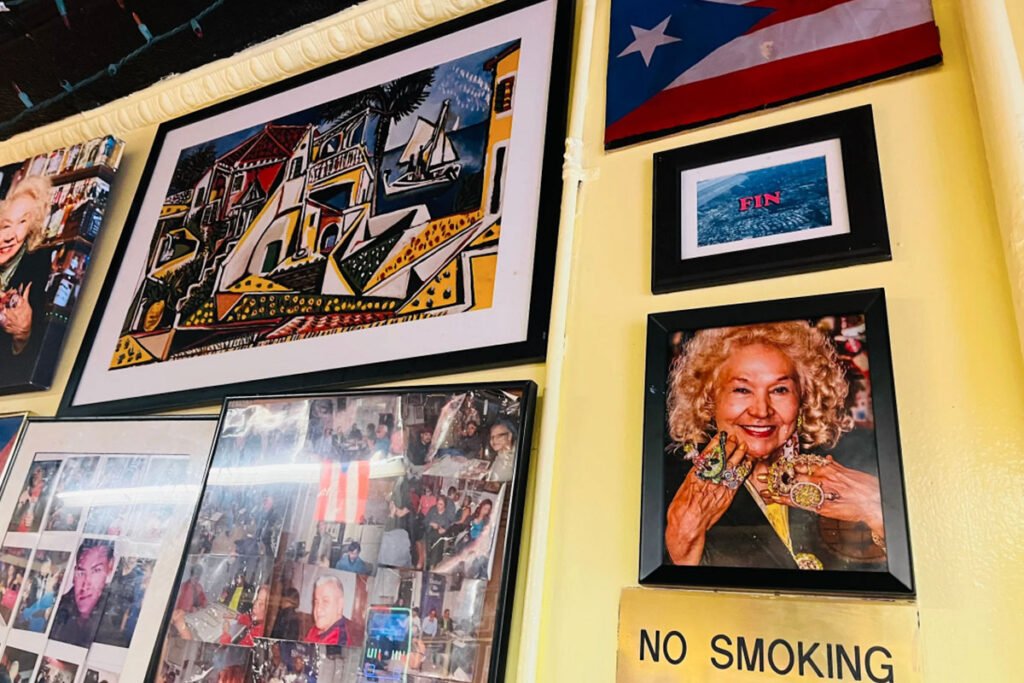
Small businesses contribute to community wealth by creating jobs, ensuring local distribution of money, and fostering social connections. One of the primary examples in Williamsburg is Toñita’s Caribbean Social Club, considered the neighborhood’s last Puerto Rican social club remaining and a mainstay for over 50 years in Los Sures (South Side).
The octogenarian owner, Maria Antonio Cay—better known as Toñita—provides work to Puerto Rican and Latinx locals to upkeep the place, help with bartending or cleaning up tables. The social club has grown in popularity over the past few years, generating opportunities for Latinx, not only within but also beyond the confines of Williamsburg.
It also provides a space for artists to perform. A block party, Toñita Fest, is now an annual event. The club also recently hosted a mini-documentary titled “El Caribbean: Es Otra Cosa,” which is the origin story of the social club as a baseball league haven. That documentary was presented by Major League Baseball, in collaboration with local organizations the Remezcla Agency and La Gesta, as the film producers.
The growing sense of community…with every night the social club is open, through its cultural events, as well as through care and trust in this inclusive space.
This is all possible because Toñita owns the six-story, seven-residential unit and commercial space. She bought the building in 1974, when prices were much lower.
Today, the average price of a multifamily home in the neighborhood is in the millions, and while land ownership is not impossible, it does look far different from how it was decades ago.
Similar to other urban neighborhoods like Miami’s Little Santo Domingo, East Portland, Los Angeles’ Boyle Heights, San Francisco’s Mission District, and Seattle‘s Asian, Mexican, and Central American community, preserving affordability requires organizing. In New York City residents are organizing for land equity and are at the helm of the community land trust (CLT) movement. CLTs offer a nonprofit community ownership structure that allows people to collectively own the land, with the key feature being that it helps keep housing and commercial spaces affordable.
Another important contribution of small businesses is social connection. Toñita’s primary goal is not making profit, but rather the growing sense of community with every night the social club is open, through its cultural events, as well as through care and trust in this inclusive space. Every night for decades, Toñita has provided free Puerto Rican food for anyone who needs it or wants it—regardless of color, ethnicity, and economic status.
Sign up for our free newsletters
Subscribe to NPQ's newsletters to have our top stories delivered directly to your inbox.
By signing up, you agree to our privacy policy and terms of use, and to receive messages from NPQ and our partners.
Toñita’s is not the only long-term Puerto Rican business that is part of this ecosystem of contributing to the wealth of the community. BK Warehouse, located a block away from Toñita’s, is a 1990s vintage sneakers, streetwear, and skateboard shop that has been open for 13 years catering to the stylistic aesthetic many millennials grew up with. On Grand Street in East Williamsburg, the custom printing store Fresh Off the Press has remained open since it started producing designs of an old Brooklyn in 2002. Nearby, there is also Brooklyn Cupcake, owned by a Puerto Rican family from Williamsburg, selling guava, coquito, and flan cupcakes since 2011.
On Graham Avenue, better know as the Avenue of Puerto Rico in East Williamsburg, La Isla Cuchifritos, a fried Puerto Rican eatery has existed for 65 years since 1960, satisfying the palates of its surrounding community. Johnny Albino Music Center opened in 1966 and San German Records in 1967, located across the street from each other to supply the soundtracks of our upbringing and culture, with old school salsa, bachata, merengue, and reggaeton CDs. Finally, there is Valencia’s Bakery, the 75-year old Bronx-based business featured in Bad Bunny’s video, returning in 2021 with a location that has been satiating our sweet tooth with guava-filled cake and tres leches.
A New Generation Returns to the Neighborhood
Despite decades of displacement and excessive rents, Puerto Ricans, particularly millennials, are slowly returning to the neighborhood to open businesses and contribute to rebuilding the community. Newer additions to the neighborhood include AM:PM Gallery, exhibiting contemporary art shows and hosting events in Los Sures since 2022 and Luxe Treasures and Boutique, a thrift store curating vintage clothes and accessories for your abuela since February 2025. Also in construction since early 2025, Casabuela Cafe, a new parent-centered and kid-friendly café lounge serving a fusion of traditional and modern Puerto Rican and Caribbean foods and pastries, will open soon at the border of North and South Streets on Metropolitan Avenue. In the summer of 2025, Chrome Williamsburg on Grand Street opened, a Puerto Rican restaurant hosting salsa, freestyle, and hip-hop nights.
Sadly, the persistent threat of gentrification and displacement still looms. Buddies, a cafe owned by Rachel Nieves, a Puerto Rican woman, and her husband opened its doors in 2020 at the border of the North and South Sides, but was forced to close earlier this year due to a rent hike. Despite calls to the landlord from locals and celebrities to save the business, famous for their coquito latte [eggnog-like drink], they were unsuccessful and closed in May 2025. The location was then rented out to the Colombian coffee shop, Devoción.
Carina Camacho, a Puerto Rican woman and millennial, is one of the new business owners who hopes to stay in business for a long time despite these threats, while maintaining low prices that cater to long-term residents. As a newer business in the area with a higher rent, Camacho shared that Luxe Treasures and Boutique’s owners rely on generating most of their money through online auctions for higher end items. This allows them to price items lower on the floor and give customers discounts.
However, just like Toñita, monetary transactions are not the end goal for Camacho but rather following the tradition of utilizing businesses as community hubs. Cultivating a welcoming space built on trust is just as important, especially in a time when the community has been fragmented.
“The other day a customer didn’t have a dollar, and I was like, ‘It’s fine, bring it to me another day.’ It’s very much that energy. It’s a language that, especially with the older generation [and our Puerto Rican culture], I resonate with and that I want to stay true to,” she explained to NPQ.
Puerto Rican businesses in Williamsburg, new and old, nurture their own special spirit and vibrancy that represent different parts of the community’s culture.
Camacho understands that building connection through trust and generosity is how the community can heal and prosper. When she was younger, she recalled, “I remember growing up [in the 1990s] with my dad teaching me about being Puerto Rican and shopping for my outfits and accessories before the [Puerto Rican Fifth Avenue] parade. We would walk down Graham and see all the record shops, the flags and all just in preparation to celebrate us.”
Like other long-term neighborhood businesses, Camacho hopes to foster a similar energy and presence of community with her shop. When walking into the thrift store, the ethos of 1980s and 1990s Williamsburg permeates, an intentional decision to create a social and physical environment that reflects Puerto Rican and Williamsburg likeness.
“From the perfume selection, Elizabeth Arden, and all these things from the ‘80s that my mom wore, that my abuela wore, I think [a lot] about curation, and I want the abuelas that come in to feel the same way [as they experienced before],” she said.
The Puerto Rican businesses in Williamsburg, new and old, nurture their own special spirit and vibrancy that represent different parts of the community’s culture. This expression of community is quite distinct from the clinical and sterile design of many other small businesses and corporate stores that gentrification produces.
“It’s important for us [Puerto Ricans] to stay here because our narratives were here before [all this change], and it’s scary to think that if we don’t stay, what will our narrative become, or will we be completely erased? I think that in us being here [and being in business], we don’t just add to each other, we add to the world in a greater whole,” Camacho concluded.