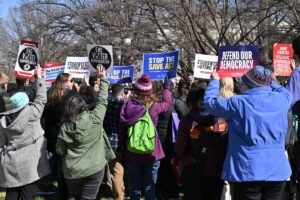

Leading up to the 2025 budget bill vote—what Republican leaders called the “Big, Beautiful Bill”—policymakers sought to justify benefit rollbacks, including cuts to food stamps (Supplemental Nutrition Assistance Program or SNAP) and massive cuts to Medicaid and children’s health insurance, estimated to total $1.02 trillion over 10 years.
When you create rules to determine who qualifies and who doesn’t, you increase bureaucracy and decrease effectiveness.
What was the Republican communications strategy? GOP leaders claimed the cuts only affected those who did not “deserve” support. Earlier this year, House Speaker Mike Johnson said on CNN that the budget bill aimed to preserve Medicaid for single mothers, “not for 29-year-old males sitting on their couches playing video games.”
Johnson’s statement was just the latest attempt to conjure up a group of “undeserving poor”—in this case, young gamers—to justify program cuts. It’s a familiar playbook. And, unfortunately, antipoverty advocates often get caught in the trap of defending beneficiaries’ “deservingness” rather than making the case that social benefits exist to support us all.
Moreover, it is well-known that when you create rules to determine who qualifies and who doesn’t, you increase bureaucracy and decrease effectiveness. As journalist Ray Suarez observed, the political goal is often to make “benefits harder to get in the hope that some people will just say, ‘Oh, the heck of it,’ and do without.”
Why US Political Support for Social Benefits Is Fragile
When President Franklin D. Roosevelt outlined his plan for a national program of social insurance in 1934, after the Great Depression laid bare the danger of widespread unemployment and deep poverty, he promised protections against both the predictable, such as old age, and the unpredictable, such as unemployment: what he called the “hazards and vicissitudes of life.” Out of this effort came federal programs such as Social Security and federal unemployment insurance. In 1965, when he signed Medicare and Medicaid into law, President Lyndon B. Johnson said that a “great burden [had been] lifted from the shoulders of all Americans.” Roosevelt and Johnson both recognized that old age, unemployment, and health crises affect us all.
How do you get beneath stereotypes? It is helpful to talk about real people.
Yet 90 years after the New Deal, the question of who deserves the protection of the social safety net persists, and that discourse has long been shaped by stories about cheaters, frauds, and moochers. Unfortunately, these stories are powerful and can be politically effective. Race is certainly the most salient example of this, but family status, class, education, and more can all be used as part of these stories to separate the “deserving” from the “undeserving.” They tap into deeply held beliefs about virtue, doing one’s part, and the value of hard work (think Aesop’s fable “The Ant and the Grasshopper”), and they can often be quite resistant to facts and logic.
A June 2025 Kaiser Family Foundation (KFF) poll showed how politically effective arguments about separating “deserving” and “undeserving” poor can be. Researchers found that two-thirds of the public supported Republican efforts to impose work requirements on able-bodied Medicaid recipients without dependents. This support rose to 79 percent when people were told that this could help fund Medicaid for other groups like children and the elderly.
Getting Beneath the Rhetoric
How do you get beneath stereotypes? It is helpful to talk about real people. Take Speaker Johnson’s example of young men playing video games. Effectively, Johnson is offering a caricature of people who policy wonks call by an acronym of “ABAWDs,” which stands for “able-bodied adults without dependents.”
Johnson obliquely references this by saying “able-bodied” in the quote above. His office later made the connection more explicit in references to papers about them. “ABAWDs” are, broadly defined, adults below retirement age, without federally recognized disabilities, and without qualifying dependents in the home.
Yet it turns out—unsurprisingly—that these “ABAWDs” (who, despite being able-bodied adults without dependents, need both food and health insurance, as everyone does) are nothing like the lazy gamer stereotype.
Most are working or trying to work, though many have unpredictable hours that make it difficult to meet the so-called work requirements—which, in practice, function as work reporting requirements. Many are caregivers, and 40 percent are parents to children who are over the age of 18 or who are not legally recognized as dependents. Some may have disabilities that aren’t yet legally recognized or don’t qualify them for other programs. About half are women, and they are disproportionately people of color.
Sign up for our free newsletters
Subscribe to NPQ's newsletters to have our top stories delivered directly to your inbox.
By signing up, you agree to our privacy policy and terms of use, and to receive messages from NPQ and our partners.
In short, most people who seek government support do so because they need it, not because they’d rather play video games than work. Given the social stigma involved with accepting benefits, this should surprise no one.
Sadly, the effects of the cuts are not small. Data show that between 12 and 17 million people, both those who fit in the “ABAWD” category and those who do not, will lose their health insurance. These cuts will put a massive strain on healthcare providers. When uninsured patients suffer medical crises, hospitals often end up on the hook for the cost of their care, with each newly uninsured person generating nearly $900 in uncompensated care costs. About two-thirds of this cost is absorbed by hospitals, many of which are already on the brink of closing, setting the entire healthcare system up for collapse.
It is not just about dollars and cents. Lives are at stake. A study from the University of Pennsylvania, for instance, found that the likely impact of the legislation passed by Congress in July could be 51,000 preventable deaths a year.
Creating a More Positive Story
What can advocates do? The disastrous consequences of rhetoric designed to split coalitions and unravel the safety net are readily apparent. If the Medicaid work requirements contained in the bill passed by Congress this past July go into effect as scheduled in 2027, they will do significant damage to the entire healthcare system. In practice, they impose a severe administrative burden that will apply to all Medicaid recipients, whether or not they are working, “able-bodied,” or have qualifying dependents.
With enough information, many people can be convinced that this rhetoric is wrong. The authors of the same KFF poll cited above found that while two-thirds of respondents favored work requirements for benefits, that support fell by half, to 35 percent, when researchers told respondents that: (a) most adults with Medicaid are already working or unable to work; and (b) that they could lose coverage due to the challenge of providing paperwork to prove need. In short, information can and does make a difference—sometimes. But absent a narrative strategy, relying on data and studies is far from adequate.
This fall, Congress spent over a month engaged in a battle over the federal budget that resulted in a historic government shutdown. Democrats pressed Republicans to commit to extending the Joe Biden-era enhanced premium tax credits for the Affordable Care Act marketplace and to rescind many of the program cuts to Medicaid passed in July. But one thing Democrats didn’t even ask for in their counterproposal was a rollback of Medicaid work requirements. In short, Democrats did not even challenge a core principle behind the bill’s cuts.
Every hole in the social safety net makes it weaker for everyone else. As nonprofit and movement leaders, it is our job to tell that story and to make sure everyone hears it.
How does this change? If advocates want people to understand the value of an inclusive safety net, then they need to speak in a language that points not just to the data but to stories about some of the millions of people who are caught in this bureaucratic vise. It is worth noting that most people in the United States do value social benefits. Eighty-three percent of respondents to the KFF poll said they had a favorable opinion of Medicaid. Support for the Affordable Care Act was at 66 percent. With the right framing, that support can be used to strengthen social benefits for everyone.
But, as the data also show, support for social benefits can be easily dislodged. To address this, antipoverty advocates need to tell stories that emphasize the value of working together for the common good, in place of zero-sum morality tales about cheaters and moochers that are designed to divide us. Advocates, for instance, might draw on Aesop’s “The Bundle of Sticks”—a story that centers the value of unity and community—rather than “The Ant and the Grasshopper.”
Offering these positive stories is necessary to speak to the lived experiences of actual people. This includes people whose lives have been improved by the social safety net, whether or not they are the direct beneficiaries. For instance, this spring the National Partnership for Women and Families published a series of blog posts highlighting the lifesaving impact of Medicaid on not only the authors but also their loved ones.
We are all better off when our neighbors are healthy, housed, and fed—every hole in the social safety net makes it weaker for everyone else. As nonprofit and movement leaders, it is our job to tell that story and to make sure everyone hears it.