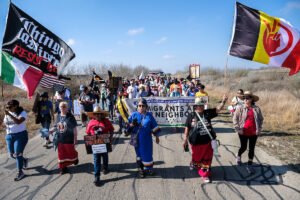
On June 6, 2025, Los Angeles changed. Federal agents (including 4,000 members of the National Guard and 700 Marines) poured in, targeting immigrants. A minimum of 2,792 people were taken in the 16 days that followed. During this period, David Huerta, president of the Service Employees International Union (SEIU) California was assaulted, arrested, detained, and charged with a federal felony while documenting an ICE (US Immigration and Customs Enforcement) raid.
During what would typically be a joyous and celebratory graduation weekend, the streets of Los Angeles were eerily quiet. Bus ridership plummeted, car wash workers were targeted, small-business corridors and swap meets were deserted, and many street vendors stayed home.
Los Angeles County is home to 3.5 million immigrants, comprising nearly 35 percent of the county’s population. Across the state, one in three workers and four in ten entrepreneurs are immigrants. And as ICE has descended upon our communities, worksites have become a leading site of physical and emotional harm. In California, an estimated 271,541 citizens and 193,428 noncitizens missed work in early June following the onset of mass ICE raids—a loss of work comparable only to that experienced during the COVID-19 lockdown and the Great Recession.
ICE intentionally sowed fear and confusion. ICE training manuals since 2006 have encouraged agents to lie—or, formally, “ruse” the public—and agents use these strategies often. One example is the August mass kidnapping event that US Border Patrol Chief Greg Bovino called “Operation Trojan Horse,” in which dozens of ICE agents piled into the back of a rented box truck as they descended upon a Home Depot in Los Angeles’s Westlake neighborhood—the driver speaking Spanish and telling day laborers in the parking lot that he was looking for workers. As plainclothes agents shrouded in tactical gear started to anonymize themselves in masks and dark sunglasses to terrorize and kidnap our families, fear and confusion settled over Los Angeles.
Small-business owners, it turns out, are often as interested in learning about their Fourth Amendment rights as immigrant workers themselves.
We knew we had to fight back. We share what we have learned here because what started in Los Angeles has not stayed in Los Angeles—as is evident by the subsequent federal use (or attempted use) of National Guard troops in other US cities, such as Chicago, Portland, Memphis, and Washington, DC. The good news is that if communities come together and act, many immigrant families can be protected.
How a Community Response Was Born
The Los Angeles Alliance for a New Economy (LAANE), where I serve as executive director, is an organizing and advocacy institution committed to advancing economic, environmental, and racial justice in Los Angeles and Long Beach. Over the past 30 years, we have worked to raise standards in low-wage sectors—including grocery, retail, and hospitality. Starting in January 2025, LAANE worker organizers began passing out Know Your Rights documents, but when mass ICE raids started in June, the need to ramp up efforts was obvious.
Working in collaboration with CLEAN Carwash Worker Center, Organized Power in Numbers, United Food and Commercial Workers (UFCW) Local 770, and Warehouse Worker Resource Center, we launched an eight-week, multi-industry Know Your Rights outreach program. In our organizational history, we had rarely engaged in direct organizing with small businesses; we found a surprisingly receptive audience. Small-business owners, it turns out, are often as interested in learning about their Fourth Amendment rights as immigrant workers themselves.
What Does a Know Your Rights Program Look Like?
Our program launched in July—just four weeks after the federal troops arrived in Los Angeles—and ended eight weeks later. During that period, we canvassed 9,140 worksites, trained 1,300 workers, and received training requests from almost 750 small businesses. To pull this off, our team operated with the following principles in mind:
- Be nimble and responsive. Moving staff quickly was key. In early July, LAANE pivoted eight full-time staff members from their regular campaigns to the Know Your Rights program. This pivot required immense flexibility; fortunately, staff were eager and grateful to help scale this work.
- Secure funds. Mass canvassing is not cheap. For the Know Your Rights push, we secured resources from individual donors and core foundation partners. Fundraising success enabled expanded efforts. Ultimately 78 canvassers at four sites were involved by August 1.
Another key cost involves printing thousands of packets (such as this sample packet), including red cards and private/no entry signage. By posting these signs, employers make it clear that the area is not public and entry requires a warrant. The printed packets also included information on how to locate detained loved ones, rights fact sheets, judicial warrant examples, rapid response numbers, and information about family preparedness plans.
Sign up for our free newsletters
Subscribe to NPQ's newsletters to have our top stories delivered directly to your inbox.
By signing up, you agree to our privacy policy and terms of use, and to receive messages from NPQ and our partners.
- Establish hubs in key areas. In a place as large as Los Angeles, multiple field offices were needed. Sites were located not just in downtown Los Angeles, but also in South Central, Huntington Park, and Ontario—this last site nearly 40 miles east of downtown. The strategic locations of these hubs meant that we were already established in the communities ICE was raiding, which facilitated more rapid responses.
- Implement a political turf model. Canvassers walked block by block in business corridors to connect with workers and small-business owners. Working in pairs to collect business information and training interest via survey, canvassers added this information to a database so that organizer teams could then follow up with businesses to schedule in-person trainings. In areas that were being heavily targeted by federal agents, teams would go out with safety liaisons who were trained in de-escalation and documentation—ensuring that we were always prepared for possible contact with ICE.
- Track your data. Part of the power of this program was the massive interest that small-business owners showed in learning about our Fourth Amendment rights. Tracking outreach allowed us to systematically follow up with small businesses—sometimes hosting larger trainings for multiple businesses in an area and building localized community networks of support.
Building Connections with Worksites
We talked to workers in seven out of 15 City Council districts, as well as in the cities of Huntington Park, Cudahy, Southgate, Vernon, Inglewood, Ontario, Chino, and San Bernardino. Time and again, workers and business owners alike shared that they felt helpless about the attacks prior to receiving information from us on how to plan, prepare, and prevent unlawful ICE activities.
One LAANE organizer told NPQ, “We have seen the community come together—people are hungry to learn how they can protect their families.…We consistently get people asking for extra packets or resources so they can share it with people at risk.”
In addition to educating people on their rights, we also gained valuable insights about small-business needs in the business corridors canvassed. For example:
- The majority of businesses canvassed were BIPOC-owned; many of the owners were renters and expressed concern about the rising cost of rent and goods, in addition to a declining customer base.
- Business owners and customers expressed that people feel safer when they see private/no entry and Know Your Rights signs, as these materials signal that the employer is welcoming to immigrants and has a plan if ICE is present. Some customers even told LAANE organizers that they would not enter a business that failed to have signs present.
- Some raided businesses have laid off regular staff and now rely on government-subsidized youth labor programs. While this may save money in the short term, it reduces worker skill and institutional knowledge.
- Some businesses are organized into informal networks or associations based on their industry or region. They connect with each other and share information and strategies about how to respond to the current moment. These networks, made it possible to provide trainings to multiple businesses at once.
Time and again, workers and business owners alike shared that they felt helpless about the attacks prior to receiving information.
Looking Forward
The work of training and educating small-business owners and workers remains urgent. ICE’s presence persists, but so does collective resistance.
Now is the time to mobilize people, build lasting power, and protect communities. While the eight-week canvassing push has ended, constitutional rights trainings for businesses and workers across the region continue. This work starts with building trust and sharing resources that can make a difference.
Throughout the course of the program, we saw Angelenos, catalyzed by these flash-point moments of terror, join the immigrant rights movement. Workers have told LAANE organizers that they feel more empowered and prepared to defend themselves and their coworkers while on the job.
The work…remains urgent. ICE’s presence persists, but so does collective resistance.
One training attendee shared that “events like these remind us of how important unity and shared purpose are to the future of our industry and our people.”
Know Your Rights trainings are effective—and can be organized far beyond Los Angeles. If implemented widely, a Know Your Rights organizing approach can not only empower workers and keep immigrant families together, but it can also lay the foundation for the type of sustained and broadened engagement needed to build a more just society overall.