
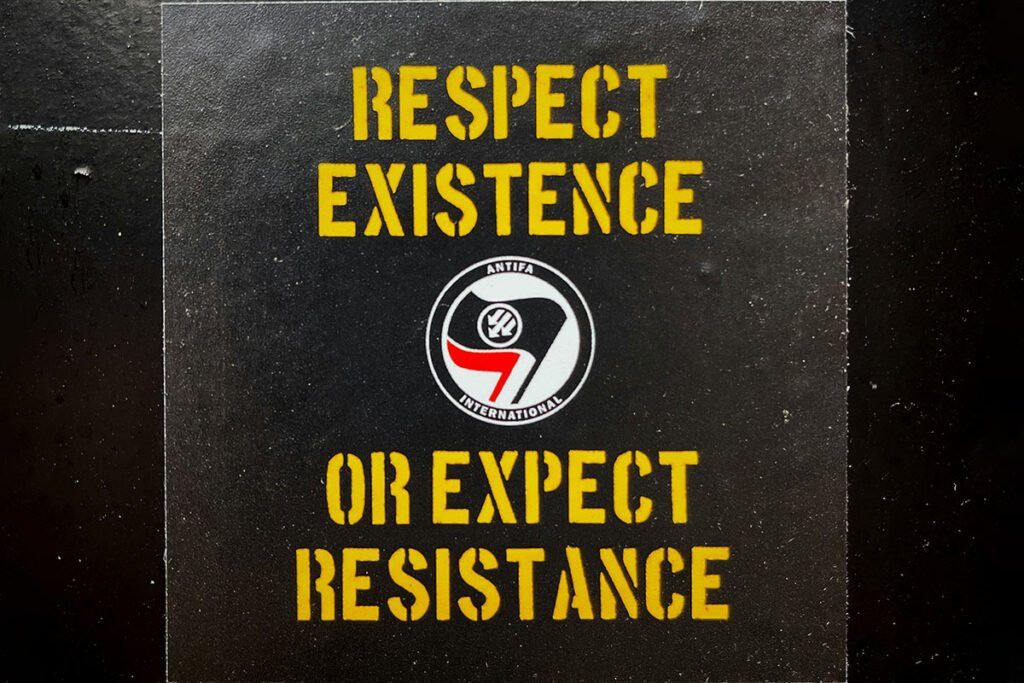
In September 2025, Donald Trump signed an executive order labeling “antifa”—short for “antifascism”—a domestic terrorist threat. Around the same time, Trump issued a presidential memorandum known as NSPM-7, which identifies “anti-Americanism,” “anti-capitalism,” “anti-Christianity,” and “extremism on migration, race, and gender” as indicators of potential violence. The memorandum directs the secretaries of the Department of the Treasury and the Department of Homeland Security, along with the attorney general, to “investigate and disrupt networks, entities, and organizations” that support antifascist organizing.
“The president declaring a domestic ideology or movement ‘terrorists’ is going to encourage both federal and local law enforcement to treat them as such,” Chip Gibbons, the policy director of Defending Rights & Dissent, told NPQ. “Trump’s memo makes clear that surveillance will be escalated.”
Attorney General Pam Bondi has publicly said that the government plans to “destroy [antifa] from top to bottom.” FBI Director Kash Patel has similarly attested that his agency “will not rest until we find every single seed money, donor organization and funding mechanism that we have,” noting that the FBI is collaborating with Treasury Secretary Scott Bessent to “map out these networks.”
These moves have alarmed civil society leaders, who warn that the administration is using the pretext of “countering political violence” to justify investigations into nonprofits and to stifle dissent.
Attempts to Further Erode Civil Society
“This attack on nonprofits is not happening in a vacuum, but as a part of a wholesale offensive against organizations and individuals that advocate for ideas or serve communities that the president finds objectionable, and that seek to enforce the rule of law against the federal government,” read an open letter opposing Trump’s directive that was signed by more than 3,000 nonprofits.
This most recent attack on nonprofit organizations is part of a broader campaign by this administration against the nonprofit sector. Previous Trump executive orders have already cut millions in federal funding to nonprofit organizations—impacting one in three nonprofits nationwide—and excluded workers engaged in transgender rights, civil rights, and immigration advocacy from public service loan forgiveness programs.
Now, by framing progressive funders as sources of “illicit funding,” the administration appears poised to further erode civil society and weaponize the nonprofit regulatory system against political opponents.
“Trump is willing to act first and seek forgiveness later, and this means the damage might already be done to groups that promote causes that the executive branch opposes,” said Dafydd Townley, author of The Year of Intelligence in the United States: Public Opinion, National Security, and the 1975 Church Committee, in an interview with NPQ. “[Nonprofits will] need to consider the impact of being labeled part of a criminal enterprise, especially those that rely on donor funds.”
Reports indicate that the administration is targeting philanthropic organizations such as the Open Society Foundations, the Southern Poverty Law Center, and the Ford Foundation. While these developments are deeply troubling, they represent only the latest chapter in a long history of US government surveillance of social movements and the weaponization of the legal system against activists.
“The government already targets domestic social movements under the framework of terrorism and has for decades. The FBI has used both international and domestic terrorism authorities to monitor completely domestic political movements,” Gibbons explained. “This has included opponents of Ronald Reagan’s Central American policy, environmental and animal rights groups, World Bank protesters, peace groups, and supporters of Palestine.”
But by looking back at this history, nonprofit organizations can learn how to prepare themselves and protect their communities.
A Short History of US Government Surveillance of Social Movements
In October, Republican Representative from Texas Lance Gooden sent a letter to Attorney General Bondi requesting that she open an investigation into the National Lawyers Guild (NLG), a progressive public interest group established in 1937 as an alternative to the American Bar Association. This isn’t the first time the NLG has faced scrutiny—the organization reported that it has “been the target of government surveillance for most of its history.”
The report detailed that between 1940 and 1975, J. Edgar Hoover—the first director of the FBI and architect of the Counterintelligence Program (COINTELPRO)—became fixated on the NLG after it published a 1949 report criticizing FBI surveillance practices. Hoover lobbied to have the organization designated as a “subversive group” and placed NLG members on the FBI’s Security Index.
The NLG recently released a letter linking its long history of government surveillance to the current moment and denouncing Rep. Gooden’s letter: “As early as the late 40’s, the NLG was accused of being the ‘legal bulwark of the Communist Party,’ by then U.S. Attorney General Herbert Brownell, Jr. Today, the Guild is being accused of being the legal arm of ‘antifa.’”
Sign up for our free newsletters
Subscribe to NPQ's newsletters to have our top stories delivered directly to your inbox.
By signing up, you agree to our privacy policy and terms of use, and to receive messages from NPQ and our partners.
The NLG was far from Hoover’s only target. From the late 1930s through the 1970s, Hoover directed the FBI to investigate thousands of Americans and hundreds of organizations it labeled “subversive.” Hoover’s FBI famously engaged in wiretapping and bugging, intercepted mail, sent anonymous letters, spread false allegations, infiltrated chapters and planted informants, and coordinated with local police to criminalize activists. It also shared surveillance files with the IRS, leading to audits of organizations and activists.
Hoover’s FBI played a central role in successive waves of political repression, from McCarthyism and the Red Scare, the FBI’s campaigns against the civil rights movement, the American Indian Movement (AIM), the women’s liberation movement, the Puerto Rico nationalist movement, and the Black Panther Party.
Many nonprofits in these movements, including the NLG, the National Association for the Advancement of Colored People (NAACP), the Southern Christian Leadership Conference (SCLC), and the Student Nonviolent Coordinating Committee (SNCC), were closely monitored and deliberately disrupted by the FBI.
Although COINTELPRO was officially discontinued in the 1970s after activists exposed it by breaking into an FBI office—sparking a major investigation—the government has continued to surveil activists and social justice movements, including the Green Scare, the so-called War on Terror, and the recent targeting of pro-Palestine advocates and Stop Cop City organizers.
Past Tactics of Resistance
Scholars and activists familiar with Hoover-era resistance tactics told NPQ that studying how past organizations protected members, maintained solidarity, and sustained their missions under pressure can help today’s nonprofits prepare for threats under the Trump administration.
For example, Hoover’s FBI, like the current Trump administration, also targeted the gay rights movement. Organizations such as the Mattachine Society, the Daughters of Bilitis, the Gay Liberation Front, and the Gay Activist Alliance were monitored and targeted with informants.
“[T]he FBI collected massive amounts of information on [LGBTQ+ Americans], checked their own voluminous files for data on them, and collated it all into a massive ‘Sex Deviates’ file ultimately reaching some 330,000 pages with multiple adjunct files, too,” Douglas M. Charles, author of Hoover’s War on Gays: Exposing the FBI’s “Sex Deviates” Program told NPQ.
Charles explained that the FBI used this information during the Lavender Scare to purge LGBTQ+ people from government employment, and shared it with local and state police, as well as universities.
Charles added that to protect themselves from being “outed” or criminalized in the 1950s and 1960s, many LGBTQ+ activists used false names, which made them more difficult for the FBI to monitor. The Mattachine Society also adopted a cell structure borrowed from the Communist Party, so that members of one cell did not know those of another, which made it more difficult for the FBI to infiltrate.
After Stonewall, more radical groups like the Gay Liberation Front (GLF) used anarchist organizational methods with no formal hierarchy, which frustrated the FBI’s attempts to identify members. In contrast, the more structured Gay Activists Alliance, which was less radical than the GLF, was easier for the FBI to surveil because it maintained a standard leadership structure.
Despite the heavy risks the gay liberation movement faced, Charles noted that “LGBTQ groups in Hoover’s era did not give in,” emphasizing that refusing to “give up” and not “bend[ing] to fear” are key lessons activists and nonprofits can draw from Hoover-era surveillance to apply to our current moment.
“Much of it is a house of cards rooted in fear,” Charles explained. “It only works if the targets give in.”