logo logo
giving banner
Donate
    • Membership
    • Donate
  • Social Justice
    • Racial Justice
    • Climate Justice
    • Disability Justice
    • Economic Justice
    • Food Justice
    • Health Justice
    • Immigration
    • LGBTQ+
  • Civic News
  • Nonprofit Leadership
    • Board Governance
    • Equity-Centered Management
    • Finances
    • Fundraising
    • Human Resources
    • Organizational Culture
    • Philanthropy
    • Power Dynamics
    • Strategic Planning
    • Technology
  • Columns
    • Ask Rhea!
    • Ask a Nonprofit Expert
    • Economy Remix
    • Gathering in Support of Democracy
    • Humans of Nonprofits
    • The Impact Algorithm
    • Living the Question
    • Nonprofit Hiring Trends & Tactics
    • Notes from the Frontlines
    • Parables of Earth
    • Re-imagining Philanthropy
    • State of the Movements
    • We Stood Up
    • The Unexpected Value of Volunteers
  • CONTENT TYPES
  • Leading Edge Membership
  • Newsletters
  • Webinars

Nonprofits Must Care that the Public is Losing Trust in Institutions of Democracy

Jeannie Fox
July 6, 2017
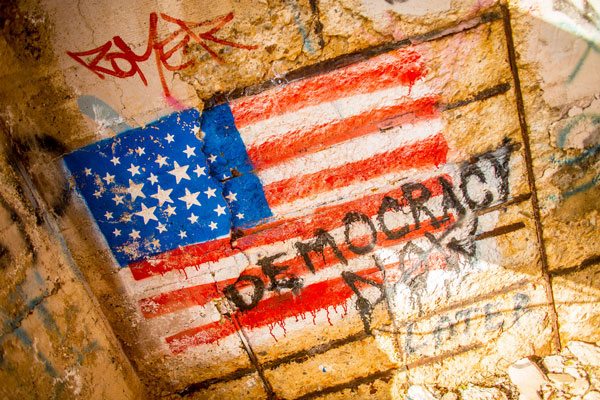
Democracy / Thomas Hawk

July 3rd, 2017; NPR

A recent poll by NPR, The Marist College Institute for Public Opinion, and PBS NewsHour finds that both public trust in the nation’s institutions and the perceived civility of the nation’s public dialogue are decreasing rapidly under President Trump. The decrease has been noted by Democrats, Independents, and Republicans, but it’s little comfort to the public to realize this is a point of consensus for our nation’s lawmakers. Elected officials of all stripes have been calling out the President’s ill-considered public comments and have begged him to “Stop it!”

There are many reasons nonprofits should be concerned about these poll numbers. As frequent partners with government in delivering services, building communities, and protecting democracy, nonprofits could end up being guilty by association. Certainly, increased scrutiny and skepticism of the sector in the last decade has shown that nonprofits themselves are not exempt from similar types of criticism.
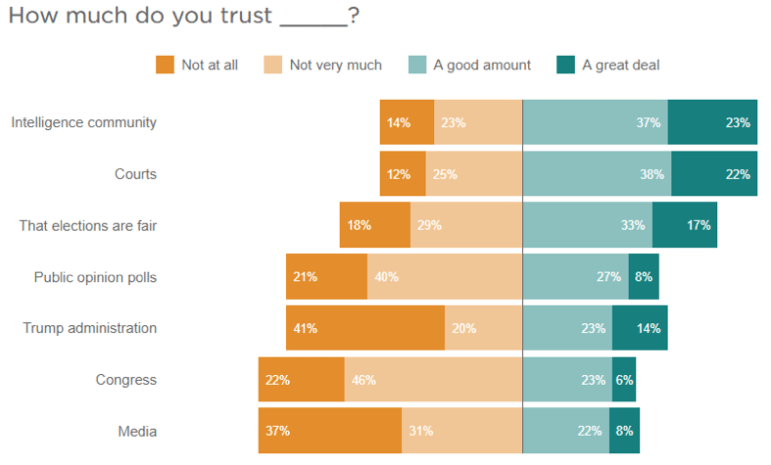
1Source: NPR/PBS NewsHour/Marist poll ; Credit: Alyson Hurt/NPR

It’s interesting to note that while only 37 percent of adults polled reported trusting the Trump administration, an even smaller number (29 percent) reported trusting Congress. Members of Congress need to continue to call out the President’s hateful rhetoric and hold him to a higher standard, if only to distance themselves from his erratic behavior. Perhaps one of the reasons the public rated their trust in the Courts higher, at 60 percent, is that there are more publicly visible challenges to Trump’s policies from the judicial branch than from the legislative branch.

Despite the president’s attacks on the CIA and the FBI for investigating his campaign’s alleged commingling with the Russians, the public demonstrated equally high levels of trust in the intelligence agencies. This may be due to career public servants, who tend to remain in key positions from administration to administration. Indeed, they may be our best hope to protect general government protocols and the rule of law.

Sign up for our free newsletters

Subscribe to NPQ's newsletters to have our top stories delivered directly to your inbox.

By signing up, you agree to our privacy policy and terms of use, and to receive messages from NPQ and our partners.

The president’s repeated verbal attacks on the media and the elections are having a clear effect. This is an area where the poll showed different perceptions along party lines; adults who consider themselves Democrats were more likely to report trust in these institutions than Republicans. This political divide showed up in other areas of civil rights as well: 44 percent of Democrats think that the right to vote has been restricted too much, but 25 percent think it has been expanded too much, something nonprofits may want to note in their advocacy efforts.

But does the poll itself prove anything? Public opinion on even this issue varies significantly by party, says NPR:

There’s similar distrust of public opinion polls, which just more than 6 in 10 Americans say, to some degree, they don’t trust. Half of Democrats, however, say they do, while just 28 percent of Republicans say they trust surveys. Thirty-four percent of independents say they trust public opinion polls, while 63 percent don’t have either much or any trust in them.

Regardless, nonprofits should take note of this snapshot and not take public support for granted. Furthermore, we too must be mindful of how we talk about our partners in government and realize we are stronger together in meeting the public’s demands.—Jeannie Fox


Our Voices Are Our Power.

Journalism, nonprofits, and multiracial democracy are under attack. At NPQ, we fight back by sharing stories and essential insights from nonprofit leaders and workers—and we pay every contributor.

Can you help us protect nonprofit voices?

Your support keeps truth alive when it matters most.
Every single dollar makes a difference.

Donate now
logo logo logo logo logo
About the author
Jeannie Fox

Jeannie Fox is on the faculty of Hamline University and directs the master's of nonprofit management program. She has over 20 years experience in nonprofit organizations and public agencies. She most recently served as chief of staff to former Minnesota Secretary of State, Mark Ritchie. Following a career as a senior manager in nonprofit direct service organizations, Fox lobbied on behalf of the nonprofit sector at all levels of government during a nine-year tenure as the deputy public policy director for the Minnesota Council of Nonprofits. She previously held adjunct faculty positions at the University of Minnesota Twin Cities and Duluth campuses and was a 2012 State Department Legislative Fellow in the Dominican Republic. Fox’s publications include chapters in the textbooks, “Nonprofit Management 101” and “The Lobbying and Advocacy Handbook for Nonprofit Organizations.”

More about: Civil Society and DemocracyNonprofit NewsPolicyTrump Administration
See comments

Call to action
You might also like
Staff Picks for 2025: Isaiah Thompson
Isaiah Thompson
Staff Picks for 2025: Steve Dubb
Steve Dubb
Staff Picks for 2025: Alison Stine
Alison Stine
Gathering for Democracy: Dispatches from Chicago
Venu Gupta
Making Sense of GivingTuesday 2025
Isaiah Thompson
Blocking Authoritarianism: Steps Nonprofits and Foundations Must Take
Saqib Bhatti

Upcoming Webinars

Group Created with Sketch.
January 29th, 2:00 pm ET

Participatory Decision-making

When & How to Apply Inclusive Decision-making Methods

Register
Group Created with Sketch.
February 26th, 2:00 pm ET

Understanding Reduction in Force (RIF) Law

Clear Guidance for Values-centered Nonprofits

Register

    
You might also like
A red circle overlayed on a yellow background with three multi-colored dots on each side. In the center it reads, " Isaiah Thompson: Staff Picks for 2025"
Staff Picks for 2025: Isaiah Thompson
Isaiah Thompson
Staff Picks for 2025: Steve Dubb
Steve Dubb
A red circle overlayed on a yellow background with three multi-colored dots on each side. In the center it reads, "Alison Stine: Staff Picks for 2025"
Staff Picks for 2025: Alison Stine
Alison Stine

Like what you see?

Subscribe to the NPQ newsletter to have our top stories delivered directly to your inbox.

See our newsletters

By signing up, you agree to our privacy policy and terms of use, and to receive messages from NPQ and our partners.

  • About
  • Advertise
  • Careers
  • Contact
  • Copyright
  • Donate
  • Editorial Policy
  • Funders
  • Submissions

We are using cookies to give you the best experience on our website.


Nonprofit Quarterly | Civic News. Empowering Nonprofits. Advancing Justice.
Powered by  GDPR Cookie Compliance
Privacy Overview

This website uses cookies so that we can provide you with the best user experience possible. Cookie information is stored in your browser and performs functions such as recognising you when you return to our website and helping our team to understand which sections of the website you find most interesting and useful.

Strictly Necessary Cookies

Strictly Necessary Cookie should be enabled at all times so that we can save your preferences for cookie settings.