

Digital Colonialism, a series co-produced by NPQ and MediaJustice, explores how the rapid expansion of artificial intelligence (AI) data centers is reshaping communities across the United States.
On the summer solstice, a place known by many names brought us together. Referred to as Chuk Shon, Sentinel Peak, ‘A’ Mountain, or the birthplace of Tucson, this land is one of the only remaining areas where the expansive open desert west of Tucson, AZ, meets the Santa Cruz River. Essential to all life and continuously inhabited by humans for over 4,000 years, this place has been central to many, namely the Tohono O’odham.
That evening felt as if we collectively stepped into a commitment to this land and our community—both of which reached back to carry us all the way through.
At the solstice’s dusk, a couple dozen people stood on this land in a circle. We came, many of us as strangers, to connect to the land and to one another at an informal “Walk and Talk” event organized by the Tucson Birthplace Open Space Coalition, an organization working to protect this corridor of connectivity and biocultural heritage. But there was another reason for gathering aside from the event.
Many of us had caught wind of the looming “Project Blue,” a proposed $3.6 billion hyperscale data center slated for development on 290 acres of land on the southeast edge of Tucson. We voiced our concerns into the dark edge of night, sharing what we knew and what we would each contribute to the fight ahead to stop its development. That evening felt as if we collectively stepped into a commitment to this land and our community—both of which reached back to carry us all the way through.
Mobilizing to Stop Project Blue
A few days prior, the Pima County Board of Supervisors had voted 3–2 to approve rezoning and the land sale for Project Blue. The next step in the approval process was seven weeks later in the form of a vote from the Tucson City Council to officially transfer ownership by annexation into the city. This would allow Project Blue to utilize the city’s water. Our timeline to mobilize was set and this is how the No Desert Data Center Coalition was born.
Identifying the scope and nature of the threats posed by the data center took the sleuthing and knowledge of many in the community, as nondisclosure agreements signed by the city and county as many as three years prior withheld critical information.
[Amazon’s involvement] raised serious concerns due to the clear connection between AWS and…ICE’s growing forces of surveillance, deportation, and incarceration.
Beale Infrastructure, Project Blue’s development company, presented a rosy image of a “sustainable” data center that would be good for Tucson’s environment, local employment, and overall economy. Eventually, we came to understand that Project Blue would require the energy equivalent of the entire city of Tucson to power it at full build. Water use would total nearly 10 million gallons per day for cooling purposes alone, without including the additional amount needed for its lengthy construction phase.
These statistics are staggering for any locale, but the concern was intense in the context of a quickly warming region with ongoing long-term drought conditions since the mid-1990s and an extreme seasonal drought with visible effects on the landscape.
An investigation by Arizona Luminaria, a community-centered local newsroom, revealed that Project Blue’s mysterious end user was Amazon Web Services (AWS). Given Amazon’s anti-union track record, it was highly unlikely that local union labor would be used. The revelation also raised serious concerns due to the clear connection between AWS and US Immigration and Customs Enforcement’s (ICE’s) growing forces of surveillance, deportation, and incarceration. As AWS expands its cloud storage, it creates more digital space, some of which is used by the Department of Homeland Security to store and reference data for tracking and targeting immigrants. In an era when many of our neighbors are increasingly threatened by these operations, the Tucson community was rightfully outraged.
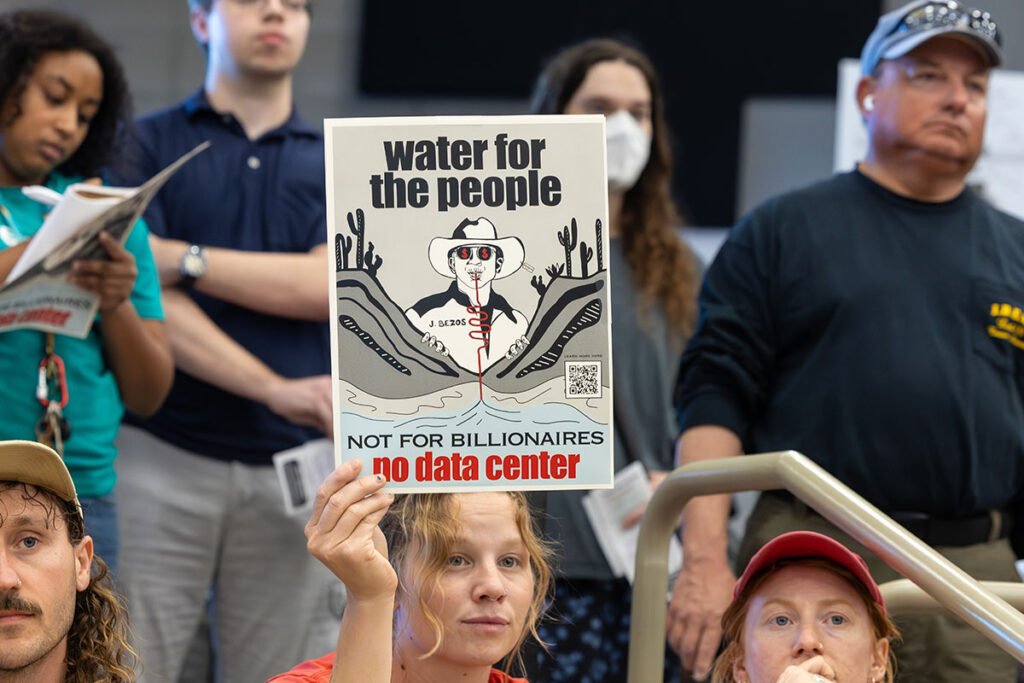
As our No Desert Data Center Coalition gained momentum, we regularly gathered to develop our strategies. We identified clear goals and moved quickly. Most importantly, community care was at the center of our efforts. Meals were shared, sign-making gatherings created connection, and visits to the land in question kept us grounded in our collective love of the Sonoran Desert. In time each member found their place in the whole and we moved together as a united front. All of us, like the diversity of the desert, created something together that had teeth. The line we agreed to hold together was not one drop for data, meaning that we valued water as a life-giving element—and none of it was to be used for extractive industry.
During two informational sessions where Beale and the City promoted the supposed benefits of Project Blue, such as its commitment to renewable energy and the promise of jobs, thousands of Tucson residents showed up mad. Wearing red in solidarity with other communities engaged in similar fights, it was crystal clear how the community felt about Project Blue. We roared and questioned, brought forward our own research and expertise; youth sobbed and begged to simply have a future; and the crowd’s chant burst through without hesitation, “Not one drop! Not one drop!”
Sign up for our free newsletters
Subscribe to NPQ's newsletters to have our top stories delivered directly to your inbox.
By signing up, you agree to our privacy policy and terms of use, and to receive messages from NPQ and our partners.
Already-eroded trust between constituents and elected and unelected officials was further fractured at these sessions. It was revealed that Pima County and the City of Tucson were planning the development of Project Blue for a full two years before the public was informed. And Amazon’s involvement was only discovered through investigative reporting. We had a sense that the decision to move Project Blue forward had already been made and our voices carried no weight. And, disturbing to many, was the exclusion of the Tohono O’odham and Pascua Yaqui Nations as decision-makers in the process. According to Tucson’s Climate Action and Adaptation Plan, the City seeks to “build reciprocity with sovereign tribal nations and Indigenous communities to address local climate change impacts,” among other things. But thus far for Project Blue, that engagement has not happened.
Extractivism at Its Root
Disturbing to many was the purposeful exclusion of the Tohono O’odham and Pascua Yaqui Nations as decision-makers in the process.
Extractivism—the economic model based on extracting natural resources—continues to dominate the colonial West through hypercapitalism. It fuels the drive to override a community’s demands and a struggling ecosystem’s needs in exchange for a temporary and insignificant boost to the local economy.
Although Project Blue might be the latest example of such extractivism in the area, it is far from the first.
Tucson’s history of environmental justice organizing and movements has been a necessity for many harmed by injustice and extraction. From the 1950s to the 1970s, trichloroethylene (TCE) and other pollutants from the Hughes Missile Systems Company (now Raytheon) poisoned the groundwater, impacting a largely Mexican American and Indigenous community who continue to fight for their health today.
The consequences traveled, as the TCE plume also drifted into the San Xavier District of the Tohono O’odham Nation. Similarly, the fate of the Santa Cruz River, having ceased perennial flow by 1913 and most seasonal flows by the 1940s due to overpumping by settlers, has been an ecological travesty and a profound injustice to the original stewards of this land. Many, including the San Xavier District and some local organizations, have worked to restore and bring awareness to this ghost river, nudging parts of it back to life and returning it to the public’s view as the heart of this region.
On August 6, 2025, Tucson’s City Council met for a study session. Council members Kevin Dahl and Karin Uhlich introduced a motion to strike down Project Blue. A unanimous vote followed, and the project stopped then and there. The crowd, filled with red shirts, cheered and cried, then booed as representatives from Beale Infrastructure left the chambers, heads held low. That day confirmed that despite what we might be told, such projects are not inevitable.
Unfortunately, Beale has since re-engaged Project Blue, which moved through the auspices of Pima County. Three of five county supervisors who wielded the power to bring the project to a halt have remained committed to it, as it also got approval through the Arizona Corporation Commission. The No Desert Data Center Coalition continues the fight and has officially filed a lawsuit against Pima County on January 14, 2026 for violating the Arizona open meeting law.
The story of Project Blue and this region at large, where multiple massive data center proposals are still on the table, is unfinished. Even with the echo of our initial win, this struggle is far from over.
Often, our coalition hears the question, “How did you do it?” The answer is complex, only some aspects known to us. We fought, and will continue to fight, with all that we have. We embraced everything from amplifying community members’ knowledge, going door-to-door with flyers in 110-degree weather, elevating local artists’ work, and hosting town halls, all while embracing an organizing structure that works across social divides.
Foundational to it all, though, is the depth of relationships that we have—to one another, to our broader community, and to the extraordinary desert in which we live. This sense of place and commitment is what moves us. We know that the opposite of extractivism is an orientation toward reciprocal relationships of care with an eye toward the future. For us, that future is bright and alive, where water is free to flow.