State of the Movements is a recurring NPQ column dedicated to tracking the pulse of social movements and the solidarity economy in 2025.
In the shadow of federal layoffs, President Donald Trump’s administration has inadvertently revealed that budgets are not neutral. Rather, public budgets are moral documents that expose our polity’s deepest priorities and health—or its failures.
To date, working mostly at the city level, people’s budget coalitions have advocated for budgets that truly meet people’s needs. In so doing, they have demonstrated that austerity is not the only option available to elected officials; it is a political choice.
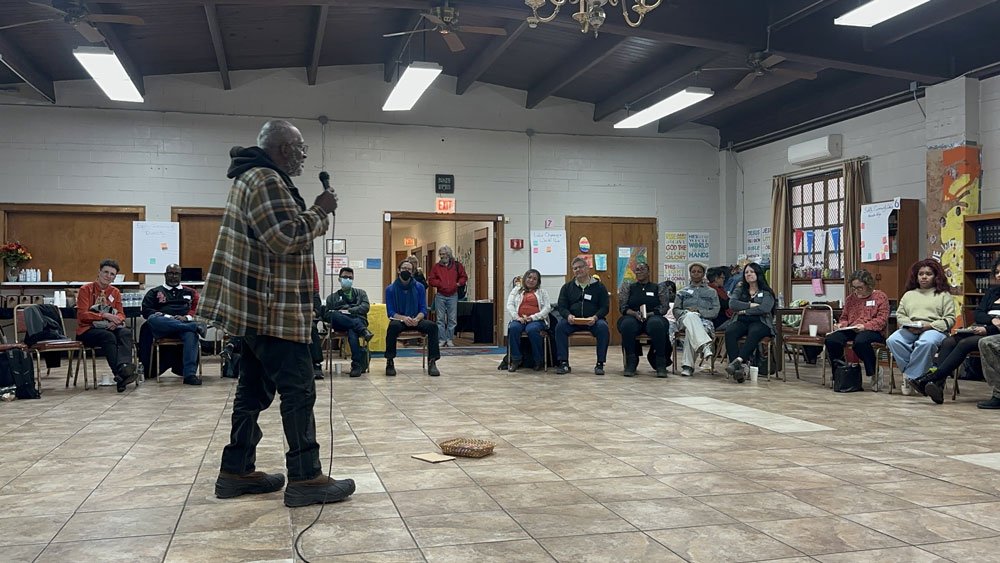
Between September 26 and 29, about two dozen people’s budget organizers from around the nation joined over 100 activists at the Participatory Budgeting Project’s conference “Our Time, Our Power: A Participatory Democracy Learning Exchange” in Orange, NJ, followed by continued conversations of shared lessons and next steps at the CUNY Graduate Center in New York City. I participated as a scholar focusing on local governance and as a volunteer researcher/collaborator with People’s Plan NYC; here, I highlight some key themes from these gatherings.
What Is a People’s Budget Anyway?
People’s budget campaigns are essential to help counter divide-and-conquer neoliberal logics and “flood the zone” tactics by the Right.
The movement for people’s budgets has been building for a few years now. Between 2020 and 2022, active campaigns using the term “people’s budget” emerged, without central coordination, in cities around the country—and not just in large, coastal ones like Seattle, Los Angeles, New York, and Philadelphia. Grassroots groups and coalitions also fought for people’s budgets in Birmingham, AL; Norman, OK; Washtenaw County, MI; Sacramento, CA; Nashville, TN; Raleigh, NC; and Cleveland, OH.
The exact names of their campaigns vary a bit; some call themselves solidarity budgets, for instance. While some had already been homing in on city budgets as focal points for years or decades, most of them took off in a short span of time, during or after the pandemic and the 2020 uprisings associated with Black Lives Matter.
Why People’s Budget Campaigns Matter
People’s budget campaigns are essential to help counter divide-and-conquer neoliberal logics and “flood the zone” tactics by the Right. They not only counter intransigence but also keep multi-issue and multi-constituency coalitions intact. They do so by engaging otherwise siloed groups (like those focused solely on affordable housing versus those focused on libraries) to not compete against each other for crumbs of the proverbial budget pie, but to work together for a bigger or different one altogether.
These efforts yield results. In Los Angeles County, the Reimagine L.A. County coalition helped to place Measure J—the “J” is for justice—on the ballot; the measure passed in November 2020. Measure J amended the county charter to permanently allocate and direct at least 10 percent of existing locally controlled revenues to community investments and alternatives to incarceration. Since its approval by voters, Measure J has had a wild ride: It was contested in the courts and then ruled constitutional by an appellate court. Reimagine L.A. County continues to organize the public to make sure that the measure is fully funded and implemented; so far, the measure has helped to direct $900 million to community services.
Even more substantively, as coalition coordinator Megan Castillo shared at the conference, Reimagine L.A. County has brought a care-first, guaranteed-investments narrative—and a rallying cry—to the county budget. This recently helped to pressure the county to reject, for the time being, a $3.5 billion jail expansion.
At the core of people’s budget work lies the goal of economic democracy—that is, government should be accountable to everyday residents.
In New York, The People’s Plan NYC (a coalition of over 50 local organizations) won major fund restorations from Mayor Eric Adams: tens of millions of dollars for public education and over $200 million for early childhood education. It also secured tens of millions of dollars in new funding for people’s budget priorities, programs like immigrant legal services and expanded peer-led crisis care and safety programs. Unifying public pressure on Mayor Adams—through rallies, testimonies, postcards, petitions, and some heckling—was decisive to these wins.
In Nashville, the Nashville People’s Budget Coalition helped secure wins like seed funding for a new “permanently affordable, decommodified social housing fund.” Efforts by the Black Nashville Assembly and Youth Assembly of the Southern Movement Committee were pivotal in securing the city’s first anti-carceral, “evidence-based, people-informed” Office of Youth Safety.
In 2022, the Seattle Solidarity Budget coalition continued to advocate for a 50 percent reduction in the police department’s budget, especially by eliminating 80 “ghost cop” positions, which the Seattle Police Department stated would remain unfilled for years. Since then, the coalition has secured various allocations for social services, such as $20 million for mental health services for public school students. And it continues to push for accountability in how revenues, like those from the 2020 JumpStart corporate payroll tax, are used.
A Movement for Economic Democracy
At the core of people’s budget work lies the goal of economic democracy—that is, government should be accountable to everyday residents rather than to real estate developers and corporate lobbies.
As such, people’s budget coalitions work not just to fight against budget cuts but to democratize the budget process.
Often, even elected officials like city councilmembers remain in the dark about what city budgets contain. In “strong mayor” cities like New York, for instance, mayors can currently unilaterally withhold funds even after the city council has approved the budget, undermining community priorities. When Trump pulled funding from public broadcasting, this measure was at least subject to a congressional vote. But mayors often need no equivalent council vote to withhold funds appropriated by city councils.
The People’s Plan NYC has advocated for changes in the city charter to limit mayoral impoundment powers to financial emergencies and only with a sign-off from at least one other entity (like the city council or the Independent Budget Office). Likewise, the Better Budget Alliance in Boston fought for and successfully won a charter amendment in 2021 that expanded the city council’s authority over the budget.
But people’s budgets also seek to deepen democracy beyond elected officials; a central goal is to demystify the city’s budget.
Campaigns produce accessible and even engaging materials on what the annual budget process looks like and what a given year’s city budget contains. This information contrasts with cities’ published budgets, which are often distributed as 500-page PDFs—just one anti-democratic move that makes even basic analysis difficult. As People’s Budget Birmingham’s Campaign Director Gabriel Cabán Cubero told NPQ, the acronym should stand for “pretty damn fucked.”
Sign up for our free newsletters
Subscribe to NPQ's newsletters to have our top stories delivered directly to your inbox.
By signing up, you agree to our privacy policy and terms of use, and to receive messages from NPQ and our partners.
People’s budget organizers emphasize that transparency is a start but not enough. They do not intend to stop at engaging constituents in budget literacy, but to help them engage to modify the city’s budget and organize for collective power. The People’s Budget Office in Philadelphia, for example, has not only distributed materials filled with helpful infographics and conducted Budget 101 and policy-specific 201 workshops; it also installed a shipping container in the center of the city, retrofitted to provide a welcoming space where residents can learn about and engage in public budgeting activities.
People’s Budget Birmingham staff often accompany constituents to budget hearings and city council meetings to provide support for residents’ appeals. They have also provided transportation for people living in homeless encampments to testify at budget hearings.
The budget testimony process can be frustrating. Often, constituents arrive with well-prepared testimonies only to find that elected officials are not listening. “We rely on the budget hearings being nothing but theater,” said Cabán Cubero. “We help [constituents] to connect with direct services, if that’s what they need, and then help them to organize for a better city.”
Building Solidarity and Governing Power
With official hearings being pure “theater,” people’s budget groups make sure everyday residents have meaningful ways to raise their voices and be truly heard. They thus develop policy platforms not just with policy experts but with base-building movement groups and constituents.
Many of these campaigns also engage in participatory democratic experiments like participatory budgeting, a process that carves out a portion of the budget for residents to work with city staff to develop specific community-based proposals that meet the needs of their neighborhoods. This process allows participants to ask each other questions and get answers, uplift local and experiential knowledge alongside technical knowledge, and critically, connect people—not as friends nor as members of voting blocs, but as neighbors. As Castillo of Reimagine L.A. County told LAist, these practices “build the muscle for co-governance.”
In Boston, the Better Budget Alliance has centered participatory democracy since its beginning, winning mandated provisions for participatory budgeting in the 2021 city’s charter revisions. The alliance is currently conducting a large-scale “people’s budget survey.” This fall, it will convene its first people’s assembly to discuss survey results and decide on priorities for the coming years’ city operating budget.
In Nashville, the city’s People’s Budget Coalition hosts events like “radical proposal writing parties” to help residents develop ambitious proposals despite “inadequate funding, inaccessibility, & burdensome control by the mayor’s office.”
Heeding Founding Principles of Mutuality, Care, and Abolition
Deep participatory democratic work becomes indispensable when communities have to grapple with fraught issues—like what it means to pursue real community safety.
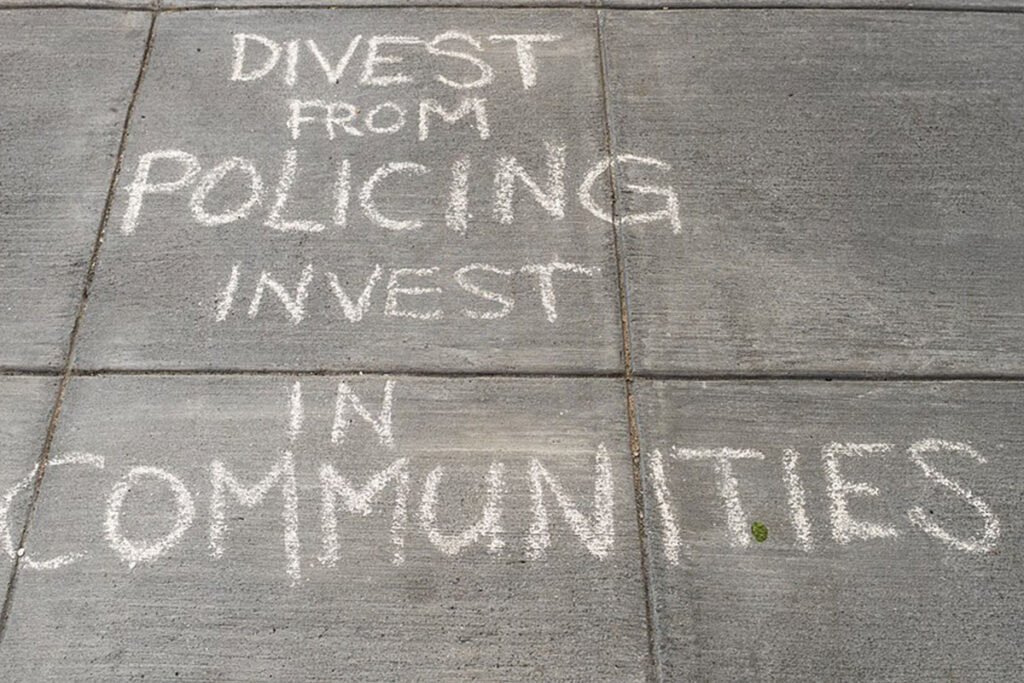
Given the country’s rising authoritarianism, people’s budget campaigns do not lead with slogans to defund police. Still, they continue to heed the movement’s founding principles born out of the 2020 nationwide protests.
Participatory democratic deliberations allow community members with disparate points of view to be exposed to each other’s vocabulary and arguments, and sometimes, to change each other’s minds. In each city engaged in people’s budget campaigns, some residents express transphobia or homophobia, others express the desire for more police, even as their neighbors routinely experience police harassment or worse.
In response, Erica Perry, executive director of the Southern Movement Committee, told NPQ that “setting the floor” of the coalition’s politics is essential, and it requires trust-building and care.
The organization uses a combination of people’s assemblies, town hall meetings, community dinners, community service, and cultural projects like podcasts to enable participants to build a common language and policy proposals.
For example, if residents are unaware that “crisis intervention teams” exist to respond to mental health crises and domestic violence, there is no way to advocate for such teams’ use. “More police” might be the residents’ default call. Once they are made aware of such policy alternatives and are able to consider them together, those same residents might agree that funding a crisis intervention team makes more sense. As Perry explained, these sorts of assemblies help communities to envision and make tractable alternatives to incarceration, like their hard-won Office of Youth Safety.
Devin Anderson, campaign and membership director at the African American Roundtable in Milwaukee, emphasized to NPQ that it was vital to decouple policing from safety. He recounted one recent conversation he had with an elderly neighbor who noted that she wanted more cops because of incidents like her front window being vandalized. Anderson asked about what happened to her window and what happened when she called the cops. They arrived late, and they didn’t fix the window—neighbors did, she said.
For people’s budget advocates, participatory democracy is not a luxury or a cute side exercise. It is a bread-and-butter issue.
Anderson shared how this conversation helped persuade this neighbor of the value of a care-first approach, which would probably get her window fixed more quickly and prevent it from ever being broken in the first place. In the meantime, “more police means that we’re not funding other things.” This sort of deep democratic work also helps community members resist xenophobic demagoguery.
Readying for the Work Ahead
With looming cuts to Medicaid and other essential public services, people’s budget campaigns are readying for more fights—emphasizing budgets as key sites of contestation for collective care and community control, pushing for guaranteed investments in care to alleviate suffering in our cities, and providing more entry points for democratic accountability.
For people’s budget advocates, participatory democracy is not a luxury or a cute-side exercise. It is a bread-and-butter issue affecting residents’ material conditions every day.
Together, these campaigns help plant seeds for economic democracy at the local level, connecting constituents across neighborhoods and policy domains, while building democratic muscle for the struggle ahead.