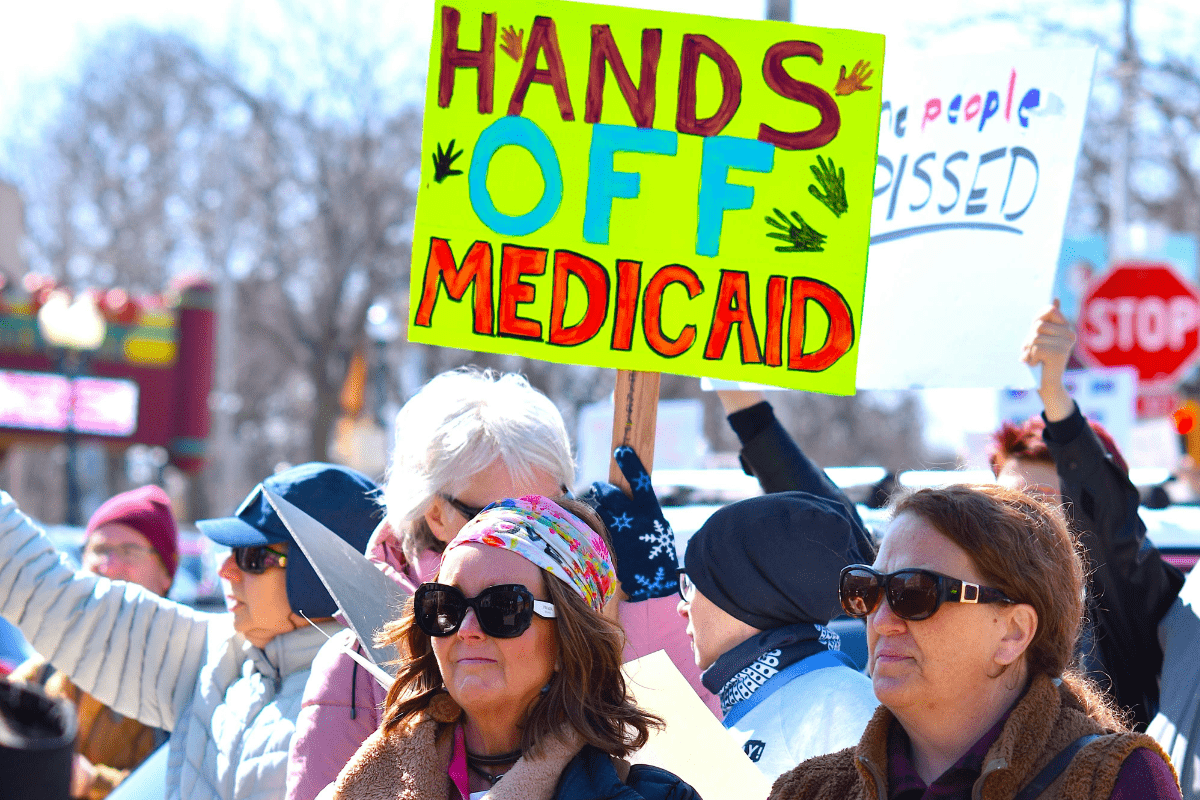
Sixty years ago, President Lyndon B. Johnson signed Medicaid and Medicare into law. Since then, Medicaid has enabled millions—particularly low-income people and rural residents—to be able to access critical healthcare. But the recent passage of the so-called Big, Beautiful Bill could greatly roll back this progress, potentially leading to millions being kicked off their healthcare, thousands of premature deaths, and hundreds of rural hospitals closing.
Enacted on July 30, 1965, Medicaid was actually decades in the making. In the 1930s, many of President Franklin D. Roosevelt’s advisors wanted to include a national health insurance system as part of the Social Security program. That did not take place, and in 1950, efforts to create a universal health insurance system were defeated.
By the 1960s, in large part because of the work of the civil rights movement, America was moving closer to what Johnson called the “Great Society.” This decade would usher in monumental legislations like the Civil Rights Act of 1964, Voting Rights Act of 1965, and Social Security Amendments of 1965, which created Medicare and Medicaid. Before this time, healthcare was largely reserved for people with private insurance, disproportionately White men and their families.
“Of all the forms of inequality, injustice in health is the most shocking and inhumane.”
It’s hard to disentangle these legislations from each other. Those who have historically been deprived of access to quality healthcare are those who have also been deprived of their civil rights and voting rights. As Martin Luther King, Jr. said in a 1966 speech at the annual meeting for the Medical Committee for Human Rights “Of all the forms of inequality, injustice in health is the most shocking and inhumane.”
Still, in the decades since its passage, Medicaid has faced challenges, particularly from conservatives who stigmatize it as “unearned welfare.” One of the leading champions of Medicaid cuts was President Ronald Reagan, who in the 1980s cut Medicaid by 18 percent, resulting in 600,000 people who depended on Medicaid losing their coverage. Medicaid is the largest source of public health insurance, comprising 18 percent of healthcare expenditures and over half of all spending on long-term care. The program covers nearly four in 10 children, including 80 percent of children who live in poverty.
The Impact of Medicaid Cuts
President Trump, like Reagan, has championed efforts to roll back the program as well. When he signed the GOP tax bill into law on Independence Day he paved the way for the rollback of much of the progress that has been made since Medicaid was enacted and later expanded through policies like the Affordable Care Act.
Sign up for our free newsletters
Subscribe to NPQ's newsletters to have our top stories delivered directly to your inbox.
By signing up, you agree to our privacy policy and terms of use, and to receive messages from NPQ and our partners.
People with disabilities, poor people, people of color, and those living in the South, particularly in rural communities, will be disparately impacted.
Currently, Medicaid provides care for more than 72 million people, including low-income people, their children, and people with disabilities. But as NPQ has previously reported, millions of people are expected to lose their Medicaid coverage in the coming years as the provisions of the bill go into effect. Though the impact will be broad, it will not be evenly felt. People with disabilities, poor people, people of color, and those living in the South, particularly in rural communities, will be disparately impacted.
According to the nonprofit Kaiser Family Foundation (KFF), which studies healthcare issues, more than 20 percent of Americans live in rural areas, where one in four adults rely on Medicaid coverage. One of the biggest impacts of the GOP tax bill is that it could potentially lead to the closure of 300 rural hospitals, according to an analysis by Cecil G. Sheps Center at the University of North Carolina at Chapel Hill. Although the GOP tax bill included a provision that would allocate $10 billion annually to rural hospitals—58 percent of which are nonprofits—over the next five years, advocates say that this is not enough to keep them afloat. In fact, a KFF report estimates that 36 states will lose $1 billion or more over 10 years in Medicaid for rural areas, even with the $50 billion rural fund.
Even before the passage of the GOP tax bill, rural hospitals were already struggling financially. Data from the American Hospital Association show that in 2023 hospitals received nearly $28 billion less from Medicaid than the actual cost of treating Medicaid patients. Between 2017 and 2023, hospital closures outpaced openings in rural areas, with 61 hospitals closing compared to only 11 opening, according to KFF. Between 2004 and 2005, nearly 200 rural hospitals across the country closed. This is particularly worrisome because people in rural communities often have significantly fewer options to receive care.
One of the biggest impacts of the GOP tax bill is that it could potentially lead to the closure of 300 rural hospitals.
Unsurprisingly, research has found that rural hospital closures cause mortality rates to rise, by nearly 6 percent, according to one estimate. Recently, researchers at the University of Pennsylvania’s Leonard Davis Institute of Health Economics estimated that the enactment of the GOP tax bill could increase the nation’s uninsured population and lead to more than 51,000 additional deaths each year.
As America commemorates the 60th anniversary of Medicaid, there is no better time to reflect on Dr. King’s words about the shocking and inhumane injustice in healthcare. It is critical to remember the lives that have been saved because of the policy and the lives that will be lost without it.