
I first realized how deep my family’s love of reading went when I peeked into the grocery sacks my father would bring my grandfather. For years, every time we visited, my father brought these brown paper bags to my grandfather’s small house in rural Indiana. He set them down by my grandfather’s recliner, and later, his oxygen tank. They were packed full and heavy, the tops folded over. The day I finally unfolded one and glanced in, I saw books—specifically, stacks and stacks of mass-market paperbacks.
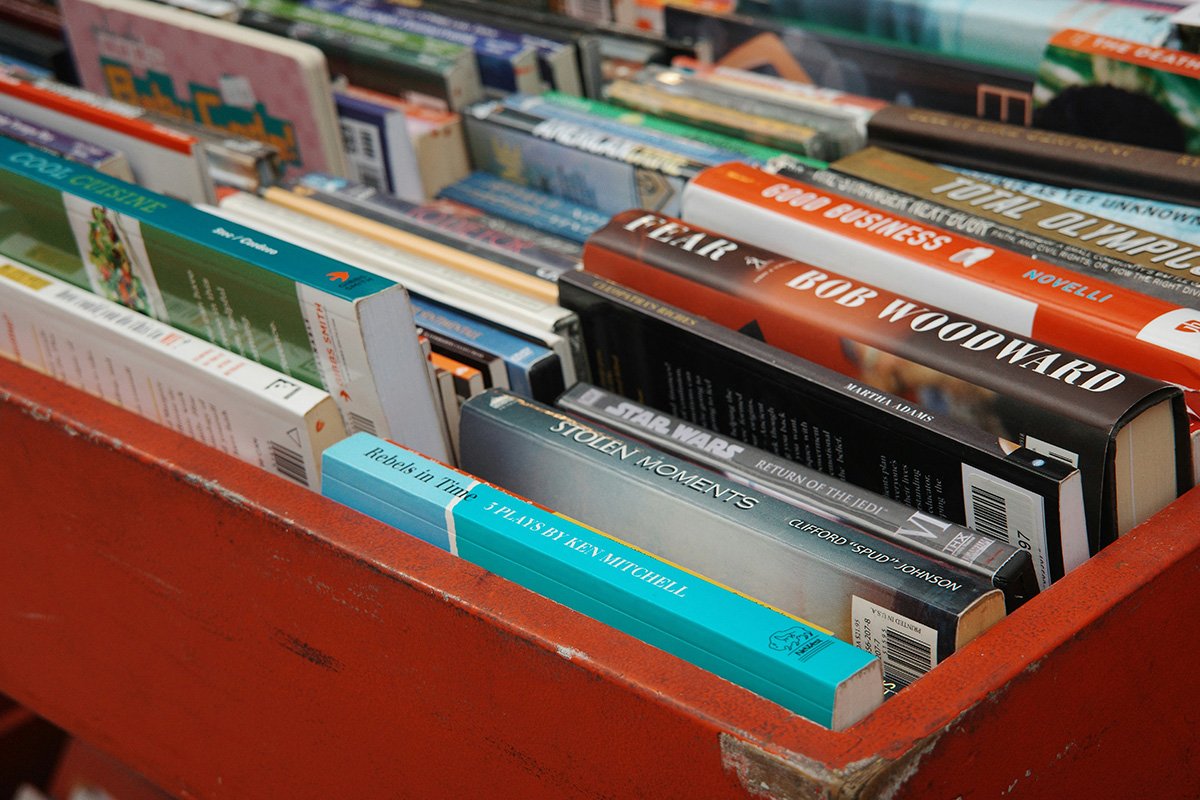
Small books with thin, gray paper that almost felt like newsprint, often tiny fonts, and a markedly low retail price, mass-market paperbacks have been in circulation for nearly one hundred years.
But that reign is soon ending.
Mass market paperbacks are being discontinued, as ReaderLink and other distributors and publishers of the format stop production, citing plummeting sales. That is both a loss for readers and writers, and an issue of economic justice.
“One of the Most Brilliant Technologies”
As American Pulp writer Paula Rabinowitz told The New York Times, mass-market paperbacks were dreamed up by an English book editor, frustrated by the lack of reading material at his local railway station. Initially, the slim paperbacks he published were sold at tobacco shops for the same price as a pack of cigarettes—and they were about the same size as one, too. Rabinowitz described the mass-market paperback as “one of the most brilliant technologies in the history of the world, precisely because you could shove it in your purse or your pocket.”
That made the mass-market paperback perfect for transit. The format was sold at train and bus stations, convenience stores, and supermarkets. Gas stations and truck stops would have rotating racks of the thin, cheap books. During World War II, they were part of the official government rations distributed to soldiers to help them pass the time.
I have found mass-market paperbacks in gas station bathrooms, and left on the seats of subway cars and trains, as travelers may have decided they were inexpensive enough to just leave for the next reader. The books could be purchased (or discovered) in places you might not normally have books, including in areas of the country not large or prosperous enough for a bookstore.
Bookstore and Library Deserts
As The Guardian wrote, in 1931, eight years before mass-market paperback publisher Pocket Books was founded, “two-thirds of U.S. counties had no bookstore at all.” The inexpensive book format was a boon to rural places and remote towns.
For many years, my own Ohio town only had one small chain bookstore in the mall. The narrow aisles were stocked overwhelmingly with mass-market paperbacks, easier for my community to afford.
Notably, mass-market paperbacks were not often purchased by libraries, because the glued (rather than sewn-in) binding was too delicate for wide circulation. Some of the paperbacks I found in used bookstores often had missing covers or a few loose pages hastily stuck back in, for this reason.
These books and their presence in unexpected spots also filled a reading gap in places without public libraries, a particular concern in poor, remote, and rural areas of the country. Debbie Weingarten argued in 2017 in Talk Poverty that rural Americans continue to have less access to books in general, writing: “The non-white and the working poor were systemically left out of the public library structure, and due to the location of most libraries, rural residents also had limited access.”
Thanks to funding cuts from the Trump administration as well as ongoing threats to free speech, the arts, and the safety of civil servants like librarians, libraries continue to be in jeopardy in many places around the country, not only in remote and rural ones. Just last month, Dallas, TX, announced it was considering closing four library branches to make up for a budget shortfall, after closing one branch already in 2025.
Reading in Crisis
These library closures are happening against the backdrop of a reading crisis. Literacy rates in the United States are declining at an alarming rate. According to the National Literacy Institute, “Fifty-four percent of US adults read below the equivalent of a sixth-grade level, and 64 percent of our country’s fourth graders do not read proficiently.” And as Literary Hub reported in 2026, “Four in ten Americans didn’t read a single book during our last spin around the sun.”
Sign up for our free newsletters
Subscribe to NPQ's newsletters to have our top stories delivered directly to your inbox.
By signing up, you agree to our privacy policy and terms of use, and to receive messages from NPQ and our partners.
America’s reading crisis is also a thinking crisis. Increasing use of AI is contributing to a decline in human cognition, as MIT first reported in a 2025 study. Reading is thinking, and requesting error-ridden, hallucinated AI summaries of text or books rather than actually reading them not only perpetuates mistakes, but it also weakens intellect, problem-solving abilities, and the many neural benefits that come from reading, including stress reduction.
Dan Levy, senior lecturer in Public Policy at the Harvard Kennedy School, told the Harvard Gazette, “No learning occurs unless the brain is actively engaged in making meaning and sense of what you’re trying to learn, and this is not going to occur if you just ask ChatGPT.”
At such a dire time, it is an issue of justice that the most inexpensive and accessible book format is being discontinued.
Opening the Marketplace
Because the format was so cheap to produce, publishers could take a chance on newer authors or niche or experimental work. Genre writers found a home in the mass-market paperback, including Black writers like Octavia E. Butler. Romance was a popular genre of the format, including books by queer writers.
A mass-market paperback could also be produced quickly, making it a useful tool for public communication. For example, the Warren Commission’s report on President John F. Kennedy’s assassination came out in paperback almost instantly in 1964, getting it to readers as soon as possible after the report was completed.
The books my grandfather would read by the grocery bagful were genre books: westerns. He liked Louis L’Amour the best, a prolific author who saw his career soar thanks to the mass market paperback format.
My family on my mother’s side were readers also—and they too started exchanging books by the grocery bag. Their books were almost entirely mass market paperbacks, especially romance and mysteries. My grandmother and aunts had so many that my grandfather built a walk-in closet in their tiny home specifically for paperbacks. He left the walls uninsulated so my grandmother could pack every single inch, from the floor to the ceiling, with books.
My parents were the first members of their respective families to attend college. My grandfather, who loved westerns, dropped out of school in eighth grade to start working for the railroad in order to support his extended family. And in my mother’s family, six children had to share two bedrooms, but the house had a walk-in closet designated specifically and only for books.
Perhaps it is not as profitable for publishers to continue manufacturing mass-market paperbacks. Perhaps it is not as popular as e-books, but the format was more accessible, and its loss is a loss to culture on multiple levels, including to future readers and writers.
Why did I become a writer? Perhaps because I spent so much of my childhood in homes full of books: the books my family could find and afford, the ones they read voraciously, the mass-market paperbacks.
For More on This Topic:
Madeleine L’Engle’s Books Were Never Meant to Be “Safe”
A Growing Literary Genre with Deep Nonprofit Ties: Prison Literature