logo logo
giving banner
Donate
    • Membership
    • Donate
  • Social Justice
    • Racial Justice
    • Climate Justice
    • Disability Justice
    • Economic Justice
    • Food Justice
    • Health Justice
    • Immigration
    • LGBTQ+
  • Civic News
  • Nonprofit Leadership
    • Board Governance
    • Equity-Centered Management
    • Finances
    • Fundraising
    • Human Resources
    • Organizational Culture
    • Philanthropy
    • Power Dynamics
    • Strategic Planning
    • Technology
  • Columns
    • Ask Rhea!
    • Ask a Nonprofit Expert
    • Economy Remix
    • Gathering in Support of Democracy
    • Humans of Nonprofits
    • The Impact Algorithm
    • Living the Question
    • Nonprofit Hiring Trends & Tactics
    • Notes from the Frontlines
    • Parables of Earth
    • Re-imagining Philanthropy
    • State of the Movements
    • We Stood Up
    • The Unexpected Value of Volunteers
  • CONTENT TYPES
  • Leading Edge Membership
  • Newsletters
  • Webinars

The Militarization of Politics and the Battle for the “We”

Cyndi Suarez
November 30, 2018
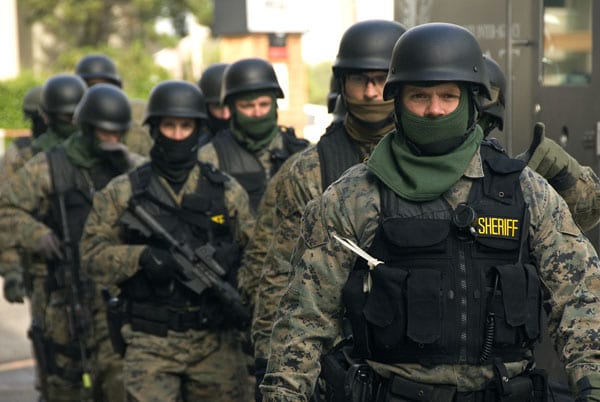
Oregon Department of Transportation [CC BY 2.0], via Wikimedia Commons

November 25, 2018; Intercept, and November 29, 2018; CityLab

Anxiety is on the rise in the US. According to Medical News Today, “anxiety disorders are the most common mental illness in the US,” affecting almost one in five people. One contributing factor may be the increased militarization of civil society, counterinsurgency tactics tested in foreign wars come back home, to be deployed at the southern (not the northern) border and in urban areas.

The Intercept’s Jeremy Scahill writes, “We are in the middle of an unprecedented paramilitarization of state and local law enforcement agencies in this country.” Referencing Bernard E. Harcourt’s book The Counterrevolution: How Our Government Went to War Against Its Own Citizens, Scahill places the US’s post-9/11 “domestic reality…within the deeper history of modern warfare and counterinsurgency doctrine.” According to Harcourt, this is the current government strategy. Scahill calls it “a counterinsurgency warfare model of politics.”

Key to this is a Defense Department program for the transference of military equipment—and, one could assume, tactics—from foreign war zones to US government agencies.

CityLab’s Tanvi Misra reports that a recent paper by sociologists Jennifer G. Correa and James M. Thomas argue that the border militarization that killed Esequiel Hernández Jr. in 1997 “evolved hand-in-hand with the rise of military-style policing in segregated US cities” that killed Michael Brown in Ferguson in 2014.

Misra continues, “Citing the scholarship of anthropologist Gilberto Rosas, the authors write that America’s urban areas are essentially a kind of ‘borderlands,’ where heavily-armed police patrol intentionally established color lines—and ‘recast black and brown bodies, immigrant and nonimmigrants alike, as exceptions and aberrations.’”

Sign up for our free newsletters

Subscribe to NPQ's newsletters to have our top stories delivered directly to your inbox.

By signing up, you agree to our privacy policy and terms of use, and to receive messages from NPQ and our partners.

The criminalization of immigration and anything associated with being black reflects the sense that, as Misra writes, “‘the border’ [has] become a vast and pliable thing.”

She concludes, “Both communities face constant surveillance and threats to the civil rights of certain residents.”

At a recent protest organized by Southern Border Communities Coalition, Joe Castillo notes, “[These are] weapons of defense against a false enemy.”

Trump inherited this system and is amplifying it. Misra says, “Whether he’s calling for troops on the border or the South Side of Chicago, the message is the same: These spaces, and the predominantly black and brown people who live in or near them, are inherently problematic, and need to be forced into submission.”

As white supremacy evolves into white nationalism and the “we” retrogrades into whiteness, how is our sector responding? Are we articulating an alternative “we” and pushing it through our practices?—Cyndi Suarez

Correction: This newswire has been altered from its initial form to correct the year in which Esequiel Hernández Jr. was shot.

Our Voices Are Our Power.

Journalism, nonprofits, and multiracial democracy are under attack. At NPQ, we fight back by sharing stories and essential insights from nonprofit leaders and workers—and we pay every contributor.

Can you help us protect nonprofit voices?

Your support keeps truth alive when it matters most.
Every single dollar makes a difference.

Donate now
logo logo logo logo logo
About the author
Cyndi Suarez

Cyndi Suarez is the former president and editor-in-chief of NPQ (Nonprofit Quarterly). She is author of "The Power Manual: How to Master Complex Power Dynamics", in which she outlines a new theory and practice of liberatory power. Suarez has worked as a strategy and innovation consultant with a focus on networks and platforms for social movements. She has 20 years of experience in the nonprofit sector—in community-based, advocacy, organizing, consulting, infrastructure, and philanthropic organizations. She is passionate about elegant design and designing for power. Her studies were in feminist theory and organizational development for social change.

More about: Nonprofit NewsPolicy
See comments

Call to action
You might also like
Social Enterprise: Lessons from Down Under
Vicki Pozzebon
If Farm School NYC Closes, What Will the City Lose?
Farm School NYC and Iris M. Crawford
The New COVID Vaccine Rules Leave Parents with More Questions Than Answers
Barbara Rodriquez
The Protective Visas That May Never Come
Mel Leonor Barclay
Moving Beyond a Buzzword: Making “Resilience” Real
Laurie Mazur
Voter Registration Faces Threats Nonprofits Can’t Ignore
Lauren Girardin

Upcoming Webinars

Group Created with Sketch.
January 29th, 2:00 pm ET

Participatory Decision-making

When & How to Apply Inclusive Decision-making Methods

Register
Group Created with Sketch.
February 26th, 2:00 pm ET

Understanding Reduction in Force (RIF) Law

Clear Guidance for Values-centered Nonprofits

Register

    
You might also like
A red circle overlayed on a yellow background with three multi-colored dots on each side. In the center it reads, " Isaiah Thompson: Staff Picks for 2025"
Staff Picks for 2025: Isaiah Thompson
Isaiah Thompson
Staff Picks for 2025: Steve Dubb
Steve Dubb
A red circle overlayed on a yellow background with three multi-colored dots on each side. In the center it reads, "Alison Stine: Staff Picks for 2025"
Staff Picks for 2025: Alison Stine
Alison Stine

Like what you see?

Subscribe to the NPQ newsletter to have our top stories delivered directly to your inbox.

See our newsletters

By signing up, you agree to our privacy policy and terms of use, and to receive messages from NPQ and our partners.

  • About
  • Advertise
  • Careers
  • Contact
  • Copyright
  • Donate
  • Editorial Policy
  • Funders
  • Submissions

We are using cookies to give you the best experience on our website.


Nonprofit Quarterly | Civic News. Empowering Nonprofits. Advancing Justice.
Powered by  GDPR Cookie Compliance
Privacy Overview

This website uses cookies so that we can provide you with the best user experience possible. Cookie information is stored in your browser and performs functions such as recognising you when you return to our website and helping our team to understand which sections of the website you find most interesting and useful.

Strictly Necessary Cookies

Strictly Necessary Cookie should be enabled at all times so that we can save your preferences for cookie settings.