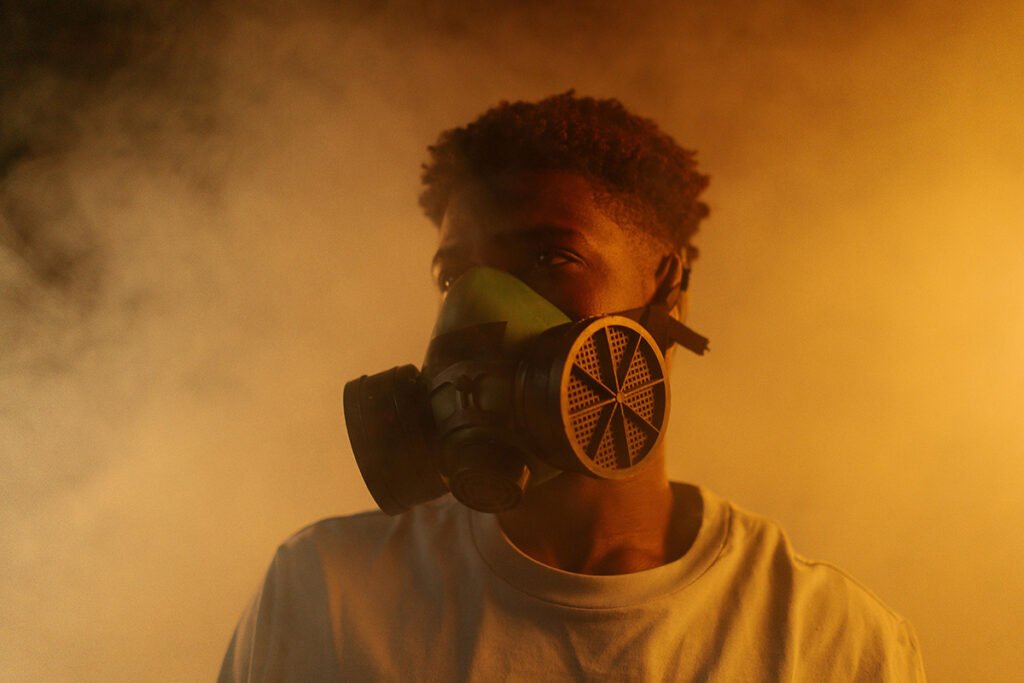
When Liz Scott wakes up in her home in Towson, MD, one of the first things she does is check her air quality app. An orange or red ranking for the day’s pollution levels is enough to drive her exercise session indoors.
“I have noticed myself [that] just being outside when the air quality is poor, it takes a little bit more to get my run in,” she said in an interview with NPQ. As the senior director of nationwide advocacy for clean air at the American Lung Association (ALA), Scott is all too aware of the effects of particulate matter (PM) 2.5 and ozone on the body, including lung disease, heart disease, cancers, and asthma.
Over the years, most states, including Scott’s state of Maryland, have seen a decline in the number of days with PM2.5 levels above those recommended by the World Health Organization. That’s in part attributable to legislation like the 1963 Clean Air Act, amended in 1970 and 1990, that puts limits on allowable emissions of big polluters such as coal-burning plants, steel mills, and oil refineries.
It’s estimated that around 230,000 early deaths a year have been saved as a result of the act, and that the average person in the United States has gained an additional 1.5 years to live. That increases to five years in parts of West Virginia and Ohio where there has historically been heavy industrialization, mining, and the dumping of toxic waste into waterways, like the Cuyahoga River.
It can be hard to put a monetary value on the lives saved and the costs avoided for hospitalizations and medicine, but the US Environmental Protection Agency (EPA) has endeavored to do so since the 1970s. Bryan Hubbell, a former EPA employee who worked on calculating the human health benefits of air pollution regulations, explained that those estimates are then factored into a cost-benefit analysis with costs to businesses of complying with the act’s regulations. Those figures can then be used to justify existing and proposed regulations that help protect people from exposures.
Now, The New York Times has reported, the EPA, under the Trump administration, will no longer produce the calculations for human lives saved. Experts indicate that this directly contradicts the EPA’s mandate of protecting human and environmental health.
Without these calculations, guidelines could weaken, risking the public’s exposure to toxic air, with deadly consequences.
Nearly everyone in the United States has benefited from the country’s air quality guidelines over the years.
Only Concerned with Industry
“Eliminating the consideration of human lives won’t just prevent further progress, it will roll back gains made and return us to times when smokestacks billowed dark clouds of pollution, roadways were full of sooty exhaust, and cities were places associated with difficulty breathing,” Sumi Mehta, vice president of climate and environmental health at Vital Strategies, said in an email to NPQ.
“If we fail to factor in the health and societal costs, all incremental costs of keeping pollution to a minimum will be seen as burdensome, there will be no rationale for not polluting, and we will reverse decades of environmental and public health progress,” Mehta added.
As of 2023, pollution levels in the United States had declined by 65 percent from 1970, when the Clean Air Act was first amended. By 1990, the act had prevented 672,000 cases of chronic bronchitis, 21,000 cases of heart disease, 843,000 asthma attacks, 189,000 cardiovascular hospitalizations, and 10.4 million lost IQ points in children, based on EPA data.
Nearly everyone in the United States has benefited from the country’s air quality guidelines over the years, according to Christa Hasenkopf, director of the Clean Air Program at the University of Chicago. But the proposed changes could reverse that.
The EPA’s reasoning, presented in a recent impact analysis, is that over the years, it had “provided point estimates instead of just ranges.” This, according to the federal agency, misleads the public into believing it has “a better understanding of the monetized impacts of exposure to PM2.5 and ozone than in reality.”
The Biden administration had aimed to generate $46 billion in net health benefits from more stringent PM2.5 and ozone regulations, an estimate that the Trump administration questions.
The EPA will no longer provide an estimate of what these changes [to emissions regulations] mean for human health.
Having worked on these calculations for years, Hubbell pushes back on the idea that they are uncertain. Such calculations, he said, are “the most peer-reviewed processes for generating numbers that exist in the federal government.”
“We spend probably more time talking about the way that we have to consider uncertainties in these estimates than the primary estimates themselves…so the idea that somehow EPA was presenting something that was too uncertain or not precise enough is just simply not true,” he said.
If there is ambiguity on the health benefits side, Hasenkopf pointed out, that would apply to industry cost estimates, too. Yet those figures aren’t being disregarded, leading to a distinct imbalance.
Sign up for our free newsletters
Subscribe to NPQ's newsletters to have our top stories delivered directly to your inbox.
By signing up, you agree to our privacy policy and terms of use, and to receive messages from NPQ and our partners.
“If you’re only counting the cost to industry and zeroing out the benefits that you could have from that in terms of lives saved [and] healthier lives, you’re only going to get one result ever, and it’s going to be on the side of industry and reducing their costs,” said Hasenkopf. This could lead to regulations that favor polluters over protecting people.
It also undermines any need for new regulations. As Hubbell said, “If you don’t show a human health effect, then there’s no need to do anything about programs that increase emissions.”
The current administration plans to increase the use of coal-fired power plants, and the EPA has announced a proposal to roll back the endangerment finding, which would remove greenhouse gas emissions regulations for vehicles. The EPA will no longer provide an estimate of what these changes mean for human health.
The change comes amid new research showing that, for the first time in over 20 years, US carbon emissions rose by 2.4 percent in 2025. New AI data centers, the rise of cryptocurrency mining, and a colder winter (due to climate change) requiring increased heating are all factors.
The Polluters Down the Street
Poor health is also bad for the economy.
As people’s exposure to toxic chemicals in the air increases, the EPA is prioritizing reducing costs and regulatory burdens for industry.
“It’s a dissonance of what the purpose of the agency is, which is to protect human health and the environment,” Scott said, adding that there’s no justification for ignoring the life-saving benefits of clean air protections.
“It just leaves the American public in the dark about what the polluters down the street from them are actually doing to their health,” she added.
In a statement to the press, the EPA said it remained committed to its core mission. Hubbell believes the agency’s current agenda is predicated on the argument that deregulation is better for the economy, but it is ignoring the fact that poor health is also bad for the economy. According to the World Economic Forum, pollution costs the economy an estimated $820 billion a year. That number could rise if levels of exposure rise, too.
“Ozone, in particular, can really trigger healthcare costs, such as asthma medication, hospitalizations, ER visits; and then you have to factor in the lost work days and all of the costs associated with that if you or your kid is sick,” said Scott.
Promoting clean air does not come at the expense of economic development. Mehta pointed out that “the US has experienced improvements in air quality even with increased energy use and increased number of vehicles on the road, for example.”
Scott urged individuals to make sure the EPA knows people care about what is in the air and to hold the agency accountable.
“Future generations will suffer from our failure to act to protect human health,” said Mehta. “We must prioritize efforts to improve air quality and save lives.”
For More on This Topic
The Silent “Cinderella” Disease