
Editors’ Note: This article was originally written for the Summer 2025 issue of Nonprofit Quarterly Magazine, “Land Justice: From Private Ownership to Community Stewardship.”
How do we advance land justice in our work? This question was put to five representatives from four nonprofits. In their responses, these community leaders touch both on land justice writ large and housing justice specifically.
Responding to this question are Savannah Romero and Trevor Smith, cofounders of the BLIS (Black Liberation/Indigenous Sovereignty) Collective; Peter Sabonis of Partners for Dignity and Rights; Olga Talamante of The Greenlining Institute; and Nick Tilsen of NDN Collective.
Land…must be thought of as a common resource that serves all of humanity.
In their contributions, the authors touch on a wide range of topics, including the need to connect land justice with broader struggles for liberation, the role foundations and faith-based institutions (like the Roman Catholic Church) can play to leverage their own assets to contain speculation, how community-based institutions like cooperatives and community land trusts can help align land uses with human values, the value of member education and leadership development, and the need to push back against mainstream models of individual land ownership.
The overall vision that emerges from these essays is hopeful. But the authors also make clear the need to rethink the role of housing and land in a healthy society. Land, in short, must be thought of as a common resource that serves all of humanity rather than a set of parcels to be bought and sold.
Return the Land, Transform Society
(Savannah Romero and Trevor Smith)
Land justice, in the context of what we now call the United States, for us is the recognition and restoration of land as a source of life, culture, and power for communities—particularly those who have been historically dispossessed.
Achieving land justice requires a shift from an economy that treats land and housing as mere commodities to be bought and sold to one that incorporates a mix of reparative and universal solutions—including the return of land to Black families and Tribal Nations—and universal policies that ensure shelter for all, such as social housing.
This work must challenge a system where land has been concentrated in corporate hands and seized by governments, making it increasingly difficult for many people to own homes or establish businesses and forcing working-class people into cycles of debt and dependency on the capitalist class.
This injustice is compounded for people from Black and Indigenous communities, who have faced centuries of exclusion and dispossession through slavery, Jim Crow laws, the Indian Removal Act, allotment, redlining, and other racist policies. Land justice seeks to disrupt these harmful systems and restore equitable access to land to all people, and, in turn, address the historical and ongoing harms of land theft, displacement, and exploitation.
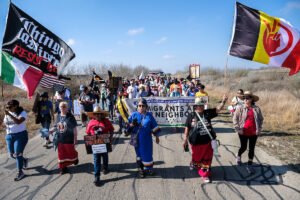
These themes are exemplified by the modern-day Indigenous Land Back movement.
As a movement, Land Back advances policies and practices for equitable redistribution, cultural revitalization, and the elevation of Indigenous sovereignty and stewardship to transform society’s understanding and relationship to the land.
This commitment to reshaping our relationship to and understanding of land requires a deeper knowledge of the historical and cultural contexts of Indigenous dispossession and colonization. This starts but does not end with practices like land acknowledgments, which we believe are essential in disrupting the systemic erasure of Native peoples and addressing the ongoing impacts of colonization.
Land justice seeks to restore equitable access to land [and] address the historical and ongoing harms of land theft, displacement, and exploitation.
True repair requires transformation. This should start by acknowledging the violent history of land theft, slavery, forced assimilation, and cultural erasure while actively supporting Indigenous sovereignty, Black land return, and access to resources.
Then, for land justice to be institutionalized, these principles must be crafted into universal measures that address systemic inequities through tangible actions. This includes such measures as establishing community land trusts, implementing social housing, rent protections, and restructuring our financial and economic systems to ensure that working-class people have the resources and opportunities needed to access land and housing. In that way, we as a society can move toward justice, ensuring that land and housing are accessible to all, not just a wealthy few.
Achieving this vision will require a de-siloing of our movements. The movement for land justice must reflect the interconnected struggles of Black, Indigenous, impoverished, and working-class communities. Because true land justice is rooted in efforts that redistribute power and resources, repair harm, and build systems grounded in equity, sustainability, and collective care.
Use Nonprofit and Community Ownership to Curb Speculation
(Peter Sabonis)
Why do you arrogate to yourselves, ye rich, exclusive right to the soil?
The struggle for land justice is ancient. Saint Ambrose penned his lament more than 1,600 years ago. Yet we find ourselves in a similar place.
Today, increasing wealth and income inequality have generated capital that is perpetually searching the globe for returns and has increasingly settled on real estate. In 2020, real estate accounted for two-thirds of global net worth. Demand from speculative investors has pushed prices for rental housing and homeownership ever higher. Land speculation also impacts commerce, as rising rents often serve to force out small businesses grounded in local culture.
While it may seem that the genie of real estate speculation can never be put back into its lamp, advancing land justice is possible. Foundations and anchor institutions, for example, can examine their real estate investments and ask whether their mission objectives are served by speculation-fueled displacement, exclusion, and homelessness. Public and private pension fund beneficiaries and managers should do the same.
We don’t need laws to act justly. Divestment is courageous, and courage is infectious.
An entire sector of grassroots-based groups is working to remove land from speculation. They need financial support and to be widely emulated by others.
Studies have noted how nonprofit anchor institutions can use land holdings to advance community affordable housing. A 2023 Urban Institute report revealed that up to 5,539 Nashville housing units could be constructed by area colleges and universities, faith-based institutions, and healthcare institutions. Other nonprofits should invite land donations and acquisitions.
Yes, there are holding costs involving insurance, property taxes, assessments, and even code enforcement, but nonprofits generally have exemption and waiver opportunities under state or local law, which are unavailable to speculators.
Property-related liability and risk can also be reduced by creating a tax-exempt title holding company under IRS Code 501c2. These must be wholly controlled by a 501c3 and pass net revenue (if any) on to the parent nonprofit. Real estate holding faith institutions that are downsizing can opt for religious values over financial ones. The US Roman Catholic Church holds an estimated 177 million acres, and many dioceses, as in Baltimore, are merging churches and disposing of land.
And an entire sector of grassroots groups is working to remove land from speculation. They need financial support and to be widely emulated by others. Community land trusts (CLTs) are participatory nonprofits that acquire and redevelop property through a ground lease arrangement that keeps housing affordable permanently; mutual housing associations, limited equity housing co-ops, and real estate cooperatives are also building the new nonspeculative sector.
Sign up for our free newsletters
Subscribe to NPQ's newsletters to have our top stories delivered directly to your inbox.
By signing up, you agree to our privacy policy and terms of use, and to receive messages from NPQ and our partners.
This often requires creative financing. For example, the East Bay Permanent Real Estate Cooperative, which owns properties in Oakland, CA, and the surrounding region, invites residents, investors, community members, and cooperative staff to make $1,000 investments to their collective fund and thereby co-own and co-steward the property.
The lesson of history is clear: Land is always contested terrain. But it requires us to use our own power to curtail the speculative forces that dehumanize and exclude.
Community ownership fosters stability, builds generational wealth, and strengthens resilience…it builds community power.
Moving Toward Land Justice: Self-Determination and Community Ownership
(Olga Talamante)
At The Greenlining Institute, we believe that land and housing justice means empowering communities to reclaim their futures.
In our view, affordable, sustainable, and stable housing is not just a necessity—it’s a fundamental human right bolstered by the US Constitution’s promise of equal protection, the 1968 Fair Housing Act, and the 1964 Civil Rights Act. These laws enshrine the right to fair and equal treatment—including access to housing free from discrimination. Yet, for decades, communities of color have been systematically denied this right due to racist housing and land-use policies.
Redlining—the deliberate denial of financial services such as mortgages and loans to communities of color—had been the dominant US housing policy regime from 1934, when the Home Owners’ Loan Corporation was created during the New Deal, until 1968. The practice was outlawed by the Fair Housing Act of 1968. However, its effects continue to shape today’s housing landscape.
While White families were able to acquire wealth through government-subsidized homeownership and build strong communities through government investments in infrastructure, communities of color were largely excluded from these benefits. This systemic exclusion persisted for decades, fueling an ever-widening racial gap and paving the way for the ongoing disparities in wealth, housing stability, and health outcomes we see to this day. Repairing these injustices requires systemic transformation.
Housing justice is not just about increasing the supply of affordable housing—it must begin by acknowledging the racist policies of the past and crafting antiracist policies that prioritize equity and justice, as envisioned by the Fair Housing Act and reinforced by subsequent fair lending and anti-discrimination laws.
At Greenlining, we analyze data through tools like the Home Mortgage Disclosure Act (HMDA) to monitor lending trends to communities of color. This research exposes ongoing disparities in home lending and informs our advocacy for fair lending practices and policies that ensure equitable access to housing and financial services.
At the heart of the housing crisis is the question of land: who has access to it, who owns it, and who benefits. Despite the deep and embedded challenges of systemic racism, communities of color have advanced solutions. By investing in their leadership, Greenlining is creating policies that build wealth equitably, foster resilience, and allow all communities to thrive.
[LandBack] is key to fighting an authoritarian state because it holds a mirror up to this country, serving as a reminder of what was here before there was a United States.
Through our Greenlining the Block initiative, we partner with grassroots organizations to reclaim power by preparing for and maximizing infrastructure investments. An example of this work is provided by Little Manila Rising in the South Stockton neighborhood of Stockton, CA, a historically marginalized community that has faced decades of disinvestment, environmental harm, and displacement.
Community ownership is central to this vision. When communities control their land and resources, they can ensure investments reflect their needs and priorities. Community ownership fosters stability, builds generational wealth, and strengthens resilience against the threats posed by economic uncertainty and climate change. In short, it builds community power.
Housing and land justice are achievable. By advocating for anti-racist policies that hold institutions accountable and empower communities that have historically been denied access to ownership, we can build a future where every community has access to safe, affordable housing. In partnership with communities of color, we can transform housing policy into a tool for equity and opportunity.
Save Multicultural Democracy by Returning Land to Native Peoples
(Nick Tilsen)
The LandBack movement seeks to liberate Indigenous peoples and our lands. This movement is the Red Power movement of our current generation. And yet, it is more than that—it is key to fighting an authoritarian state because it holds a mirror up to this country, serving as a reminder of what was here before there was a United States.
LandBack and land justice offer an opportunity to create models to build community wealth and push back against mainstream models of individual land ownership. Creating models of collective and community ownership like community land trusts is a way to both return stolen lands while creating opportunities for community self-governance.
The processes of returning stolen lands and building up new models must happen simultaneously. It’s imperative that we actively create new models because LandBack is not about capitalistic transactions for real estate; it’s about reestablishing human relationship to the land.
The current system that was put in place has been entirely based on extractive practices. It’s often asked, “When you get the land back what are you going to do with it?” The answer is always, “First, let it heal.” Reestablish the relationship with the land and then engage in regenerative solutions with the land, including developing sustainable food systems, housing systems, and land stewardship systems.
If the land is best used for conservation, then use it for conservation. If it has the ability to feed the people, then feed the people. If the land can be used to build schools, community centers, and healing spaces, then we engage with the land in that way.
But why is LandBack so important in our current moment, not just to achieve land justice for Native people but also to enable people in the United States, Native and non-Native, to build a multiracial democracy?
The reason goes back to the societal illness that has created the foundation—largely ignored by US liberals—that sustains authoritarianism. That foundational illness is US settler colonialism, which has created deep institutions of oppression and White supremacy throughout history. Unless the United States as a nation tackles its past, rights historical wrongs, and creates a meaningful path toward justice and equity, it’s destined to repeat that history.
The only true path forward to counter the rise of authoritarianism is to build a multiracial democracy. For Indigenous people, that means we need to build a democracy where we can see ourselves.
Indigenous people are about 3 percent of the US population. There are 574 federally recognized tribes. Native people have a unique political relationship to the federal government. The implementation of traditional Indigenous ecological knowledge is imperative in fighting the global climate crisis.
Simply put, a multiracial democracy is not possible without Indigenous people, and Indigenous people will not participate in a democracy that doesn’t include LandBack. Indigenous people have survived the invasion of our homelands, forced assimilation, and US government–led genocide.
Our lived experience positions us very well to fight an authoritarian state. The lessons learned both from our resistance and our healing will be invaluable at this moment in history.
The complex issue of land justice ripples throughout society. Land has been one of the primary points of historical injustice. The process of land theft is one of the largest contributing factors to the nation’s wealth inequality.
The LandBack movement and land justice work have the ability to deliver tangible results to poor and working-class people everywhere. Truth and justice in the United States have long required the return of Native lands to Native land stewardship. Now, LandBack has become imperative.