logo logo
giving banner
Donate
    • Membership
    • Donate
  • Social Justice
    • Racial Justice
    • Climate Justice
    • Disability Justice
    • Economic Justice
    • Food Justice
    • Health Justice
    • Immigration
    • LGBTQ+
  • Civic News
  • Nonprofit Leadership
    • Board Governance
    • Equity-Centered Management
    • Finances
    • Fundraising
    • Human Resources
    • Organizational Culture
    • Philanthropy
    • Power Dynamics
    • Strategic Planning
    • Technology
  • Columns
    • Ask Rhea!
    • Ask a Nonprofit Expert
    • Economy Remix
    • Gathering in Support of Democracy
    • Humans of Nonprofits
    • The Impact Algorithm
    • Living the Question
    • Nonprofit Hiring Trends & Tactics
    • Notes from the Frontlines
    • Parables of Earth
    • Re-imagining Philanthropy
    • State of the Movements
    • We Stood Up
    • The Unexpected Value of Volunteers
  • CONTENT TYPES
  • Leading Edge Membership
  • Newsletters
  • Webinars

Housing Crunch Leads to Revival of the “Granny Flat” in California

Steve Dubb
May 1, 2018
“accessory dwelling unit,” radcliffe dacanay

April 27, 2018; Next City

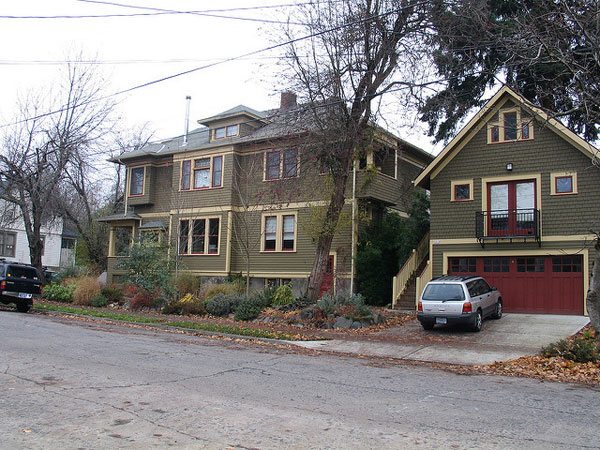
In hot-market cities, in-law housing—also known as “granny flats” and officially often designated as “accessory dwelling units,” or ADUs—is making a comeback. Common during World War II when migration to cities outpaced housing development, this form of housing has long been discouraged by zoning ordinances. But that is changing, notes Jared Brey in Next City, as cities acknowledge that one of the most effective ways to increase the housing supply is to encourage add-on units to existing lots.

The San Francisco Bay Area has one of the hottest housing markets in the country. In San Francisco proper, the median home price is now $1.6 million, twice as much as in 2013. For the Bay Area as a whole, the cost is lower but, at $820,000, still nobody’s bargain; according to the New York Times, $820,000 requires a household income of over $171,000—and that assumes you have $164,000 that you can apply to the down-payment.

It is thus not surprising that many Bay Area cities are seeking to increase the housing supply by encouraging in-law units. For example, “San Francisco passed a local ordinance in 2014 that allowed owners to legalize one accessory unit per residential lot,” notes Brey. San Francisco has spawned many Bay Area imitators, including most cities in neighboring San Mateo County.

In 2016, the state of California also followed San Francisco’s lead and passed three laws to facilitate in-law unit production. These laws did three things: 1) made it easier and cheaper to build a second unit, 2) made it easier for homeowners to convert an illegal unit into a legal one; and 3) sought to “ease or eliminate the off-street parking requirements and often-enormous utility-hookup fees that homeowners face when they create a second dwelling.”

According to the Terner Center for Housing Innovation at the University of California, Berkeley, in Los Angeles, the city had 1,980 applications in 2017 for in-law units. Before 2017, the city did not even track these, except for new construction, which was below 100 units. In San Francisco, the number of applications has skyrocketed from 41 in 2015 to 593 for the first three quarters of 2017.

Sign up for our free newsletters

Subscribe to NPQ's newsletters to have our top stories delivered directly to your inbox.

By signing up, you agree to our privacy policy and terms of use, and to receive messages from NPQ and our partners.

“This year,” notes Brey, “San Francisco earned a National Planning Achievement Award for its efforts.” In its award announcement, the American Planning Association noted that in-law units in San Francisco “cost less than $150,000 to build compared to $500,000 for new development.”

According to Gina Simi, communications manager for the San Francisco Planning Department, there are currently around 1,200 in-law units in the construction pipeline. Additionally, 685 permits have been submitted to legalize pre-existing in-law units, with 166 of these already approved. As Brey explains, “In order to become legal, accessory units have to meet all the standards of the Building Code, but not some zoning requirements that apply to other new residential construction, like standards related to parking, open space, and density.”

Brey notes that some obstacles remain in place. For instance, Todd David, executive director of the San Francisco Housing Action Coalition, contends that if construction were “really by right,” San Francisco could build as many as 10,000 new in-law units in three years.

Jennifer Fieber, political campaign director for the San Francisco Tenants Union, notes that in-law unit construction is not always simple and can sometimes disrupt existing housing. For example, Fieber mentions that “some long-term tenants are being pushed out due to construction work to add units to existing multifamily buildings or bring old units into compliance.”

“I think [in-law units] are a great idea, because they’re generally going to be smaller, they’re in unused spaces, and we’re running out of space to build new buildings,” Fieber says. “I totally support it, but they just need to be careful.”

Outside of California, the in-law unit idea is spreading too. For example, in its “Fourth Regional Plan” for the New York City metro area, the Regional Plan Association recommended that municipalities revive zoning laws to encourage in-law units. Brey notes that the plan writers indicate that, “If just 10 percent of single- and two-family homes in the region built an accessory unit…the region would add 300,000 new homes to its supply.”—Steve Dubb


Our Voices Are Our Power.

Journalism, nonprofits, and multiracial democracy are under attack. At NPQ, we fight back by sharing stories and essential insights from nonprofit leaders and workers—and we pay every contributor.

Can you help us protect nonprofit voices?

Your support keeps truth alive when it matters most.
Every single dollar makes a difference.

Donate now
logo logo logo logo logo
About the author
Steve Dubb

Steve Dubb is senior editor of economic justice at NPQ, where he writes articles (including NPQ’s Economy Remix column), moderates Remaking the Economy webinars, and works to cultivate voices from the field and help them reach a broader audience. In particular, he is always looking for stories that illustrate ways to build a more just economy—whether from the labor movement or from cooperatives and other forms of solidarity economy organizing—as well as articles that offer thoughtful and incisive critiques of capitalism. Prior to coming to NPQ in 2017, Steve worked with cooperatives and nonprofits for over two decades, including twelve years at The Democracy Collaborative and three years as executive director of NASCO (North American Students of Cooperation). In his work, Steve has authored, co-authored, and edited numerous reports; participated in and facilitated learning cohorts; designed community building strategies; and helped build the field of community wealth building. Most recently, Steve coedited (with Raymond Foxworth) Invisible No More: Voices from Native America (Island Press, 2023). Steve is also the lead author of Building Wealth: The Asset-Based Approach to Solving Social and Economic Problems (Aspen 2005) and coauthor (with Rita Hodges) of The Road Half Traveled: University Engagement at a Crossroads, published by MSU Press in 2012. In 2016, Steve curated and authored Conversations on Community Wealth Building, a collection of interviews of community builders that Steve had conducted over the previous decade.

More about: Community DevelopmentNonprofit NewsPolicy
See comments

Call to action
You might also like
Social Enterprise: Lessons from Down Under
Vicki Pozzebon
If Farm School NYC Closes, What Will the City Lose?
Farm School NYC and Iris M. Crawford
A Community Land Trust Movement Rises in New York City: Leadership Lessons
Deyanira Del Rio and Debra Ack
From Tenant Power to Social Housing: Pathways to a Just Housing System
Fernando X. Abarca
Resisting Gentrification in Seattle: The Fight for Community Stewardship of Land
J.M. Wong
Confronting the Private Equity Menace to Restore Housing Affordability
Dr. Seumalu Elora Raymond

Upcoming Webinars

Group Created with Sketch.
January 29th, 2:00 pm ET

Participatory Decision-making

When & How to Apply Inclusive Decision-making Methods

Register
Group Created with Sketch.
February 26th, 2:00 pm ET

Understanding Reduction in Force (RIF) Law

Clear Guidance for Values-centered Nonprofits

Register

    
You might also like
A protest sign reading, “No Business on a dead planet”, emphasizing how the wellbeing of our planet is more important than profit.
Social Enterprise: Lessons from Down Under
Vicki Pozzebon
Participants growing garlic at the Farm School NYC. 2025.
If Farm School NYC Closes, What Will the City Lose?
Farm School NYC and Iris M. Crawford
Colorful mural of a child holding a nest, surrounded by community figures, birds, NYC landmarks, and the word “Brownsville” in bold letters.
A Community Land Trust Movement Rises in New York City:...
Deyanira Del Rio and Debra Ack

Like what you see?

Subscribe to the NPQ newsletter to have our top stories delivered directly to your inbox.

See our newsletters

By signing up, you agree to our privacy policy and terms of use, and to receive messages from NPQ and our partners.

  • About
  • Advertise
  • Careers
  • Contact
  • Copyright
  • Donate
  • Editorial Policy
  • Funders
  • Submissions

We are using cookies to give you the best experience on our website.


Nonprofit Quarterly | Civic News. Empowering Nonprofits. Advancing Justice.
Powered by  GDPR Cookie Compliance
Privacy Overview

This website uses cookies so that we can provide you with the best user experience possible. Cookie information is stored in your browser and performs functions such as recognising you when you return to our website and helping our team to understand which sections of the website you find most interesting and useful.

Strictly Necessary Cookies

Strictly Necessary Cookie should be enabled at all times so that we can save your preferences for cookie settings.