
logo logo
giving banner
Donate
    • Membership
    • Donate
  • Social Justice
    • Racial Justice
    • Climate Justice
    • Disability Justice
    • Economic Justice
    • Food Justice
    • Health Justice
    • Immigration
    • LGBTQ+
  • Civic News
  • Nonprofit Leadership
    • Board Governance
    • Equity-Centered Management
    • Finances
    • Fundraising
    • Human Resources
    • Organizational Culture
    • Philanthropy
    • Power Dynamics
    • Strategic Planning
    • Technology
  • Columns
    • Ask Rhea!
    • Ask a Nonprofit Expert
    • Economy Remix
    • Gathering in Support of Democracy
    • Humans of Nonprofits
    • The Impact Algorithm
    • Living the Question
    • Nonprofit Hiring Trends & Tactics
    • Notes from the Frontlines
    • Parables of Earth
    • Re-imagining Philanthropy
    • State of the Movements
    • We Stood Up
    • The Unexpected Value of Volunteers
  • CONTENT TYPES
  • Leading Edge Membership
  • Newsletters
  • Webinars

The Pressure on NY’s Designated Banks: Get Our Money Out of Climate-Hostile Businesses!

Erin Rubin
November 30, 2018
From PopularResistance.org

November 29, 2018; Gothamist and Last Real Indians

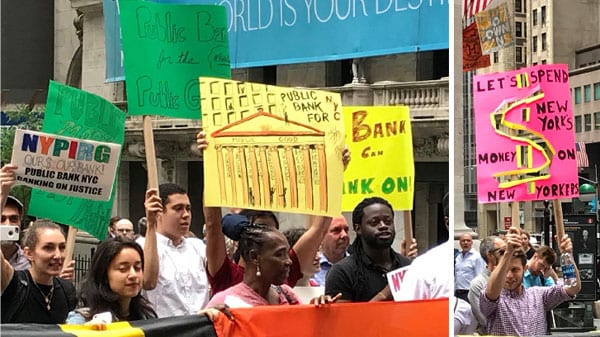
It’s time to walk the talk on climate change. That’s the message activists communicated this week when they rallied outside New York City Hall on the fourth UN-backed Annual Climate Finance Day to demand that New York divest from its designated banks, which invest heavily in the fossil fuel industry, and create a municipal public bank.

The movement for a public bank has been building in New York for some time, as it has across the country. Proponents see the public bank as a tool to move communities toward racial and economic justice. The organization Public Bank NYC declares, “Through a public bank, New York City can support vital sectors of our local economy and divest from banks that are financing destructive corporate interests, including speculative real estate, private prison and immigrant detention companies, the global arms trade and the fossil fuel industry.”

Public Bank NYC was joined at this rally by fellow community groups including NYPIRG, South Bronx Unite, the New Economy Project, New York Communities for Change, and Chhaya CDC.

Jake Offenhartz of Gothamist writes, “Just about every major bank in New York City is complicit in fossil fuel financing.” New York does its banking with institutions known as “designated” banks, which are deemed eligible to hold NYC public financing by the NYC Banking Commission, a three-member body comprised of Mayor de Blasio, City Comptroller Scott Stringer, and Finance Commissioner Jacques Jiha. It’s unusual for the city to revoke the designation or remove funds, but it does happen, as when Wells Fargo was caught up in an account fraud scandal.

Activists are motivated by both the increasing danger of climate change and the inequity perpetrated by the for-profit banking system. “In my South Bronx community, where asthma hospitalization rates are eight times the national average, we live and breathe a climate catastrophe,” said Mychal Johnson, co-founder of South Bronx Unite. “Our environmental and social justice advocacy is directly linked to community economic justice.”

Sign up for our free newsletters

Subscribe to NPQ's newsletters to have our top stories delivered directly to your inbox.

By signing up, you agree to our privacy policy and terms of use, and to receive messages from NPQ and our partners.

Even some officials agree; Public Bank NYC quoted Councilman Mark Levine saying, “Our City should put its own money to work for New Yorkers through a public bank, which would supercharge investments in critical projects…and return financial power to the people and businesses that need it most.” Unfortunately, the people that most need investment are also the most at risk when superstorms hit the city.

Mayor de Blasio has made some attempts to put New York on the map in the fight against fossil fuel companies, such as when ex-attorney general Eric Schneiderman sued ExxonMobil and other companies for damages related to climate change; the suit was dismissed, but other cities fight on.

However, as with many social justice movements, activists are tired of the “we’ll talk about it later” approach and demand more immediate action. Climate change is becoming a bigger problem faster than we can react to it. Economic inequality has reached historic levels. Awareness of the problem is not enough, nor are demands for accountability from fossil fuel companies.

Mayor de Blasio committed to divesting the city’s pension fund from fossil fuel companies, but hundreds of millions of dollars in city finances still sit with institutions that increased their investments in fossil fuels last year. According to Gothamist, “Citibank, which holds $425 million in city cash, increased their commitments as well, led by $522 million in financing for the Dakota Access Pipeline.” Rachel Rivera, member of New York Communities for Change, said, “New York City needs to do everything in its power to end climate change, and that includes creating a public bank so we can stop doing business with the banks funding the fossil fuel industry.”

New York officials are being presented with a solution that both empowers marginalized communities and sends a message to the fossil fuel industry. The reluctance to move on this idea lays bare city’s hesitancy to shift significant power, in the form of capital, from bankers to communities. What would it look like if that amount of money were reinvested in the communities that advocate for a more sustainable city?—Erin Rubin


Our Voices Are Our Power.

Journalism, nonprofits, and multiracial democracy are under attack. At NPQ, we fight back by sharing stories and essential insights from nonprofit leaders and workers—and we pay every contributor.

Can you help us protect nonprofit voices?

Your support keeps truth alive when it matters most.
Every single dollar makes a difference.

Donate now
logo logo logo logo logo
About the author
Erin Rubin

Erin Rubin was an assistant editor at the Nonprofit Quarterly, where she was in charge of online editorial coordination and community building. Before joining NPQ, in 2016, Erin worked as an administrator at Harvard Business School and as an editorial project manager at Pearson Education, where she helped develop a digital resource library for remedial learners. Erin has also worked with David R. Godine, Publishers, and the Association of Literary Scholars, Critics, and Writers. As a creative lead with the TEDxBeaconStreet organizing team, she worked to help innovators and changemakers share their groundbreaking ideas and turn them into action.

More about: ActivismCommunity FinanceNonprofit NewsPolicy
See comments

Call to action
You might also like
Navigating Conflict in Movement Spaces
Dean Spade
Blocking Authoritarianism: Steps Nonprofits and Foundations Must Take
Saqib Bhatti
Climate Conservationists Push for People to Live with Nature Rather Than Against It
Anmol Irfan
On Boycotts and Blackouts, Mobilizing and Organizing: Understanding the Basics
Steve Dubb
Social Enterprise: Lessons from Down Under
Vicki Pozzebon
A National Network of Activists Pursuing “People’s Budgets” Gains Prominence
Celina Su

Upcoming Webinars

Group Created with Sketch.
January 29th, 2:00 pm ET

Participatory Decision-making

When & How to Apply Inclusive Decision-making Methods

Register
Group Created with Sketch.
February 26th, 2:00 pm ET

Understanding Reduction in Force (RIF) Law

Clear Guidance for Values-centered Nonprofits

Register

    
You might also like
A red circle overlayed on a yellow background with three multi-colored dots on each side. In the center it reads, " Isaiah Thompson: Staff Picks for 2025"
Staff Picks for 2025: Isaiah Thompson
Isaiah Thompson
Staff Picks for 2025: Steve Dubb
Steve Dubb
A red circle overlayed on a yellow background with three multi-colored dots on each side. In the center it reads, "Alison Stine: Staff Picks for 2025"
Staff Picks for 2025: Alison Stine
Alison Stine

Like what you see?

Subscribe to the NPQ newsletter to have our top stories delivered directly to your inbox.

See our newsletters

By signing up, you agree to our privacy policy and terms of use, and to receive messages from NPQ and our partners.

  • About
  • Advertise
  • Careers
  • Contact
  • Copyright
  • Donate
  • Editorial Policy
  • Funders
  • Submissions

We are using cookies to give you the best experience on our website.


Nonprofit Quarterly | Civic News. Empowering Nonprofits. Advancing Justice.
Powered by  GDPR Cookie Compliance
Privacy Overview

This website uses cookies so that we can provide you with the best user experience possible. Cookie information is stored in your browser and performs functions such as recognising you when you return to our website and helping our team to understand which sections of the website you find most interesting and useful.

Strictly Necessary Cookies

Strictly Necessary Cookie should be enabled at all times so that we can save your preferences for cookie settings.