logo logo
giving banner
Donate
    • Membership
    • Donate
  • Social Justice
    • Racial Justice
    • Climate Justice
    • Disability Justice
    • Economic Justice
    • Food Justice
    • Health Justice
    • Immigration
    • LGBTQ+
  • Civic News
  • Nonprofit Leadership
    • Board Governance
    • Equity-Centered Management
    • Finances
    • Fundraising
    • Human Resources
    • Organizational Culture
    • Philanthropy
    • Power Dynamics
    • Strategic Planning
    • Technology
  • Columns
    • Ask Rhea!
    • Ask a Nonprofit Expert
    • Economy Remix
    • Gathering in Support of Democracy
    • Humans of Nonprofits
    • The Impact Algorithm
    • Living the Question
    • Nonprofit Hiring Trends & Tactics
    • Notes from the Frontlines
    • Parables of Earth
    • Re-imagining Philanthropy
    • State of the Movements
    • We Stood Up
    • The Unexpected Value of Volunteers
  • CONTENT TYPES
  • Leading Edge Membership
  • Newsletters
  • Webinars

Can Prevailing Wage Laws Also Foster Equity in Business Ownership?

Erin Rubin
March 13, 2019
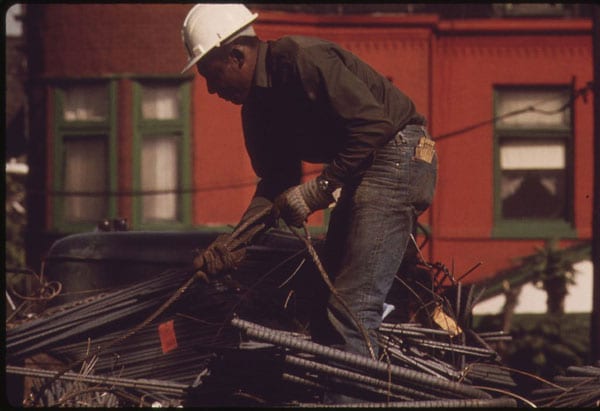
National Archives at College Park [Public domain], via Wikimedia Commons

March 8, 2019; Shelterforce

Framing is critical to advocacy work, as all nonprofits know. It’s especially critical when dealing with issues like attempting to redress structural racism, because the unintended—or implied—consequences of a law can end up being its most impactful result.

Take, for instance, the Davis-Bacon Act, better known as the “prevailing wage law.” It requires that “contractors and subcontractors performing on federally funded or assisted contracts in excess of $2,000 for the construction, alteration, or repair (including painting and decorating) of public buildings or public works” must pay all their workers, regardless of age, gender, or race, the “prevailing wage” in a county or state—usually the local union-established wage.

Sounds great, right? The construction industry has the lowest gender pay gap of all major industries in the US. (To be fair, construction also has one of the lowest percentages of female workers; in Massachusetts, for instance, seven percent of construction labor union members are women.) Mandating union pay eliminates wage discrimination and benefits many workers.

Except, says Travis Watson of Shelterforce, the law is still achieving its original goal—excluding workers of color from employment on federal construction projects. It’s well documented that the act’s author, Representative Robert Bacon, supported immigration quotas and introduced his wage bill to keep non-unionized black workers from being hired to build a veterans’ hospital in New York. In 1931, when the act passed, black workers were excluded from many, if not most, construction unions.

Watson looks particularly at Boston, where he says the prevailing wage law is “a significant obstacle to Black-owned businesses working in Boston neighborhoods.” Most contracting businesses owned by people of color in the city are smaller, and the paperwork required to comply with federal standards is onerous. Moreover, the union wages that are accepted as “prevailing” are negotiated by union leadership, which is mostly white, and may be unsustainable for smaller businesses, as he says those owned by people of color tend to be.

Sign up for our free newsletters

Subscribe to NPQ's newsletters to have our top stories delivered directly to your inbox.

By signing up, you agree to our privacy policy and terms of use, and to receive messages from NPQ and our partners.

This might sound familiar to those of us worried about equity in philanthropy. Many small nonprofits run by people of color find it more difficult to get funding due to opaque or convoluted application processes and reporting or performance requirements that don’t make any sense for a smaller, nimbler organization. Requirements that seem neutral because “they apply equally to everyone” are not neutral when some applicants do not have equal access to the resources needed to meet them.

The situation is a little different in the union wage space. It is a good thing to require equal pay, and contractors have been known to skimp on wages to workers who may feel their jobs are vulnerable. So, some kind of wage regulation is needed here.

Boston actually does have diversity requirements for its construction projects, and has for over thirty years. At least 51 percent of journeyman and apprenticeship opportunities on private development projects over 50,000 square feet and any public development projects must go to Boston residents; 40 percent must go to people of color; 12 percent must go to women. Those requirements are making an impact in unionizing historically underrepresented communities: not only is labor union membership in Massachusetts at a 10-year high, but black workers are union members at a higher rate than white workers.

But those requirements are for staff, not for who owns or leads the contracting businesses. People of color still make up a small minority of construction workers overall, even if they unionize at higher rates. Watson’s point is that the wage law makes it harder for smaller businesses, which are more likely than larger ones to be owned by people of color, to win federal contracts, which makes it that much harder for them to survive.

Is there a way to retrofit a law originally meant to exclude people of color into one that benefits them? This question is emblematic of a bigger debate around the function of larger US systems and whether they can be made just or have to be completely reimagined. In order to answer these questions, it’s critical that the discussion’s frame looks at questions of equity, and not just equality.—Erin Rubin


Our Voices Are Our Power.

Journalism, nonprofits, and multiracial democracy are under attack. At NPQ, we fight back by sharing stories and essential insights from nonprofit leaders and workers—and we pay every contributor.

Can you help us protect nonprofit voices?

Your support keeps truth alive when it matters most.
Every single dollar makes a difference.

Donate now
logo logo logo logo logo
About the author
Erin Rubin

Erin Rubin was an assistant editor at the Nonprofit Quarterly, where she was in charge of online editorial coordination and community building. Before joining NPQ, in 2016, Erin worked as an administrator at Harvard Business School and as an editorial project manager at Pearson Education, where she helped develop a digital resource library for remedial learners. Erin has also worked with David R. Godine, Publishers, and the Association of Literary Scholars, Critics, and Writers. As a creative lead with the TEDxBeaconStreet organizing team, she worked to help innovators and changemakers share their groundbreaking ideas and turn them into action.

More about: LaborNonprofit NewsPolicyStructural Racism
See comments

You might also like
Blue-State Pensions Are Subsidizing the Billionaire Takeover: This Must Stop!
Sara Myklebust and Aditi Sen
Can the Fight Against AI Revitalize the US Labor Movement?
Ted Siefer
Social Enterprise: Lessons from Down Under
Vicki Pozzebon
If Farm School NYC Closes, What Will the City Lose?
Farm School NYC and Iris M. Crawford
Resisting Gentrification in Seattle: The Fight for Community Stewardship of Land
J.M. Wong
From Buffalo to the Red Cup Rebellion: Why Starbucks Workers Are on Strike
Jill Webb

Upcoming Webinars

Group Created with Sketch.
January 29th, 2:00 pm ET

Participatory Decision-making

When & How to Apply Inclusive Decision-making Methods

Register
Group Created with Sketch.
February 26th, 2:00 pm ET

Understanding Reduction in Force (RIF) Law

Clear Guidance for Values-centered Nonprofits

Register

    
You might also like
A pair of pliers cutting a blue wire, symbolizing cutting off blue-state funding sources for Trump.
Blue-State Pensions Are Subsidizing the Billionaire...
Sara Myklebust and Aditi Sen
Senator Elizabeth Warren speaks into a microphone in front of a sign reading "We are the Supermajority" while an audience listens.
Supermajority, Group Organizing Women Around Politics, Is...
Jennifer Gerson
A black and white x-ray image of human lungs.
Can the Fight Against AI Revitalize the US Labor Movement?
Ted Siefer

Like what you see?

Subscribe to the NPQ newsletter to have our top stories delivered directly to your inbox.

See our newsletters

By signing up, you agree to our privacy policy and terms of use, and to receive messages from NPQ and our partners.

  • About
  • Advertise
  • Careers
  • Contact
  • Copyright
  • Donate
  • Editorial Policy
  • Funders
  • Submissions

We are using cookies to give you the best experience on our website.


Nonprofit Quarterly | Civic News. Empowering Nonprofits. Advancing Justice.
Powered by  GDPR Cookie Compliance
Privacy Overview

This website uses cookies so that we can provide you with the best user experience possible. Cookie information is stored in your browser and performs functions such as recognising you when you return to our website and helping our team to understand which sections of the website you find most interesting and useful.

Strictly Necessary Cookies

Strictly Necessary Cookie should be enabled at all times so that we can save your preferences for cookie settings.