logo logo
Donate
    • Membership
    • Donate
  • Social Justice
    • Racial Justice
    • Climate Justice
    • Disability Justice
    • Economic Justice
    • Food Justice
    • Health Justice
    • Immigration
    • LGBTQ+
  • Civic News
  • Nonprofit Leadership
    • Board Governance
    • Equity-Centered Management
    • Finances
    • Fundraising
    • Human Resources
    • Organizational Culture
    • Philanthropy
    • Power Dynamics
    • Strategic Planning
    • Technology
  • Columns
    • Ask Rhea!
    • Ask a Nonprofit Expert
    • Gathering in Support of Democracy
    • Hope in the Dark
    • Humans of Nonprofits
    • Inside the States
    • In Defense of Civil Society
    • The Myth of Heroic Leadership
    • Notes from the Frontlines
    • Notes from the Long Arc
    • Reimagining Philanthropy
    • The Unexpected Value of Volunteers
    • We Stood Up
  • Newsletters
  • NPQ Online Events
    • Learn Out Loud
    • Leading Edge Webinars
    • Partner Events
    • On Demand
  • Leading Edge Membership

SAFE Cities Network Boosts Legal Aid for Immigrants Facing Deportation

Karen Kahn
November 14, 2017
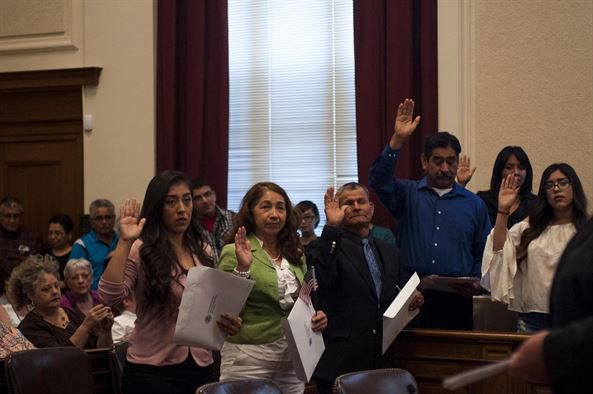
Immigrants gain citizenship By Senior Airman Scott Jackson, 17th Training Wing Public Affairs

November 12th, 2017; NPR

The Vera Institute for Justice, a nonprofit committed to fairness and safety in our justice systems, has launched a new program that will expand the availability of legal counsel to people facing deportation. The Safety and Fairness for Everyone (SAFE) Cities Network supports 11 cities and counties committed to “well-being and rights of all residents.”

The SAFE Cities Network is a response to increased anti-immigrant rhetoric, along with a surge in arrests under the Trump administration. Since January 2017, arrests have increased from about 9,000 per month during the Obama administration to about 14,000 per month. In addition, the Trump administration has cast a wider net, arresting people who have no criminal records who are integrated into the fabric of communities across the country.

Eleven jurisdictions—Atlanta; Austin, Texas; Baltimore; Chicago; Columbus, Ohio; Dane County, Wisconsin; Oakland/Alameda County, California; Prince George’s County, Maryland; Sacramento, California; San Antonio, Texas; and Santa Ana, California—will participate in the program. Each of these communities is using public dollars to provide public defense lawyers for immigrants facing deportation hearings. The Vera Institute will provide matching funds, infrastructure support (i.e., training and technical assistance), and evaluation research to assess the program’s success.

Sign up for our free newsletters

Subscribe to NPQ's newsletters to have our top stories delivered directly to your inbox.

By signing up, you agree to our privacy policy and terms of use, and to receive messages from NPQ and our partners.

Studies show that legal representation in deportation hearings significantly improves the chances of remaining in the country. In 2015, the University of Pennsylvania Law Review published findings that showed a more than tenfold increase in successful hearings for immigrants with counsel as compared to those representing themselves.

Despite the Trump administration’s threat to withhold federal funds from jurisdictions that refuse cooperation with immigration enforcement officials, cities and states are continuing to do what they can to protect their residents. On November 7th, the citizens of Salem, Massachusetts voted on a ballot question that sought to overturn the city’s sanctuary ordinance, first passed by the City Council last March. In almost every precinct across the city, residents voted to keep the ordinance, which writes into law longstanding police department policies that bar discrimination based on immigration status. The local police chief reiterated several times throughout the campaign that the law keeps the community safer by ensuring residents who witness a crime or have an emergency can call local police and not fear that they will be asked about their immigration status.

On the state level, the Massachusetts legislature is considering the Safe Communities Act, which would bar local police from arresting or detaining anyone solely on the basis of their immigration status. California has already passed similar statewide sanctuary legislation, which will go into effect in 2018.—Karen Kahn


The work isn’t done. Neither is our commitment.

The challenges facing nonprofits aren’t going away. Neither can the journalism that informs, connects, and amplifies the sector.

Help NPQ keep this work free and accessible.

Give Today
logo logo logo logo logo
About the author
Karen Kahn

Karen Kahn is a writer, editor, and communications strategist who spent nearly two decades as the communications director for the nonprofit Paraprofessional Healthcare Institute. The co-author of Courting Equality: A Documentary History of America’s First Same-Sex Marriages (Beacon Press 2007), Karen has published frequently on the economic, social and cultural issues affecting the LGBT community, women, and low-wage workers. Early in her career, she was the editor-in-chief of Sojourner: The Women’s Forum, a monthly national feminist newsjournal published in the Boston area. You can find her on LinkedIn at https://www.linkedin.com/in/karenakahn/ or on Twitter at @Karenakahn.

More about: ImmigrationNonprofit News
See comments

Stuffing-1
You might also like
A century-old Texas church is fighting Trump’s border wall
Marianne Dhenin
How can nonprofits do more with less? Try addressing multiple issues at once
Zanny Merullo
When migrant women build the safety net: Mutual aid economies in American cities
Ebru Akgün
Preserving the body politic against anti-immigration surges on Election Day
Katherine Graham
No bond, no judge: The case that could redefine immigrant rights in the United States
María Constanza Costa
First Trump Came for Immigrants. Then He Came for Their Lawyers.
Kyle Paoletta

Upcoming Webinars

Group Created with Sketch.
December 3, 2:00 pm ET

After the Midterms

What’s Next for Nonprofits?

Register
Group Created with Sketch.
January 28, 2:00 pm ET

Democratic Staff Structures

Weaving Shared Leadership and Union Practice in Nonprofits

Register
You might also like
Ruidosa Church
A century-old Texas church is fighting Trump’s border wall
Marianne Dhenin
A lightboard sign that reads “Less is More” and the “s” is a dollar sign.
How can nonprofits do more with less? Try addressing...
Zanny Merullo
A group of women with varying skin tones standing and overlapping their hands into the middle of a circle.
When migrant women build the safety net: Mutual aid...
Ebru Akgün

Like what you see?

Subscribe to the NPQ newsletter to have our top stories delivered directly to your inbox.

See our newsletters

By signing up, you agree to our privacy policy and terms of use, and to receive messages from NPQ and our partners.

  • About
  • Advertise
  • Careers
  • Contact
  • Copyright
  • Donate
  • Funders
  • Editorial Policy
  • Media Relations
  • Privacy Policy
  • Submissions

We are using cookies to give you the best experience on our website.


Nonprofit Quarterly | Civic News. Empowering Nonprofits. Advancing Justice.
Powered by  GDPR Cookie Compliance
Privacy Overview

This website uses cookies so that we can provide you with the best user experience possible. Cookie information is stored in your browser and performs functions such as recognising you when you return to our website and helping our team to understand which sections of the website you find most interesting and useful.

Strictly Necessary Cookies

Strictly Necessary Cookie should be enabled at all times so that we can save your preferences for cookie settings.