
logo logo
giving banner
Donate
    • Membership
    • Donate
  • Social Justice
    • Racial Justice
    • Climate Justice
    • Disability Justice
    • Economic Justice
    • Food Justice
    • Health Justice
    • Immigration
    • LGBTQ+
  • Civic News
  • Nonprofit Leadership
    • Board Governance
    • Equity-Centered Management
    • Finances
    • Fundraising
    • Human Resources
    • Organizational Culture
    • Philanthropy
    • Power Dynamics
    • Strategic Planning
    • Technology
  • Columns
    • Ask Rhea!
    • Ask a Nonprofit Expert
    • Economy Remix
    • Gathering in Support of Democracy
    • Humans of Nonprofits
    • The Impact Algorithm
    • Living the Question
    • Nonprofit Hiring Trends & Tactics
    • Notes from the Frontlines
    • Parables of Earth
    • Re-imagining Philanthropy
    • State of the Movements
    • We Stood Up
    • The Unexpected Value of Volunteers
  • CONTENT TYPES
  • Leading Edge Membership
  • Newsletters
  • Webinars

The Overhead Myth

Ken Berger, Jacob Harold and Art Taylor
June 17, 2013


Editors’ Note: NPQ is proud to highlight this important letter from GuideStar, Charity Navigator and the Wise Giving Alliance calling for an end to the obsession many have had with nonprofit overhead costs as a proxy for measuring effectiveness BUT for the letter to be effective it is important that people share it in every way they can. 

Please see NPQ’s statement on this letter here

OM

To the Donors of America:

We write to correct a misconception about what matters when deciding which charity to support.

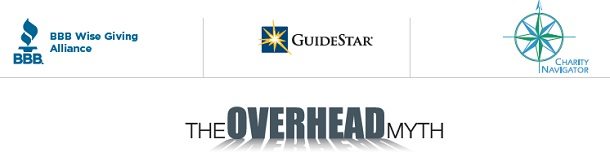
The percent of charity expenses that go to administrative and fundraising costs—commonly referred to as “overhead”—is a poor measure of a charity’s performance.

We ask you to pay attention to other factors of nonprofit performance: transparency, governance, leadership, and results. For years, each of our organizations has been working to increase the depth and breadth of the information we provide to donors in these areas so as to provide a much fuller picture of a charity’s performance.

Sign up for our free newsletters

Subscribe to NPQ's newsletters to have our top stories delivered directly to your inbox.

By signing up, you agree to our privacy policy and terms of use, and to receive messages from NPQ and our partners.

That is not to say that overhead has no role in ensuring charity accountability. At the extremes the overhead ratio can offer insight: it can be a valid data point for rooting out fraud and poor financial management. In most cases, however, focusing on overhead without considering other critical dimensions of a charity’s financial and organizational performance does more damage than good.

In fact, many charities should spend more on overhead. Overhead costs include important investments charities make to improve their work: investments in training, planning, evaluation, and internal systems—as well as their efforts to raise money so they can operate their programs. These expenses allow a charity to sustain itself (the way a family has to pay the electric bill) or to improve itself (the way a family might invest
in college tuition).

When we focus solely or predominantly on overhead, we can create what the Stanford Social Innovation Review has called “The Nonprofit Starvation Cycle.” We starve charities of the freedom they need to best serve the people and communities they are trying to serve.

If you don’t believe us—America’s three leading sources of information about charities, each used by millions of donors every year—see the back of this letter for research from other experts including Indiana University, the Urban Institute, the Bridgespan Group, and others that proves the point.

So when you are making your charitable giving decisions, please consider the whole picture. The people and communities served by charities don’t need low overhead, they need high performance.

Thank you,

Art Taylor
President & CEO,
BBB Wise Giving Alliance
overheadmyth.give.org
Jacob Harold
President & CEO,
GuideStar
overheadmyth.guidestar.org
Ken Berger
President & CEO,
Charity Navigator
www.charitynavigator.org/
thebestandworstwaytopickacharity

READ THE FULL PDF VERSION HERE

Our Voices Are Our Power.

Journalism, nonprofits, and multiracial democracy are under attack. At NPQ, we fight back by sharing stories and essential insights from nonprofit leaders and workers—and we pay every contributor.

Can you help us protect nonprofit voices?

Your support keeps truth alive when it matters most.
Every single dollar makes a difference.

Donate now
logo logo logo logo logo
About the authors
Ken Berger

Ken Berger is the president and CEO of Charity Navigator.

Jacob Harold

Jacob Harold is the President and CEO of Guidestar

Art Taylor

Art Taylor is the President and CEO of BBB Wise Giving

More about: Financial ManagementPhilanthropy
See comments

You might also like
The Power of Direct Community Funding
Ana Valéria Araújo
Equitable Intermediaries: Power, Protection, Partnership
Frank Gargione and Andrea Granda
GivingTuesday: Mobilizing Grassroots Donors
Isaiah Thompson
Four Ways Philanthropy Can Support the Movement for a Third Reconstruction
Richard Besser and Carmen Rojas
Black Women Claiming Philanthropic Space: A Conversation with LaTosha Brown
Rebekah Barber and LaTosha Brown
Foundations Look to New Models of International Development amid Retrenchment
Ted Siefer

Upcoming Webinars

Group Created with Sketch.
December 9th, 2:00 pm ET

Nonprofit Safety & Security: Protecting Our People, Data, and Organizations in a Time of Unprecedented Threat

Register
Group Created with Sketch.
January 29th, 2:00 pm ET

Future is Collective

Register

    
You might also like
A afro-Brazilian man waving a Brazilian flag joyfully, symbolizing the positive effect that direct funding can have on communities.
The Power of Direct Community Funding
Ana Valéria Araújo
A person walking overhead in the protection of a safety net, symbolizing how fiscal sponsors can serve as a safety net for movement groups.
Equitable Intermediaries: Power, Protection, Partnership
Frank Gargione and Andrea Granda
A red heart, formed by a group of people with painted hand palms, symbolizing solidarity in giving among the many.
GivingTuesday: Mobilizing Grassroots Donors
Isaiah Thompson

Like what you see?

Subscribe to the NPQ newsletter to have our top stories delivered directly to your inbox.

See our newsletters

By signing up, you agree to our privacy policy and terms of use, and to receive messages from NPQ and our partners.

  • About
  • Advertise
  • Careers
  • Contact
  • Copyright
  • Donate
  • Editorial Policy
  • Funders
  • Submissions

We are using cookies to give you the best experience on our website.


Nonprofit Quarterly | Civic News. Empowering Nonprofits. Advancing Justice.
Powered by  GDPR Cookie Compliance
Privacy Overview

This website uses cookies so that we can provide you with the best user experience possible. Cookie information is stored in your browser and performs functions such as recognising you when you return to our website and helping our team to understand which sections of the website you find most interesting and useful.

Strictly Necessary Cookies

Strictly Necessary Cookie should be enabled at all times so that we can save your preferences for cookie settings.