logo logo
giving banner
Donate
    • Membership
    • Donate
  • Social Justice
    • Racial Justice
    • Climate Justice
    • Disability Justice
    • Economic Justice
    • Food Justice
    • Health Justice
    • Immigration
    • LGBTQ+
  • Civic News
  • Nonprofit Leadership
    • Board Governance
    • Equity-Centered Management
    • Finances
    • Fundraising
    • Human Resources
    • Organizational Culture
    • Philanthropy
    • Power Dynamics
    • Strategic Planning
    • Technology
  • Columns
    • Ask Rhea!
    • Ask a Nonprofit Expert
    • Economy Remix
    • Gathering in Support of Democracy
    • Humans of Nonprofits
    • The Impact Algorithm
    • Living the Question
    • Nonprofit Hiring Trends & Tactics
    • Notes from the Frontlines
    • Parables of Earth
    • Re-imagining Philanthropy
    • State of the Movements
    • We Stood Up
    • The Unexpected Value of Volunteers
  • CONTENT TYPES
  • Leading Edge Membership
  • Newsletters
  • Webinars

Improving Individual Health Requires a Village of Service Providers

Martin Levine
June 29, 2018

June 26, 2018; RevCycleIntelligence.com

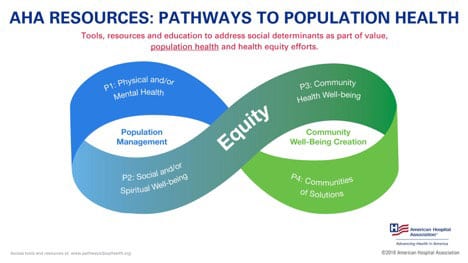
For health care providers and hospitals, just treating patients may not be good enough. Increasingly, experts have seen the need to view health in a larger, societal context. The American Hospital Association has recognized that people’s health is heavily influenced by the overall context of their lives.

To meet medical objectives and to reduce the overall cost of health care, the American Hospital Association now advises its members that the “social determinants of health—where we live, work and play—have tremendous effect on one’s health, and they can affect anyone, regardless of age, race, ethnicity.” And it is urging hospitals to become engaged in efforts to change this larger picture.

According to a recent article on RevCycleIntelligence.com, a patient’s overall health is more dependent on the quality of their overall circumstances of their lives than it is on the quality of the health care they receive or on the accessibility of health care services. “Socioeconomic factors are responsible for approximately 40 percent of a patient’s health, while just 20 percent was tied to care access and quality of care.”

Being homeless, living in unsafe or unhealthy conditions, lacking transportation to get to needed medical appointments, or living in a food desert effects health more significantly than being able to see the best doctor or be treated in the finest hospital.

Sign up for our free newsletters

Subscribe to NPQ's newsletters to have our top stories delivered directly to your inbox.

By signing up, you agree to our privacy policy and terms of use, and to receive messages from NPQ and our partners.

With pressure from all quarters to reduce the cost of health care, hospitals and health care providers are motivated to build partnerships with other service providers toward improving the larger context of their patient’s lives. The AHA advises its members to invest in network building: “Knowing that hospitals and health systems alone cannot address all of these issues, external partnerships will be critical. Externally, hospitals and health systems can partner with other stakeholders or make other investments in their communities. This allows hospitals to not only serve as part of the solution, but to work with other stakeholders to better use limited resources to match the needs of their communities.”

Recognizing that many patients enter care with nutrition deficits, “organizations should also consider investments in food systems, such as food banks, local pantries, grocery stores, and farmers…establish community gardens, and allow food stands from local farmers on their property.”

Homeless individuals are heavy and regular emergency room users. Helping them leave the streets and enter stable, safe housing requires skills and resources outside the health care system. RevCycleIntelligence.com cited the University of Illinois Medical Center as a dramatic example of a service network addressing homelessness. The Center partnered with a community group called the Center for Housing and Health:

Hospital providers identified emergency department patients who were experiencing chronic homelessness and referred them to the community group. A panel of physicians, social workers, and other experts would then determine each applicant’s needs and pair qualifying individuals with an outreach worker who connects the individuals with the needed services. Individuals who accept the hospital’s help move into a “bridge unit,” or transitional housing unit, and case managers develop long-term solutions for independent living.

Hospitals’ openness to forming partnerships like these presents an opportunity for a range of organizations that focus on community improvement. Effective initiatives will require each partner to look beyond its own needs and see the work’s overall context. With each sector of the service community already under fiscal pressure as funding becomes harder to get and maintain, everyone needs to be concerned about more than the individual bottom line. The ongoing well-being of each partnership is important if the array of needed support services and community interventions will continue.—Martin Levine


Our Voices Are Our Power.

Journalism, nonprofits, and multiracial democracy are under attack. At NPQ, we fight back by sharing stories and essential insights from nonprofit leaders and workers—and we pay every contributor.

Can you help us protect nonprofit voices?

Your support keeps truth alive when it matters most.
Every single dollar makes a difference.

Donate now
logo logo logo logo logo
About the author
Martin Levine

Martin Levine is a Principal at Levine Partners LLP, a consulting group focusing on organizational change and improvement, realigning service systems to allow them to be more responsive and effective. Before that, he served as the CEO of JCC Chicago, where he was responsible for the development of new facilities in response to the changing demography of the Metropolitan Jewish Community. In addition to his JCC responsibilities, Mr. Levine served as a consultant on organizational change and improvement to school districts and community organizations. Mr. Levine has published several articles on change and has presented at numerous conferences on this subject. A native of New York City, Mr. Levine is a graduate of City College of New York (BS in Biology) and Columbia University (MSW). He has trained with the Future Search and the Deming Institute.

More about: Nonprofit NewsPolicySocial Determinants of Health
See comments

Call to action
You might also like
Social Enterprise: Lessons from Down Under
Vicki Pozzebon
If Farm School NYC Closes, What Will the City Lose?
Farm School NYC and Iris M. Crawford
The New COVID Vaccine Rules Leave Parents with More Questions Than Answers
Barbara Rodriquez
The Protective Visas That May Never Come
Mel Leonor Barclay
Moving Beyond a Buzzword: Making “Resilience” Real
Laurie Mazur
Voter Registration Faces Threats Nonprofits Can’t Ignore
Lauren Girardin

Upcoming Webinars

Group Created with Sketch.
January 29th, 2:00 pm ET

Participatory Decision-making

When & How to Apply Inclusive Decision-making Methods

Register
Group Created with Sketch.
February 26th, 2:00 pm ET

Understanding Reduction in Force (RIF) Law

Clear Guidance for Values-centered Nonprofits

Register

    
You might also like
A red circle overlayed on a yellow background with three multi-colored dots on each side. In the center it reads, " Isaiah Thompson: Staff Picks for 2025"
Staff Picks for 2025: Isaiah Thompson
Isaiah Thompson
Staff Picks for 2025: Steve Dubb
Steve Dubb
A red circle overlayed on a yellow background with three multi-colored dots on each side. In the center it reads, "Alison Stine: Staff Picks for 2025"
Staff Picks for 2025: Alison Stine
Alison Stine

Like what you see?

Subscribe to the NPQ newsletter to have our top stories delivered directly to your inbox.

See our newsletters

By signing up, you agree to our privacy policy and terms of use, and to receive messages from NPQ and our partners.

  • About
  • Advertise
  • Careers
  • Contact
  • Copyright
  • Donate
  • Editorial Policy
  • Funders
  • Submissions

We are using cookies to give you the best experience on our website.


Nonprofit Quarterly | Civic News. Empowering Nonprofits. Advancing Justice.
Powered by  GDPR Cookie Compliance
Privacy Overview

This website uses cookies so that we can provide you with the best user experience possible. Cookie information is stored in your browser and performs functions such as recognising you when you return to our website and helping our team to understand which sections of the website you find most interesting and useful.

Strictly Necessary Cookies

Strictly Necessary Cookie should be enabled at all times so that we can save your preferences for cookie settings.