logo logo
giving banner
Donate
    • Membership
    • Donate
  • Social Justice
    • Racial Justice
    • Climate Justice
    • Disability Justice
    • Economic Justice
    • Food Justice
    • Health Justice
    • Immigration
    • LGBTQ+
  • Civic News
  • Nonprofit Leadership
    • Board Governance
    • Equity-Centered Management
    • Finances
    • Fundraising
    • Human Resources
    • Organizational Culture
    • Philanthropy
    • Power Dynamics
    • Strategic Planning
    • Technology
  • Columns
    • Ask Rhea!
    • Ask a Nonprofit Expert
    • Economy Remix
    • Gathering in Support of Democracy
    • Humans of Nonprofits
    • The Impact Algorithm
    • Living the Question
    • Nonprofit Hiring Trends & Tactics
    • Notes from the Frontlines
    • Parables of Earth
    • Re-imagining Philanthropy
    • State of the Movements
    • We Stood Up
    • The Unexpected Value of Volunteers
  • CONTENT TYPES
  • Leading Edge Membership
  • Newsletters
  • Webinars

What Does Inclusive Economic Development Look Like?

Steve Dubb
July 18, 2018
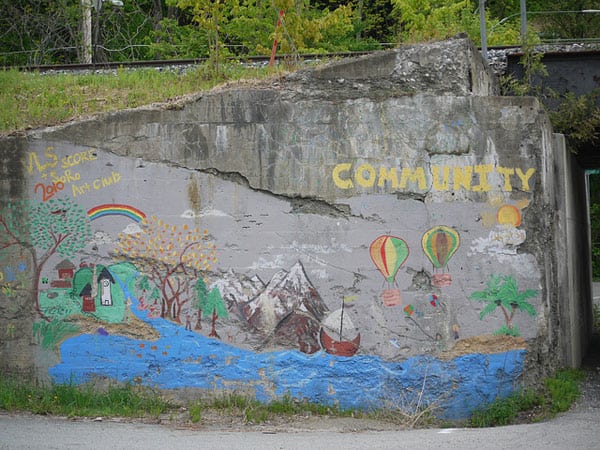
“Community,” by Rebecca Siegel

July 17, 2018; GreenBiz

At NPQ, we have written regularly about the shortfalls of economic development that relies on tax abatements and other forms of economic incentive payments. As NPQ’s Derrick Rhayn wrote earlier this week, “Collectively, cities and states in the US spend upwards of $80 billion annually on tax incentives, an amount equivalent to the GDP of the state of Hawaii…[yet] some research shows that incentives have little to no impact on job creation at all.” But what is the alternative? Writing in GreenBiz, Michael Fortunato and Bruce Balfour, two economic development consultants, identify three key principles for engaging in homegrown economic development, aimed at especially for those seeking to revitalize the economies of small towns. These are:

1. Be more than a developer of places. You will have to be a developer of communities.

2. Instead of revitalizing only buildings, you must also revitalize relationships.

3. With no economic momentum in the community, if you want to sail, you will have to bring your own wind.

“These techniques are not new,” Fortunato and Balfour explain. “In fact, they have more in common with life in the early United States than they do with life in modern times. Back then, techniques revolved around relationships and doing for one another in very strategic ways. Blending them with modern approaches and modern situations makes them feel quite innovative, and we would like to see more of them in common use by developers across the globe.”

Sign up for our free newsletters

Subscribe to NPQ's newsletters to have our top stories delivered directly to your inbox.

By signing up, you agree to our privacy policy and terms of use, and to receive messages from NPQ and our partners.

In terms of tactics and strategy, the community economic development toolkit that they advocate employing contains four elements: 1) partnerships, 2) community wealth building strategies, 3) blending of multiple strategies (which they call “hybridizing”) and 4) self-sustaining strategies.

Fortunato and Balfour outline each of these strategies. For instance, employing partnerships requires the developer to be a “catalyzing force.” “Rather than advancing your own vision,” they say, “find out what others in the community want to see.” The community spirit that is generated “can be written right into the by-laws of your project’s business entity, ensuring strong connections with local organizations and possibly local oversight.”

As for building community wealth, the key, Fortunato and Balfour explain, is to “enhance community involvement and defray risk.” For example, cooperatives are beneficial because they bring about “many owners, less risk.” Part of the reason for the lower risk, they add, is that “Co-op businesses draw their membership directly from the community, providing a loyal customer base.” An example of this is the craft brewing co-op of Ronan, Montana that NPQ profiled this past January. Other forms of community wealth building they mention include community land trusts, commons area preservation, and community-supported agriculture.

Such community-based “strategies really gain their power when they are blended effectively,” Fortunato and Balfour add. One reason for blending strategies is to reduce the risk of failure. As Fortunato and Balfour explain, single-use projects create the “possibility that the project could fail, taking all investment with it. This is especially destructive in a small town. However, by launching affordable housing jointly with a food hub and a food entrepreneurship incubator, the risk of failure of one project is more likely to be buffered by the other two.”

The last point that Fortunato and Balfour emphasize is to avoid reliance “on external grant funding that is not directly controlled by the community, as this brings external risk to the table.” Fortunato and Balfour explain that, “A community may really want a food hub, and may need affordable housing.” They add that, “If your project must be launched in segments, always begin with the highest profit potential activity first. This can then support the other activities as they all grow at different rates. Thus, the commercial kitchen can kick-start the launch of the food hub, opening access to local food, which enhances the commercial kitchen incubator. This power duo then can be used to launch affordable housing (a low-profit venture), which can house more potential food entrepreneurs, and so on.”

Fortunato and Balfour conclude by stating their hope that “these and other innovative techniques will become more commonplace in economic development circles.” Often, they add, “the key to reconstituting community life is …building more diverse projects at a smaller scale.”—Steve Dubb


Our Voices Are Our Power.

Journalism, nonprofits, and multiracial democracy are under attack. At NPQ, we fight back by sharing stories and essential insights from nonprofit leaders and workers—and we pay every contributor.

Can you help us protect nonprofit voices?

Your support keeps truth alive when it matters most.
Every single dollar makes a difference.

Donate now
logo logo logo logo logo
About the author
Steve Dubb

Steve Dubb is senior editor of economic justice at NPQ, where he writes articles (including NPQ’s Economy Remix column), moderates Remaking the Economy webinars, and works to cultivate voices from the field and help them reach a broader audience. In particular, he is always looking for stories that illustrate ways to build a more just economy—whether from the labor movement or from cooperatives and other forms of solidarity economy organizing—as well as articles that offer thoughtful and incisive critiques of capitalism. Prior to coming to NPQ in 2017, Steve worked with cooperatives and nonprofits for over two decades, including twelve years at The Democracy Collaborative and three years as executive director of NASCO (North American Students of Cooperation). In his work, Steve has authored, co-authored, and edited numerous reports; participated in and facilitated learning cohorts; designed community building strategies; and helped build the field of community wealth building. Most recently, Steve coedited (with Raymond Foxworth) Invisible No More: Voices from Native America (Island Press, 2023). Steve is also the lead author of Building Wealth: The Asset-Based Approach to Solving Social and Economic Problems (Aspen 2005) and coauthor (with Rita Hodges) of The Road Half Traveled: University Engagement at a Crossroads, published by MSU Press in 2012. In 2016, Steve curated and authored Conversations on Community Wealth Building, a collection of interviews of community builders that Steve had conducted over the previous decade.

More about: Community DevelopmentCommunity Land TrustsEconomic DevelopmentNonprofit NewsPolicy
See comments

You might also like
If Farm School NYC Closes, What Will the City Lose?
Farm School NYC and Iris M. Crawford
A Community Land Trust Movement Rises in New York City: Leadership Lessons
Deyanira Del Rio and Debra Ack
From Tenant Power to Social Housing: Pathways to a Just Housing System
Fernando X. Abarca
Resisting Gentrification in Seattle: The Fight for Community Stewardship of Land
J.M. Wong
Confronting the Private Equity Menace to Restore Housing Affordability
Dr. Seumalu Elora Raymond
Owning Versus Renting, and Other Questions Nonprofits Should Ask About Real Estate: A Conversation with Rudy Espinoza and Allison Wagstrom
Steve Dubb, Rudy Espinoza and Allison Wagstrom

Upcoming Webinars

Group Created with Sketch.
December 9th, 2:00 pm ET

Nonprofit Safety & Security: Protecting Our People, Data, and Organizations in a Time of Unprecedented Threat

Register
Group Created with Sketch.
January 29th, 2:00 pm ET

Future is Collective

Register

    
You might also like
Participants growing garlic at the Farm School NYC. 2025.
If Farm School NYC Closes, What Will the City Lose?
Farm School NYC and Iris M. Crawford
Colorful mural of a child holding a nest, surrounded by community figures, birds, NYC landmarks, and the word “Brownsville” in bold letters.
A Community Land Trust Movement Rises in New York City:...
Deyanira Del Rio and Debra Ack
Mural of a person with eyes closed and hand on chin, surrounded by hearts, flowers, and drawings imagining the future, blending thought and hope.
From Tenant Power to Social Housing: Pathways to a Just...
Fernando X. Abarca

Like what you see?

Subscribe to the NPQ newsletter to have our top stories delivered directly to your inbox.

See our newsletters

By signing up, you agree to our privacy policy and terms of use, and to receive messages from NPQ and our partners.

  • About
  • Advertise
  • Careers
  • Contact
  • Copyright
  • Donate
  • Editorial Policy
  • Funders
  • Submissions

We are using cookies to give you the best experience on our website.


Nonprofit Quarterly | Civic News. Empowering Nonprofits. Advancing Justice.
Powered by  GDPR Cookie Compliance
Privacy Overview

This website uses cookies so that we can provide you with the best user experience possible. Cookie information is stored in your browser and performs functions such as recognising you when you return to our website and helping our team to understand which sections of the website you find most interesting and useful.

Strictly Necessary Cookies

Strictly Necessary Cookie should be enabled at all times so that we can save your preferences for cookie settings.