logo logo
Donate
    • Membership
    • Donate
  • Social Justice
    • Racial Justice
    • Climate Justice
    • Disability Justice
    • Economic Justice
    • Food Justice
    • Health Justice
    • Immigration
    • LGBTQ+
  • Civic News
  • Nonprofit Leadership
    • Board Governance
    • Equity-Centered Management
    • Finances
    • Fundraising
    • Human Resources
    • Organizational Culture
    • Philanthropy
    • Power Dynamics
    • Strategic Planning
    • Technology
  • Columns
    • Ask Rhea!
    • Ask a Nonprofit Expert
    • Economy Remix
    • Gathering in Support of Democracy
    • Humans of Nonprofits
    • The Impact Algorithm
    • Living the Question
    • Nonprofit Hiring Trends & Tactics
    • Notes from the Frontlines
    • Parables of Earth
    • Re-imagining Philanthropy
    • State of the Movements
    • We Stood Up
    • The Unexpected Value of Volunteers
  • CONTENT TYPES
  • Leading Edge Membership
  • Newsletters
  • Webinars

Frigid Temperatures and Poverty Meet Reduced Fuel Assistance Budgets

Ruth McCambridge
February 23, 2015


Heater

February 22, 2015;PBS NewsHour

In the face of the last month’s record-setting low temperatures and high snowfall, community organizations all over the country are struggling to keep up with the pace of calls for emergency energy assistance.

“We still have numerous applications that haven’t been processed yet, because they all come in at the same time,” says Mary Knittle, director of energy resources at the Worcester Community Action Council. Worcester, Massachusetts is now officially the snowiest city in the United States, with 107.7 inches so far this season against a yearly average for this date of 44.4. (But check for updates.)

“A lot of those people heat with utilities,” Knittle says, “and utilities won’t shut you off in the winter. So, we’re working as hard as we can to get them processed.” But the agency is out of benefits to pay those who deliver fuel, and they “probably process 100 calls a day, at least, for people who are looking for more benefits.”

According to Knittle, all the emergency energy assistance providers in the state of Massachusetts are together petitioning for additional funds. Not only have federal allocations to fuel assistance programs diminished from $5.1 billion in 2010 to $3.4 billion this fiscal year, as reflected in the following bar graph…
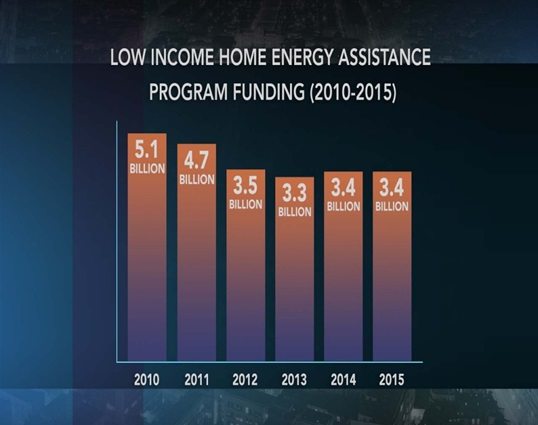
Energy Assistance
Source: U.S. Department of Health and Human Services. Image Credit: Daniel Finley/NewsHour Weekend

Sign up for our free newsletters

Subscribe to NPQ's newsletters to have our top stories delivered directly to your inbox.

By signing up, you agree to our privacy policy and terms of use, and to receive messages from NPQ and our partners.

…but the peculiar hardships caused by extreme weather this winter have affected household budgets negatively in other ways. In Massachusetts, schools have been closed for several days, causing additional expenses or missed workdays for many low-income households, and in and around Boston, public transport ground to a halt for extended periods, which also had an impact on low-wage workers.

A mild December mitigated some of the past month’s intensity of need, but as Ms. Knittle said, “The federal government gives money to the state every year to help households through the coldest times of winter, and most of the households have used up those fuel assistance benefits. In spite of the fact that the price of home heating oil is considerably lower than it was last year, the price of electricity and natural gas has increased considerably.”

A report for PBS NewsHour out of Asheville, N.C., describes the quandaries of a few residents making use of fuel assistance funds:

“Jorge Londono is 40 years old and has four kids. His single-family home is equipped with an oil heater. He told us he couldn’t afford the upfront cost of having the oil company deliver the minimum of 100 gallons, so his family opted to switch on electric space heaters instead. Now he’s facing two electric bills totaling more than $1,000.

“Debra Wolf, 36, came to Eblen Charities with her mother, Jackie Henry (left). Wolf owes back payments of $417 on her utility bill. She and her four kids have struggled since her husband’s work schedule was cut from 80 hours to 40 hours each week. His hour-long commute each day means gas—along with food and utilities—are straining the family budget.”

Fuel assistance programs limit the amounts that can be drawn down per family, but as Mr. Londono’s story exhibits, attempts by families to limit expenditures can backfire—not just in higher costs elsewhere, but in healthcare and other expenses as well as safety. Although energy companies may not cut off utilities in the dead of winter, many families worry about the kind of instability that February’s reduced incomes and increased fuel costs will mean for their families as the weather gets warmer and threats of shutoffs are more imminent.—Ruth McCambridge


 

Our Voices Are Our Power.

Journalism, nonprofits, and multiracial democracy are under attack. At NPQ, we fight back by sharing stories and essential insights from nonprofit leaders and workers—and we pay every contributor.

Can you help us protect nonprofit voices?

Your support keeps truth alive when it matters most.
Every single dollar makes a difference.

Donate now
logo logo logo logo logo
About the author
Ruth McCambridge

Ruth is Editor Emerita of the Nonprofit Quarterly. Her background includes forty-five years of experience in nonprofits, primarily in organizations that mix grassroots community work with policy change. Beginning in the mid-1980s, Ruth spent a decade at the Boston Foundation, developing and implementing capacity building programs and advocating for grantmaking attention to constituent involvement.

More about: Corporations and InequalityEconomic DevelopmentNonprofit NewsPolicy
See comments

You might also like
Disability Groups Are Standing United for Trans Rights. That Hasn’t Always Been the Case.
Sara Luterman
New Student Loan Limits Could Threaten Diversity in Nursing and Public Health Programs
Lauren Nuttall
‘I’m Heartbroken’: Trans Kansans Reckon with Their Driver’s Licenses Being Invalidated
Sherman Smith and Morgan Chilson
After Years of Waiting, She Wanted to Start Gender-Affirming Care. Politics Interfered.
Orion Rummler
In the Face of Authoritarianism, Connection Is Resistance
EJ Juárez
Nonprofits Can Help Fight Trump’s Persecution of Immigrants
Matthew Rozsa

Upcoming Webinars

Group Created with Sketch.
March 19th, 2:00 pm ET

Open Board Search

How Casting a Wide Net Transforms Nonprofit Governance

Register
Group Created with Sketch.
March 26, 2:00 pm ET

Learn Out Loud

How Every Philanthropy, Nonprofit, and Community Member Can Leverage Power in Our Fight Against ICE

Register

    
You might also like
A person at a march holds a sign with the blue, pink, and white trans flag that reads “We See You, We’ve Got You”
Disability Groups Are Standing United for Trans Rights. That...
Sara Luterman
Yellow CLOSED sign hanging in a dusty shop window, conveying themes of business failure, recession, and economic downturn.
Nonprofits in Limbo as Flipcause Bankruptcy Unfolds
Lauren Girardin
A close shot of the front of the US Department of Education in Washington, DC.
New Student Loan Limits Could Threaten Diversity in Nursing...
Lauren Nuttall

Like what you see?

Subscribe to the NPQ newsletter to have our top stories delivered directly to your inbox.

See our newsletters

By signing up, you agree to our privacy policy and terms of use, and to receive messages from NPQ and our partners.

  • About
  • Advertise
  • Careers
  • Contact
  • Copyright
  • Donate
  • Editorial Policy
  • Funders
  • Submissions

We are using cookies to give you the best experience on our website.


Nonprofit Quarterly | Civic News. Empowering Nonprofits. Advancing Justice.
Powered by  GDPR Cookie Compliance
Privacy Overview

This website uses cookies so that we can provide you with the best user experience possible. Cookie information is stored in your browser and performs functions such as recognising you when you return to our website and helping our team to understand which sections of the website you find most interesting and useful.

Strictly Necessary Cookies

Strictly Necessary Cookie should be enabled at all times so that we can save your preferences for cookie settings.