logo logo
giving banner
Donate
    • Membership
    • Donate
  • Social Justice
    • Racial Justice
    • Climate Justice
    • Disability Justice
    • Economic Justice
    • Food Justice
    • Health Justice
    • Immigration
    • LGBTQ+
  • Civic News
  • Nonprofit Leadership
    • Board Governance
    • Equity-Centered Management
    • Finances
    • Fundraising
    • Human Resources
    • Organizational Culture
    • Philanthropy
    • Power Dynamics
    • Strategic Planning
    • Technology
  • Columns
    • Ask Rhea!
    • Ask a Nonprofit Expert
    • Economy Remix
    • Gathering in Support of Democracy
    • Humans of Nonprofits
    • The Impact Algorithm
    • Living the Question
    • Nonprofit Hiring Trends & Tactics
    • Notes from the Frontlines
    • Parables of Earth
    • Re-imagining Philanthropy
    • State of the Movements
    • We Stood Up
    • The Unexpected Value of Volunteers
  • CONTENT TYPES
  • Leading Edge Membership
  • Newsletters
  • Webinars

UN Report Finds Alarming Increase in Murders of Indigenous Environmental Activists

Sheela Nimishakavi
September 5, 2018
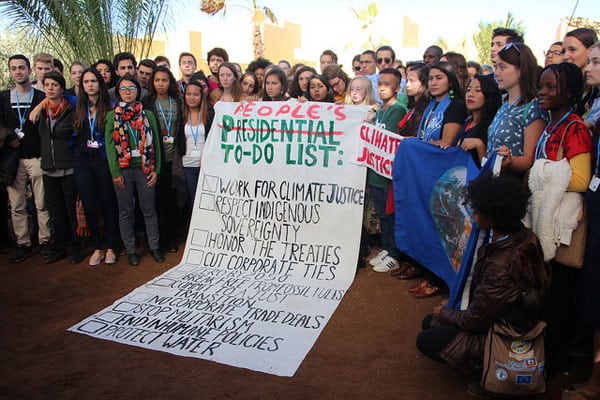
“Youth Grieve and Denounce Trump’s Election at UN Climate Talks COP22,” Takver

September 4, 2018; Indian Country Today

In 2017, NPQ reported that 2016 was the deadliest year for indigenous activists; in the end, 2017 surpassed even that. With large-scale projects promising heaping profits, the alarming trend of the murder, persecution, and criminalization of indigenous peoples continues to rise, as indicated in the latest report by the UN Special Rapporteur on the Rights of Indigenous Peoples, Victoria Tauli-Corpuz. NPQ readers are encouraged to read the full report, as Tauli-Corpuz explains the crisis and its root causes in detail.

According to the report, the basis for these attacks lies in “the intensified competition over natural resources led by private companies, at times with government complicity” which “has placed indigenous communities seeking to protect their traditional lands at the forefront as targets of persecution.” Tauli-Corpuz explains:

Instances of criminalization and violence arises, in most cases, when indigenous leaders and community members voice opposition to large projects relating to extractive industries, agribusiness, infrastructure, hydroelectric dams and logging. In other instances, indigenous peoples’ ways of life and subsistence are deemed illegal or incompatible with conservation policies, leading to the prohibition of indigenous traditional livelihoods and the arrest, detention, forced eviction and violations of other human rights of indigenous peoples.

Sign up for our free newsletters

Subscribe to NPQ's newsletters to have our top stories delivered directly to your inbox.

By signing up, you agree to our privacy policy and terms of use, and to receive messages from NPQ and our partners.

Because of this, most of 2017’s attacks and transgressions took place in resource-rich countries such as Brazil, Colombia, Mexico, and the Philippines. However, we also saw human rights violations unfold in our own backyard with the Standing Rock Sioux Reservation and the Dakota Access Pipeline. Moreover, this is not a new phenomenon. NPQ has been reporting on these human rights violations since at least 2014, covering the murders of high-profile indigenous activists in both Peru and Honduras.

At first glance, it seems impossible that so many people are killed each year without these stories receiving more attention. Global Witness reported that 207 murders of environmental defenders took place just in 2017. Yet, a deeper look into this system reveals that the killings take place within a framework of arrests based on “trumped-up charges,” smear campaigns against native communities, “undue legal prosecution,” and increasing militarization. Entire indigenous communities have been labeled terrorists or thugs, even when they are just exercising their right to peaceful protest.

The horror of murder is easier to grasp, but the other human rights violations must not be dismissed. Years of legal proceedings have an enormous economic impact on the families involved, not to mention the mental and emotional fatigue resulting from fighting arbitrary arrests. Smear campaigns labelling indigenous leaders as criminals contribute to the systemic racism these communities face and make it more difficult for indigenous communities to receive aid. Moreover, the danger associated with indigenous activism undoubtedly hinders their ability to recruit help and support.

That this situation is dire goes without saying. In her report, however, Tauli-Corpuz lays out a handful of recommendations, two of which occur at the government level and must be enacted if we are to ever put an end to this crisis. First, governments must adopt a “zero-tolerance approach to the killing and violence of indigenous human rights defenders.” Secondly, governments must publicly support indigenous communities and their rights. This support goes beyond merely mouthing words to working with indigenous peoples to get their “free, prior and informed consent” on projects affecting their land or their traditions. The government must make it their mission to protect the welfare of all their people—including indigenous communities.— Sheela Nimishakavi


Our Voices Are Our Power.

Journalism, nonprofits, and multiracial democracy are under attack. At NPQ, we fight back by sharing stories and essential insights from nonprofit leaders and workers—and we pay every contributor.

Can you help us protect nonprofit voices?

Your support keeps truth alive when it matters most.
Every single dollar makes a difference.

Donate now
logo logo logo logo logo
About the author
Sheela Nimishakavi

Sheela Nimishakavi is a nonprofit finance and operations professional with a passion for creating socially just and inclusive communities. She has held senior management positions at several community based organizations addressing access to healthcare and services for persons with disabilities, currently serving as the Director of Operations of the Brain Injury Association of Virginia. After working in the nonprofit field for over a decade and seeing many organizations struggle with the administrative requirements of running a nonprofit, Sheela founded ThirdSuite, a consulting firm that offers nonprofit administrative services and trainings to help organizations increase their capacity and further their mission. Sheela received an MA/MPH in Health Policy and Management from Boston University School of Public Health, and a BS in Neurobiology, Physiology and Behavior from the University of California, Davis. She currently serves on the boards of the Central Virginia Grant Professionals Association and Empowering People for Inclusive Communities.

More about: Indigenous CommunitiesNonprofit NewsPolicy
See comments

Call to action
You might also like
Social Enterprise: Lessons from Down Under
Vicki Pozzebon
If Farm School NYC Closes, What Will the City Lose?
Farm School NYC and Iris M. Crawford
A Lakota Matriarch Offers Perspective on the Long Struggle for LandBack
Martell Hesketh
How to Reclaim Land Ownership for Black Americans in the South
Dãnia Davy
A Sacred Responsibility: The Struggle to Restore Native Cultures in the South
Dr. Crystal Cavalier-Keck
An Indigenous Nonprofit Responds to Budget Cuts with a New Strategic Vision
Steve Dubb

Upcoming Webinars

Group Created with Sketch.
January 29th, 2:00 pm ET

Participatory Decision-making

When & How to Apply Inclusive Decision-making Methods

Register
Group Created with Sketch.
February 26th, 2:00 pm ET

Understanding Reduction in Force (RIF) Law

Clear Guidance for Values-centered Nonprofits

Register

    
You might also like
A red circle overlayed on a yellow background with three multi-colored dots on each side. In the center it reads, " Isaiah Thompson: Staff Picks for 2025"
Staff Picks for 2025: Isaiah Thompson
Isaiah Thompson
Staff Picks for 2025: Steve Dubb
Steve Dubb
A red circle overlayed on a yellow background with three multi-colored dots on each side. In the center it reads, "Alison Stine: Staff Picks for 2025"
Staff Picks for 2025: Alison Stine
Alison Stine

Like what you see?

Subscribe to the NPQ newsletter to have our top stories delivered directly to your inbox.

See our newsletters

By signing up, you agree to our privacy policy and terms of use, and to receive messages from NPQ and our partners.

  • About
  • Advertise
  • Careers
  • Contact
  • Copyright
  • Donate
  • Editorial Policy
  • Funders
  • Submissions

We are using cookies to give you the best experience on our website.


Nonprofit Quarterly | Civic News. Empowering Nonprofits. Advancing Justice.
Powered by  GDPR Cookie Compliance
Privacy Overview

This website uses cookies so that we can provide you with the best user experience possible. Cookie information is stored in your browser and performs functions such as recognising you when you return to our website and helping our team to understand which sections of the website you find most interesting and useful.

Strictly Necessary Cookies

Strictly Necessary Cookie should be enabled at all times so that we can save your preferences for cookie settings.