
logo logo
giving banner
Donate
    • Membership
    • Donate
  • Social Justice
    • Racial Justice
    • Climate Justice
    • Disability Justice
    • Economic Justice
    • Food Justice
    • Health Justice
    • Immigration
    • LGBTQ+
  • Civic News
  • Nonprofit Leadership
    • Board Governance
    • Equity-Centered Management
    • Finances
    • Fundraising
    • Human Resources
    • Organizational Culture
    • Philanthropy
    • Power Dynamics
    • Strategic Planning
    • Technology
  • Columns
    • Ask Rhea!
    • Ask a Nonprofit Expert
    • Economy Remix
    • Gathering in Support of Democracy
    • Humans of Nonprofits
    • The Impact Algorithm
    • Living the Question
    • Nonprofit Hiring Trends & Tactics
    • Notes from the Frontlines
    • Parables of Earth
    • Re-imagining Philanthropy
    • State of the Movements
    • We Stood Up
    • The Unexpected Value of Volunteers
  • CONTENT TYPES
  • Leading Edge Membership
  • Newsletters
  • Webinars

Standoff between Mounties and First Nations in British Columbia Continues

Erin Rubin
January 16, 2019

January 14, 2019; Popular Resistance and Vancouver Sun

Last week, NPQ reported on a standoff in British Columbia between a First Nations tribe called the Wet’suwet’en and the Royal Canadian Mounted Police (RCMP). RCMP says they were merely enforcing an injunction from a Canadian supreme court, but they arrested 14 First Nations people who were asserting their right to control their own land. This week, the Wet’suwet’en have been calling on other First Nations and their allies to stand in solidarity and support their story against the dominant narrative being pushed by the Canadian government, RCMP, and the oil and gas companies.

Much like the protest at Standing Rock a couple of years ago—or the Kanesatake standoff near Montréal decades before—the Wet’suwet’en protest is seen as emblematic of the struggle between indigenous groups and settler colonial governments. The Wet’suwet’en never ceded their land to Canada and assert that they are merely living on their land and wish their government to be dealt with on equal terms. Canada’s government, meanwhile, under Justin Trudeau, has talked a lot about indigenous rights but has failed to make material progress toward a framework for respecting those rights.

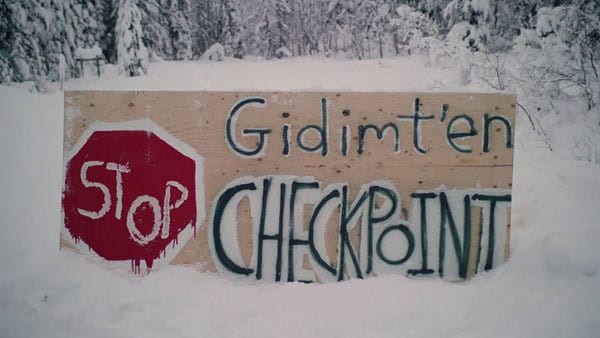
After the raid last week, the hereditary chiefs came to an agreement with the RCMP to avoid any further traumatic events, injuries, or arrests. The Wet’suwet’en agreed to dismantle their checkpoint gate to allow workers into the area but maintain that they will not permit the pipeline to be built.

“It’s very insulting, but it’s negotiations, a give and take. We need to look after our people. But there will be no construction, that must be made very clear,” said hereditary Chief Namok. Others have pointed out that agreement under fear or other coercive forces is hardly the start of real and respectful negotiations, but the chiefs have said that while they will not yield on the question of the pipeline, the safety of tribe members is paramount.

Jennifer Wickham, a member of the Gidum’ten clan of Wet’suwet’en, explained that the RCMP weren’t even supposed to be removing the gate; according to the injunction, they were only supposed to keep the peace. However, she said, they attempted to move and dismantle the gate when they invaded the checkpoint and nearly broke the arms of defenders chained to the gate.

Sign up for our free newsletters

Subscribe to NPQ's newsletters to have our top stories delivered directly to your inbox.

By signing up, you agree to our privacy policy and terms of use, and to receive messages from NPQ and our partners.

According to Justin Brake at APTN, “RCMP Assistant Commissioner Eric Stubbs said the RCMP would conduct a standard review of their operation, which will include reviewing video footage of the arrests, but that as of Monday they ‘have not yet identified any issues regarding police officer conduct.’”

Now, people posting on Facebook from the camp say the new agreement, reached under at least some degree of duress, is not being respected either.

“That agreement, which dictates that all police exclusion zones will be lifted immediately and that our members will have free access to our territories, has already been violated by the RCMP,” wrote Julia Landry. Video shows tribe member Rita David arguing with police, saying, “You guys are invading our space…that’s just intimidating towards us.” David says she is being kept from the road in front of her home by RCMP’s enforcement of a work zone that was not part of the agreement.

Mounties have been blocking the press from where the police are, saying “This is a worksite, so we can’t allow you here for your safety,” although there isn’t any work going on yet, per the agreement.

More solidarity actions have been taking place across Canada and the US over the past week, including a non-indigenous group who blocked a pipeline in their area to protest the primacy of natural resource extraction companies.

As Carey Newman, a First Nations artist and professor, said, “Until this country is willing to listen to their own Supreme Court and recognize hereditary rights and title, these unresolved issues will continue to end in confrontation.”

The agreement reached this week was for the purpose of allowing continued negotiations, hopefully with a more respectful framework and recognition of who carries tribal authority.—Erin Rubin


Our Voices Are Our Power.

Journalism, nonprofits, and multiracial democracy are under attack. At NPQ, we fight back by sharing stories and essential insights from nonprofit leaders and workers—and we pay every contributor.

Can you help us protect nonprofit voices?

Your support keeps truth alive when it matters most.
Every single dollar makes a difference.

Donate now
logo logo logo logo logo
About the author
Erin Rubin

Erin Rubin was an assistant editor at the Nonprofit Quarterly, where she was in charge of online editorial coordination and community building. Before joining NPQ, in 2016, Erin worked as an administrator at Harvard Business School and as an editorial project manager at Pearson Education, where she helped develop a digital resource library for remedial learners. Erin has also worked with David R. Godine, Publishers, and the Association of Literary Scholars, Critics, and Writers. As a creative lead with the TEDxBeaconStreet organizing team, she worked to help innovators and changemakers share their groundbreaking ideas and turn them into action.

More about: Land JusticeNonprofit NewsPolicy
See comments

Call to action
You might also like
Social Enterprise: Lessons from Down Under
Vicki Pozzebon
A Vision for Land and Liberation
Emily Kawano
What Is Land Justice? Nonprofit Leaders Share Their Answers
Steve Dubb, Savannah Romero, Trevor Smith, Peter Sabonis, Olga Talamante and Nick Tilsen
If Farm School NYC Closes, What Will the City Lose?
Farm School NYC and Iris M. Crawford
A Community Land Trust Movement Rises in New York City: Leadership Lessons
Deyanira Del Rio and Debra Ack
A Lakota Matriarch Offers Perspective on the Long Struggle for LandBack
Martell Hesketh

Upcoming Webinars

Group Created with Sketch.
January 29th, 2:00 pm ET

Participatory Decision-making

When & How to Apply Inclusive Decision-making Methods

Register
Group Created with Sketch.
February 26th, 2:00 pm ET

Understanding Reduction in Force (RIF) Law

Clear Guidance for Values-centered Nonprofits

Register

    
You might also like
A protest sign reading, “No Business on a dead planet”, emphasizing how the wellbeing of our planet is more important than profit.
Social Enterprise: Lessons from Down Under
Vicki Pozzebon
Mural of a girl wearing a VR headset projecting colorful shapes toward a hummingbird, with the words “S.T.E.A.M. DREAMS” on a light green wall.
A Vision for Land and Liberation
Emily Kawano
Mural of a woman looking left, wearing a gold necklace with the word “Newark,” overlaid with city buildings and a starry sky in the background.
What Is Land Justice? Nonprofit Leaders Share Their Answers
Steve Dubb, Savannah Romero, Trevor Smith, Peter Sabonis, Olga Talamante and Nick Tilsen

Like what you see?

Subscribe to the NPQ newsletter to have our top stories delivered directly to your inbox.

See our newsletters

By signing up, you agree to our privacy policy and terms of use, and to receive messages from NPQ and our partners.

  • About
  • Advertise
  • Careers
  • Contact
  • Copyright
  • Donate
  • Editorial Policy
  • Funders
  • Submissions

We are using cookies to give you the best experience on our website.


Nonprofit Quarterly | Civic News. Empowering Nonprofits. Advancing Justice.
Powered by  GDPR Cookie Compliance
Privacy Overview

This website uses cookies so that we can provide you with the best user experience possible. Cookie information is stored in your browser and performs functions such as recognising you when you return to our website and helping our team to understand which sections of the website you find most interesting and useful.

Strictly Necessary Cookies

Strictly Necessary Cookie should be enabled at all times so that we can save your preferences for cookie settings.