

Notes from the Frontlines highlights the stories, needs, and solidarity of organizations on the frontlines in the struggle for a multiracial and equitable democracy in the United States. Each installment will explore how organizations are responding to the current political landscape—and what the entire nonprofit and philanthropic ecosystem can do to support them.
In the United States, we have become accustomed to bursts of solidarity that show up during movement moments and national crises. In the past few months, people and organizations have gathered for protests against immigration enforcement, No Kings rallies, and mutual aid support. These powerful examples of episodic solidarity—which are often catalyzed by injustice, state violence, or catastrophic events—spread awareness, mobilize people, and make demands to power holders.
Nowhere is this more evident than in Minneapolis, where people of all backgrounds have shown us what it means to organize quickly, center vulnerable immigrants, address survival needs, and speak truth to power.
We have seen this kind of solidarity before: the rallies that followed the murder of Breanna Taylor in Louisville, KY; the local efforts nationwide to push for ceasefire resolutions to end the genocide in Palestine; and the mutual aid and support after the Los Angeles wildfires.
When solidarity arrives in bursts—ignited by movement moments, urgent campaigns, or collective outrage—it tends to recede when the crisis subsides or another one takes its place. But to sustain solidarity beyond the initial spark and to transform it into a meaningful, lasting practice, we must support, organize, and buttress both short-term scaffolding and long-term infrastructure.
The Conditions for Transformative Solidarity
While momentary expressions of solidarity matter, transformative solidarity happens when there is a material shift.
At the Building Movement Project, we draw upon Black, Indigenous, labor, disability, and queer transnational traditions, as well as our own work with coalitions and networks on the frontlines, to frame transformative solidarity as a set of practices that are always in conversation and in relationship with each other.
We have identified six identifiable practices of transformative solidarity that often show up in social movements, including:
- Connections and Commonalities
The practice of building shared understanding across differences
- Centering
The practice of following the leadership and wisdom of those most impacted by oppression and injustice
- Co-conspiratorship
The practice of taking risks to fairly redistribute power and resources
- Co-liberation
The practice of acknowledging that our freedom is bound together and taking coordinated actions from this understanding
- Capacity and Conflict
The practice of navigating harm, tension, and repair within and across organizations and communities
While momentary expressions of solidarity matter, transformative solidarity happens when there is a material shift. That change could be at the individual level—perhaps, after listening to Black immigrants speak about their experiences with anti-Black racism and xenophobia, an individual could shift their understanding of issues such as restrictions on asylum and refugee rights.
It takes time, intentionality, and infrastructure for solidarity to move beyond a spark to sustained change.
The shift could also happen at an organizational level; perhaps, after being asked by community members to take a position on the genocide in Palestine, an organization’s leadership begins a conversation about values alignment.
Or the change could happen at a systemic level, like after hearing testimony from survivors of profiling and hate violence in the post 9/11 era, Congress passes redress and repair legislation.
Transformative Solidarity Requires Infrastructure
In each of the examples above about transformative solidarity, one factor is evident: it takes time, intentionality, and infrastructure for solidarity to move beyond a spark to sustained change. At the Building Movement Project, our solidarity work with movement partners has shown us that building and maintaining solidarity—both in crisis moments and across the long arc of movement building—requires intentional investment across four interconnected parts.
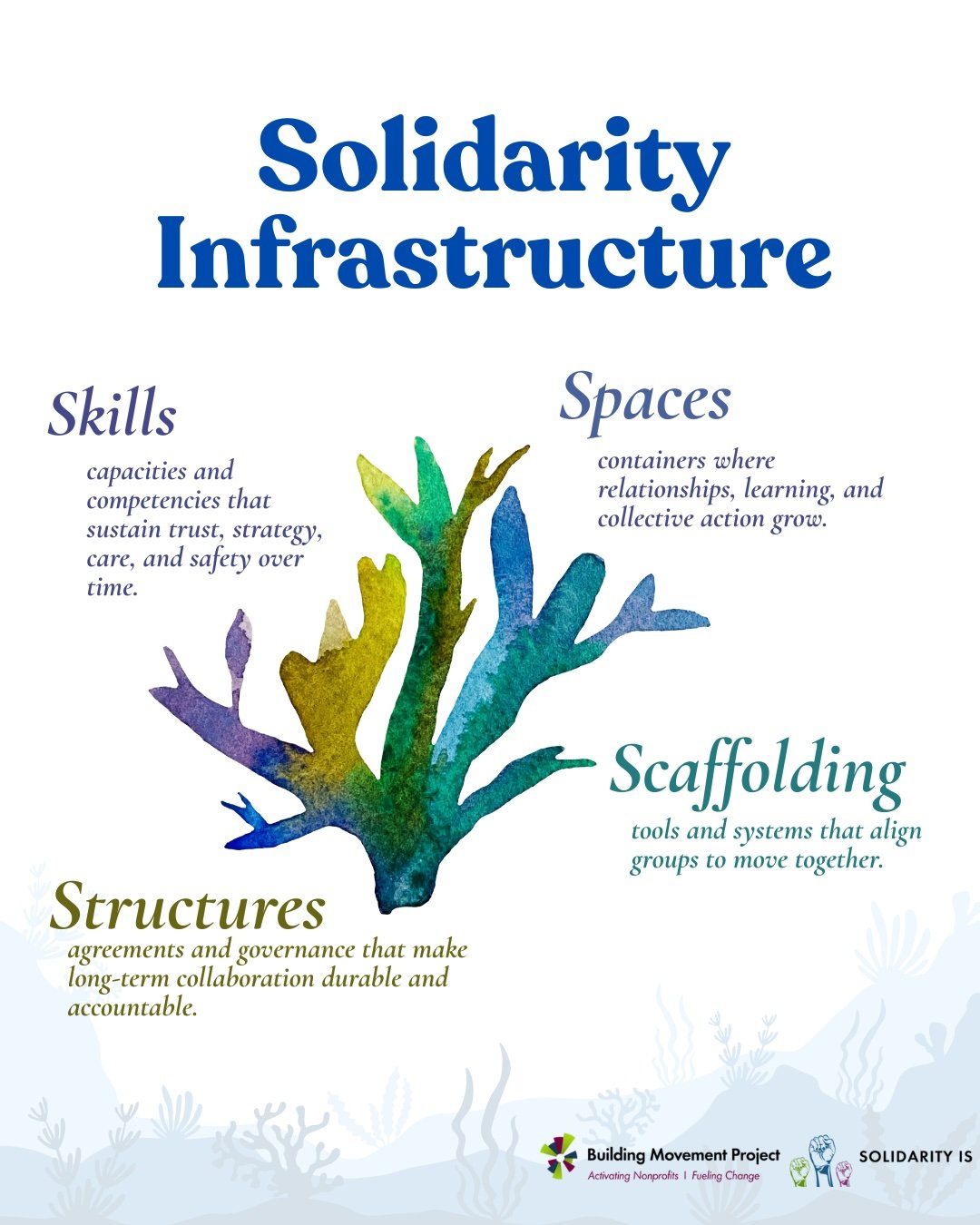
Each piece strengthens the others, forming the foundational blocks that can hold us through immediate challenges while building toward lasting power and transformation.
Sign up for our free newsletters
Subscribe to NPQ's newsletters to have our top stories delivered directly to your inbox.
By signing up, you agree to our privacy policy and terms of use, and to receive messages from NPQ and our partners.
- Skills
Transformative solidarity depends on developing shared skills and practices that can sustain us for the long haul. Movement leaders tell us that these skills include building trust, navigating conflict with care, strategic scenario planning, consensus building, analyzing systemic oppression across movements, understanding historical patterns of policies, balancing complexities and contradictions in our analysis of conditions, dismantling narratives that pit communities against each other, and protecting the security and safety of leaders and organizations.
- Spaces
Transformative solidarity deepens when there are intentional spaces—physical, digital, and collaborative—where relationships are strengthened, strategies become aligned, political education is shared, bold visions are dreamed, and collective work can unfold. These spaces could look like strategy sessions where movements align in direction; co-learning exchanges to connect organizers across geographies and issue areas; rapid response channels to communicate quickly during crises; spaces where community members come together for political education; and healing circles that resource our people.
- Scaffolding
To maintain solidarity in the short and long term, movements need scaffolding: frameworks, tools, and connective systems that support coordination and shared understanding. Scaffolding helps organizations locate themselves within broader ecosystems and clarifies how groups can move together rather than in silos. For coalitions emerging in a crisis moment, scaffolding could include coordinated response systems and network weavers who understand how to hold space and support alignment for rapid response through skilled facilitation, political context-setting, and strategic sensemaking.
- Structures
Durable structures carry us beyond immediate crisis moments into sustained collaboration for the long haul. These structures are often determined during the time of scaffolding to understand what might work to keep organizations and networks together during and beyond the rapid response moment. Structures could include protocols, agreements and governance practices that make solidarity sustainable beyond single moments.
For example, establishing clear protocols for decision-making can clarify confusion. Explicit agreements around resource-sharing, communication flows, and accountability can mitigate tension between groups. Additionally, conflict transformation agreements—around whom to go to when conflict arises, when mediation will be used, and how healing justice frameworks can be relied upon— can help groups tend to tension and sustainability through a generative approach. Structures also attend to questions of power and position by identifying which communities and organizations are most directly impacted and learning how to center their voices and perspectives. Structures can also look like a statement of alignment that signals a network’s values and principles internally and to the external world.
When investments are not sustained beyond the short term burst of solidarity, organizers have to start over every time a new issue or crisis emerges.
Transformative solidarity infrastructure requires that these four parts work together. Skills without spaces remain theoretical. Spaces without scaffolding lack coherence. Scaffolding without structures becomes temporary. Structures without skills and spaces can become hollow ecosystems, the mechanics of coordination lacking both the people equipped to operate them and the relationships to give them meaning.
When we build across all four arenas—developing capacities, creating intentional containers, establishing shared frameworks, and constructing durable systems—we create infrastructure capable of holding us through crisis, strengthening relationships over time, and increasing our power to achieve lasting transformation.
Philanthropy’s Role in Sustaining Solidarity
Philanthropic institutions can play a role in supporting transformative solidarity infrastructure by increasing their investments in these four arenas. In order to make a significant impact in solidarity, funders must go well beyond investing in short-term campaigns and rapid response.
When investments are not sustained beyond the short term burst of solidarity, organizers have to start over every time a new issue or crisis emerges. Robustly supporting solidarity infrastructure can make all the difference.
Examples of philanthropic support include funding for:
- Gatherings, convenings, and strategy spaces regionally and nationally
- Movement weavers who have the credibility and trust to facilitate spaces for organizations to come together
- Pre- and post-campaign actions such as volunteer training and management, political education, and power mapping
- Individual sabbaticals and community healing circles
- Staff positions responsible for solidarity and partnerships (rather than relying on the executive director alone to hold key relationships)
- Solidarity education and practice
- Small experiments that organizations can try out with minimal risk to determine the conditions that could seed solidarity
- Solidarity conversations on the ground between communities and neighbors (rather than solely relying on relationships at the grasstops levels)
Funders must also resist the temptation to evaluate solidarity using outcomes and deliverables that are better suited to short-term campaigns. Transformative solidarity requires a long-term perspective, and its results might not be seen quickly.
In the same vein, if solidarity recedes after a movement moment, funders must not assume that the conditions have shifted. Instead, it is important to recognize that organizers are doing the hard work of building relationships and aligning around principles—work that happens outside of the view of television cameras and social media.
In these ways, philanthropic support for solidarity infrastructure can be a significant investment to support coalitions and networks well beyond movement moments.
Solidarity as a Survival and Civic Strategy
In this time of heightened scrutiny, it is vital for organizations and communities to rely on transformative solidarity, both as a means for survival and a civic strategy.
This means embedding solidarity into the systems that shape our everyday lives, our organizations, and our social change movements. When systems seek to divide us, create wedges between us, and force us to look away from one another, transformative solidarity is the practice that enables us to develop empathy, take risks for each other, and demonstrate the possibilities of shared responsibility.
If we don’t intentionally choose solidarity, both as a commitment and a practice, we risk losing the ground we have gained, crisis response becomes the norm, communities become fragmented, and values become negotiable under pressure. We might also lose the opportunity to imagine a shared future which is essential for a robust democracy to thrive.
We must not assume that solidarity will just emerge and then organically deepen. Instead, we must devote time, funding, staffing, skills building, spaces, and structures to buttress solidarity practices for now and the long run. This is how solidarity—much like voting, organizing, and advocacy—can become a civic strategy for individuals and organizations in the current political environment and beyond.