

As staff leaders and board members, how do we respond when our organizational values are tested in real time? Executive orders, legal threats, and funding pressures are forcing this question every day now across the nonprofit and philanthropic sectors. Often, boards turn to the language they know. But their proximity to risk is different from that of staff, communities, or leaders on the ground. And that difference shapes how risk is understood, prioritized, and acted upon by the organization. It can result in very real risks going unexamined and in an under-recognition for what is truly at stake.
Join strategist, writer, and advisor to mission-driven organizations Dax-Devlon Ross on Thursday, June 25, 2026, at 2 PM (ET), for a discussion about reframing organizational risk. Click here to register.
It’s no secret that “flooding the zone“ has been the primary strategy of this administration—or that the approach has reached a fever pitch when it comes to dismantling diversity, equity, and inclusion (DEI). From my vantage point in mid-2026, the strategy has unfolded in three distinct movements. There was the Day One wave, a blunt-force trauma to the federal bureaucracy that shuttered DEI offices and redefined sex as a strictly biological binary. Then came the second wave, which took the fight to our classrooms and courtrooms by revoking disparate impact protections. By the third wave, the administration sought to “cleanse“ the private sector, targeting everything from AI guardrails to the fiduciary duties of investment firms.
The result has been a volatile mix of immediate enforcement, fierce legal contestation, and sudden abandonment. One could easily argue that this chaos wasn’t a collateral effect; it was the point. But hindsight has a way of making chaos look more coherent than it felt while we were living through it.
In those early months of 2025, perspective was a luxury we did not have. The executive orders crash landed into our lives. They hit faster than organizations could digest them, faster than counsel could interpret them, and certainly faster than leaders could assemble their boards to ask the all-important question: What has actually changed, and what is just noise?
By spring, the administration had scrambled the field, distorted the signal, and made institutions question the ground beneath their own feet. Universities, nonprofits, foundations, and school systems found themselves caught in an atmosphere of escalating uncertainty, legal ambiguity, and political intimidation. All across the mission-driven ecosystem, institutions that had spent years naming equity as central to their values suddenly found themselves asking whether that language had become a liability.
On April 3, that sweeping national anxiety became acutely personal. That morning, the Department of Education issued a certification demand tied to federal funding, requiring education-related institutions to swear they weren’t engaging in what the administration branded “illegal DEI“—a brazen attempt to stretch the logic of the Supreme Court’s Students for Fair Admissions v. Harvard affirmative action ruling into K–12 classrooms. For the nonprofits embedded in schools, it was a sudden, sharp reminder that no one was flying under the radar.
Scrubbing the website or quietly softening their language carried its own massive, volatile risk—a clear threat to staff trust, community credibility, and the very integrity of the mission.
As it happened, exactly one hour after the story broke, I entered a Midtown Manhattan boardroom to lead a conversation with the board of a nonprofit operating in several dozen New York City schools about its embattled anti-racism efforts. The room was packed tight. Board members bumped elbows along the heavy conference table, while a pair of out-of-towners hovered on the Zoom screen. I’d been briefed that this board was a mixed bag: some were veterans deeply anchored to the mission, while others were burgeoning philanthropists looking to roll up their sleeves. All were high-achieving professionals who genuinely wanted NYC’s children to thrive.
But the atmosphere had shifted, seemingly overnight. The administration had signaled a surprisingly sophisticated, granular awareness of the DEI lexicon, treating the terminology as a set of traceable signatures used to smuggle “illegal“ ideologies into policy. For these board members, the moral vocabulary they had comfortably affirmed from a safe distance for years was suddenly a heat map for federal targeting. Terms that had once sounded like earnest conviction—anti-racism, systemic barriers, culturally responsive—now felt like evidence.
I entered the session prepared to move them away from abstract debates and reconnect their anti-racism commitments back to the actual children, schools, and neighborhoods the organization served. More than that, I wanted to talk about the profound risk of changing course. I tried to urge them to consider that scrubbing the website or quietly softening their language carried its own massive, volatile risk—a clear threat to staff trust, community credibility, and the very integrity of the mission. I argued that retreating in a panic would cost them something they might never be able to buy back.
But it was like speaking a foreign language. The words wouldn’t stick. Every time I tried to raise the cost of changing course, the gravitational pull of the room dragged us right back to the immediate, terrifying threat of staying visible.
The questions came quickly: Should the organization remove references to anti-racism or DEI from its website? Was that language now creating unnecessary exposure? How much legal risk were they actually facing? Could continuing to publicly frame the work this way jeopardizes funding streams or institutional partnerships?
I was witnessing in real time the way pressure narrows the imagination. Sitting there at the head of the table, trying valiantly to facilitate several conversations at once, I felt the walls closing in around me. I wanted to help the organization navigate the moment responsibly, to avoid deepening fractures inside the board, and to create movement without causing harm. But legal exposure and institutional vulnerability kept swallowing the room. I could feel how little space there was for people to say plainly what they feared, what they were protecting, or how differently they were carrying the moment.
When the meeting finally ended, people affirmed that it had gone as well as anyone could have expected, maybe better.
Still, I drove back to Washington, DC, replaying every moment in my mind. The board had not failed, and they genuinely cared. By most ordinary measures, the session was fine. But I could not shake the feeling that “fine“ was entirely inadequate for the moment we were in. The warnings I had laid out about the cost of retreating had completely bounced off them.
At the time, I blamed myself, convinced I had failed to facilitate the conversation effectively. What I was actually beginning to wrestle with—what all of us were trying to do—was how to govern through a disturbance we did not yet know how to interpret.
II.
Before last spring, many of us had been living inside a kind of assumed alignment. Across the progressive nonprofit and philanthropic world, especially after the murder of George Floyd, boards and organizations had grown accustomed to saying certain things out loud. Equity was central. Race was foundational. Representation was required. Systems were everywhere. Mission could not be separated from the conditions shaping the lives of the people organizations existed to serve. That all became mantra even if we had differing views on the mandate.
There was disagreement, of course. As there was skepticism. People who never fully understood the language or who quietly wondered whether the work had gone too far. But in the years immediately after 2020, the broader moral atmosphere made it relatively easy for many people to say yes. Yes, we believe in this. Yes, this belongs in our mission. Yes, we want to be on the right side of history.
There is, however, a gulf between affirming a value when the wind is at your back and standing inside a wind tunnel when the turbines roar to life. People who had once agreed in principle now had to ask themselves what that agreement meant under threat. Was equity still mission-critical if it attracted scrutiny? Was anti-racism still central to the work if the language itself could be weaponized? Were these commitments fundamental, or were they secondary to the mission?
Yes, they were governance questions. Of course, they were fiduciary questions. It made sense that boards were grappling with them. But what I began to sense, first dimly and then with more clarity, was that “organizational strategy” was just the language used to mask a deeper panic. In reality, they were trying to locate themselves inside a terrifying new risk environment.
For some, the administration’s assault confirmed the necessity of the work; the backlash was evidence that the commitment was essential, and retreat would be surrender. For others, the same set of facts produced the opposite instinct: if the work was now exposed, the responsible thing was to lower the temperature, change the language, make the commitments less visible, and protect the institution. And between those poles were many people who were not resistant, not indifferent, not hostile, but profoundly unsettled. They supported the work but did not know how to carry it in public. They believed in the mission but were unsure how to defend the language. They wanted to do the right thing but were newly aware that the right thing might cost something.
That was the part I had not anticipated. Something fundamental was still blocking the light, a hidden friction I couldn’t yet see. And so, throughout that volatile spring, as the pressure continued to rise across the sector, I carried that unresolved ache with me everywhere. I kept returning to the question: What was I missing?
III.
Around that time, I started hearing the word resilience everywhere. It showed up in board retreats, staff meetings, strategy conversations, leadership trainings, philanthropic reports. Everyone wanted resilient leaders, resilient organizations, resilient movements.
The word often felt opaque and undefined to me. Too often, resilience seemed to mean endurance. Hold on. Keep going. Absorb the blow. Stay functional while the world becomes less stable around you. That definition never sat right with me.
Disturbance alone does not produce resilience. A shock can teach, but only if a system is willing to learn.
So, I went looking, researching the word. I found myself reading about ancient societies whose histories were punctuated by droughts, crop failures, demographic collapse, migration, conflict, and environmental stress. What held my attention was the variation: some societies recovered, adapted, and carried lessons forward, while others became more brittle after the blow. In case after case, the societies that recovered best were the ones that had faced repeated disturbance. The question was why.
As I looked deeper, I began to see a pattern. Repeated shocks forced people to develop new habits: ways of sharing food, moving across terrain, storing resources, building networks, telling stories, and passing down lessons. Over time, adaptation became collective memory. Memory became culture. Culture became capacity.
Agriculture offered one example. Farming created new possibilities for settlement, storage, and collective life, but it also introduced new vulnerabilities: drought, pests, famine, soil depletion, dependency on seasonal cycles. The innovation produced risk, and the risk required further innovation. Irrigation. Food storage. Trade networks. Migration patterns. New social arrangements.
Disruption became instruction—but only when societies actually did something with it. That was the insight I kept returning to. Disturbance alone does not produce resilience. A shock can teach, but only if a system is willing to learn. Otherwise, disruption simply passes through the system as fear, confusion, or retreat.
That helped me think differently about what had happened in organizations after 2020. The murder of George Floyd was a profound social and moral rupture. Many institutions responded quickly. They issued statements, hired trainers, created equity committees, recruited more people of color, and rewrote values. Some of that work was meaningful, and some of it was performative, but broadly speaking, the sector reached for moral and financial solutions. Organizations wanted to signal that they were listening, that they understood something had changed, and that they were willing to respond.
[M]oral risk does not disappear because legal counsel is in the room. Community risk does not disappear because federal funding feels uncertain. Staff trust does not disappear because the board is focused on exposure. They simply become harder to see.
Here’s the thing: those post-2020 changes rarely altered the underlying mechanics of how decisions were made. Consequently, they never became collective memory or governance muscle. The disruption passed through the sector, rather than teaching it how to learn.
This time, the pressure did not invite organizations to demonstrate moral alignment. Rather, it threatened them for having done so. And because many institutions had never fully stress-tested their values as governance commitments, their systems struggled to respond. Organizations that asked in 2020 what does the moment requires of us morally began asking a different question: What does this expose us to legally, financially, politically?
But moral risk does not disappear because legal counsel is in the room. Community risk does not disappear because federal funding feels uncertain. Staff trust does not disappear because the board is focused on exposure. They simply become harder to see. And that was what I had missed in the first boardroom. The group was responding through the risk language most available to it. What we had not yet done was slow down enough to ask what else the disturbance was revealing. We had not asked people to locate themselves inside the pressure. We had not made room to distinguish personal anxiety from organizational risk. We had not created a way to name moral, reputational, or community risk with the same seriousness given to legal exposure.
Sign up for our free newsletters
Subscribe to NPQ's newsletters to have our top stories delivered directly to your inbox.
By signing up, you agree to our privacy policy and terms of use, and to receive messages from NPQ and our partners.
The reality is that for some board members, the pressure produced urgency. For others, caution. For others, confusion. For others, fear. And because those responses were not made visible, they could not become useful. They remained private interpretations masquerading as organizational judgment.
That was the moment the core question changed for me. I stopped asking about how do I help boards respond to risk and began asking: How do I help boards understand how they are interpreting risk in the first place?
Most organizations assume risk is something outside the room. But risk is also interpreted inside the room, within the people who have been charged with stewarding an institution. It is filtered through identity, role, proximity, memory, ideology, fear, and responsibility. Every interpretation may not be equally sound, but they each stem from a deep, subjective source. And if we do not surface those sources, they continue shaping decisions from underneath.
This was where the resilience work began to feel especially consequential. Certainly, a resilient organization should strive for a stable balance sheet and healthy reserves. But it is also one that can be disturbed without becoming entirely unintelligible to itself—without losing its identity. A resilient organization can step back and ask: What is this moment revealing about us? What are we learning? What are we protecting? What are we avoiding? What must change if we are going to meet the next disturbance with more capacity than we had before?
That was the work I could not do that day. And once I saw that, I knew that the next time I was in a room like that, I would approach it differently.
IV.
Months later, I got my chance. Another social services organization had reached an impasse with its anti-racism work in the current context. This time, I did not begin with the assumption that the goal was alignment; I began with listening. Before the retreat, I spoke at length with board members and staff, looking to understand how they viewed the work, what they believed was at stake, and what they worried might happen if the board moved too quickly, too cautiously, or failed to move at all.
I heard warmth, respect for the mission, pride in the organization’s work, and a genuine desire to be useful. But beneath the goodwill was a board that had not yet developed the shared language and muscle memory to act as a collective under pressure.
Through those conversations, the hidden forces shaping the boardroom finally became visible. Some board members saw anti-racism as inseparable from mission, client safety, and organizational integrity. For them, the only question was how to deepen consistency. Others believed in the commitment but needed help understanding how it translated into practical governance, strategy, and oversight. Still some struggled to reconcile their belief in meritocracy with the organization’s insistence that fairness requires accounting for unequal starting points. And then there were those whose support became deeply cautious once the external environment entered the equation—they were consumed by anxieties over funding, exposure, public perception, and legal challenge.
What I was hearing was more than a range of standard opinions. It was the live confirmation of the pattern I had encountered across leadership spaces for years: when pressure rose, people assumed recognizable postures toward risk.
They were not just debating anti-racism or DEI; they were locating themselves in relation to what felt most threatened. And because no one had ever asked them to make that location visible, those internal postures had spent years showing up indirectly—as hesitation, urgency, confusion, procedural concern, or neutrality.
I have come to think of this pattern as the risk posture spectrum.
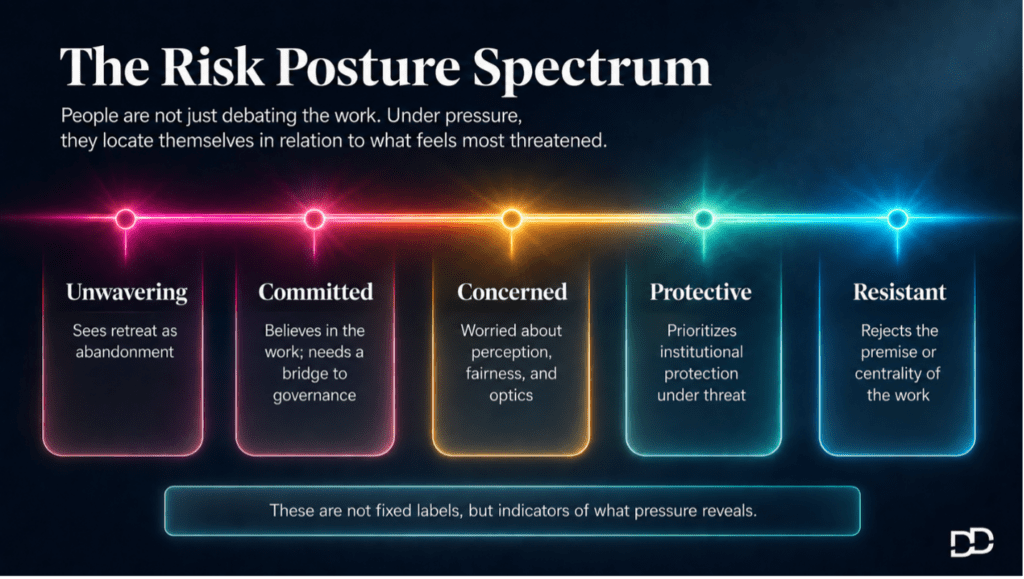
On one end were the unwavering. For them, the backlash did not introduce doubt; it clarified the stakes. They saw equity, anti-racism, or DEI commitments as inseparable from mission. Retreat was not prudence. It was abandonment. Their question was not, should we keep going? But rather, how could we not?
Near them were the committed but seeking clarity. These were people who believed in the work but needed a stronger bridge between values and governance. They were asking: What does this mean for the board? What does this mean for oversight? What does this mean for fundraising, public communication, strategy, or budget decisions? Their uncertainty was not necessarily resistance. Often, it was a request for translation.
Closer to the center were the concerned interpreters. They were trying to read the world beyond the room. They were thinking about donors, political narratives, public perception, legal exposure, media framing, and how the organization’s language might land with people who did not share its assumptions. They might worry that equity language would be read as exclusionary or preferential. They might invoke fairness, neutrality, merit, or equal treatment. Sometimes they were not rejecting the work so much as asking, how will this be perceived?
Further along were the protective reticent. They framed caution as stewardship. They might believe the organization needed to reduce visibility, change language, delay action, or avoid certain public commitments in order to protect itself. They were often fluent in the language of fiduciary responsibility. Their questions were familiar in boardrooms: What if we lose funding? What if we are sued? What if we become a target? What if the organization cannot withstand the cost of being visible?
And at the far end were the resistant. In the kinds of mission-driven organizations I work with, they are usually fewer in number, though not absent. They reject the premise more directly. They do not believe race, identity, or equity should be central to the work. They may see these commitments as divisive, ideological, preferential, or outside the proper scope of the organization. In some rooms, this posture is voiced plainly. In others, it appears through procedural objections, endless requests for proof, or appeals to neutrality.
These postures are not fixed labels, but indicators of what pressure reveals. Seeing them allowed me to design the room differently, treating variation as vital information rather than a conflict to smooth over. Every hesitation had a source, and every certainty carried underlying assumptions. The goal was not to collapse these differences into a premature consensus, but to make them visible enough for the board to learn from.
I opened with connection. Board members spoke to one another about purpose, responsibility, and the experiences that shaped how they understood justice. We created a container for first-draft speech, for uncertainty, for the fact that people were not all entering the conversation from the same place. Only then did I invite the board to look at what had surfaced in the interviews as a mirror. And the mirror showed a board with real commitment, but different orientations, different fears, and different assumptions about what this moment required. Those differences were not obstacles to the work. They were the work.
Because the conversation began with a clearer sense of the identities, orientations, and lived interpretations in the room, people could name tensions without immediately needing to resolve them. Newer members could acknowledge confusion without being shamed. Staff could see where board members were trying to understand. And board members could begin to recognize that their uncertainty had consequences beyond themselves as individuals.
That is one value of the spectrum: it gives a room a way to see itself.
Once these postures were named, the conversation changed. The question was no longer who supports the work and who does not? That question was too crude, too binary, too flat for what disruption reveal. The better questions—the ones that helped them look past their immediate locations on the spectrum—forced a deeper interrogation of the reasoning, assumptions, and anxieties beneath the surface:
- Is my concern about the organization’s actual exposure, or about my personal discomfort with being associated with a contested idea?
- Am I seeing the community’s risk, or only the institution’s?
- Am I asking for clarity because I want to move responsibly, or because uncertainty gives me permission to delay?
- Am I invoking fairness because I am genuinely concerned about equity of treatment, or because I have never fully examined the systems that produced unequal outcomes in the first place?
To force these questions is not to suggest that fear is illegitimate. Fear often carries vital information; it tells us what people believe is fragile, what they think can be lost, and what they feel uniquely responsible for protecting. But fear should never be allowed to disguise itself as the whole of organizational judgment. A board that cannot ask these questions is not governing with clarity. It is managing tension without understanding it. And in a moment of disruption, that is not enough.
The result was not a neat resolution. It was something more useful: a room better able to work with its own complexity. Board members could speak more directly about why their perspectives mattered. Differing viewpoints became less of a threat to manage and more of a resource for discernment.
From there, the board could begin drafting clearer statements of belief and intention, anchored less in external panic than in internal purpose.
V.
Looking back, the contrast between those two rooms clarified everything. In that first boardroom, I had tried to move too quickly toward the risk conversation. I believed that if the board could see the fuller landscape, it would be able to make a better decision. But a fuller map is entirely useless if people do not know where they are standing. That was the painful lesson I had to learn.
Once people can see that they are not simply “for“ or “against“ a value, but are positioned differently in relation to consequence, the entire atmosphere changes. The conversation becomes less defensive and far more discerning. Leaders can begin to not only ask, what risk do I see? But also, what risk might I be missing because of where I stand?
Only then can a board truly widen its aperture. Only then can a room begin to take seriously the risks that are harder to quantify, but no less consequential:
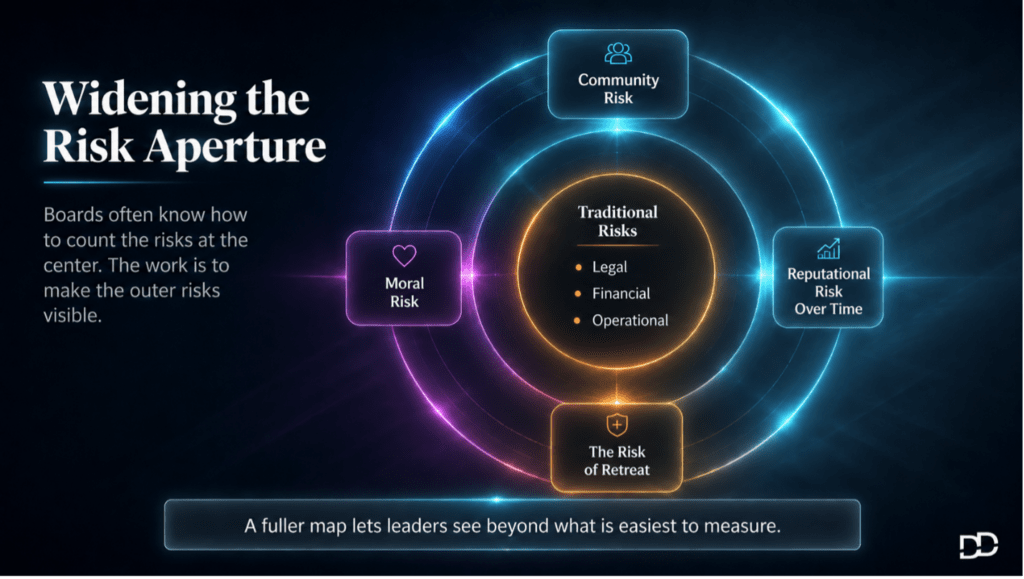
- Community risk: Are we only counting the risks that threaten the institution, or are we also counting the risks borne by the people the institution exists to serve?
- Moral risk: Are we treating staff trust, community confidence, and mission integrity as strategic assets, or as sentiments to be managed after the “real“ decisions have been made?
- Reputational risk over time: How will this decision be understood not just next week, but years from now, when people ask what we did when the pressure came?
- The risk of retreat: Are we using legal uncertainty as a reason to think more carefully, or as permission to abandon commitments before we have fully tested what is actually required?
I am not trying to give boards a neat formula or a rigid rubric that will dictate what courage requires in advance. These questions will not magically resolve every tension. If anything, they may deepen them. Every organization still has to decide for itself what it is willing to risk, what it is trying to protect, and exactly how far its commitments go. But these questions will make the conversation truer. And that is precisely what disruption asks of us, if we are willing to learn from it.
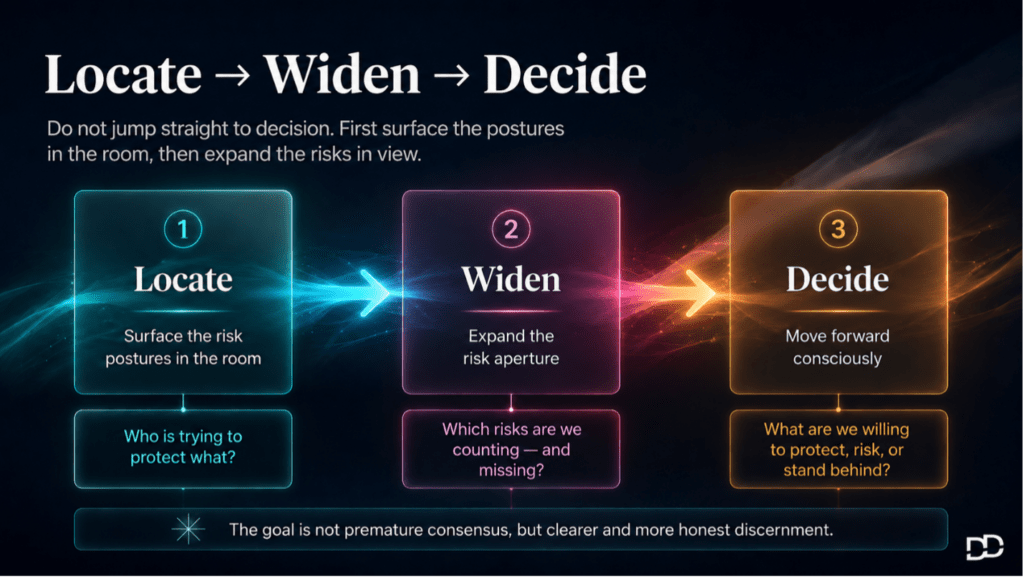
So, the next time your board is stuck, do not begin only with the risks everyone already knows how to name. Begin by asking people to locate themselves inside the moment. Then, and only then, widen the aperture. Something entirely different may become visible.
Once the fuller landscape is visible, a board may still choose caution. It may choose adaptation. It may choose to stand firm. But at least it will know, honestly, what it is choosing. That is what it means to meet the moment. Not to be fearless. Not to pretend the danger is not real. But to see clearly enough to move the mission forward without pretending the hidden risks were never there.