

In a simpler world, worthwhile justice work would always result in a compelling grant application. But in reality, a polished grant application more often proves that an organization has an experienced grant writer, knows the language of philanthropy, and understands how to translate its work into the format a funder expects. As a result, many worthy causes fall by the wayside because grantwriting skills are one of the most influential factors determining who gets funded.
This reality was not lost on the Vancouver Foundation, which was grappling with a troubling pattern in its grantmaking process: Indigenous organizations were underrepresented among recipients of its systems change grant. The grant itself was intended to help communities address systemic inequality, which made the inequity within its selection process especially important to understand.
An unintentionally biased selection process was rewarding other organizations for their fluency in philanthropy’s systems and language.
I spoke to service designer Ayushi Jain, who worked with social impact design studio InWithForward as part of an extensive research and design process examining how organizations experienced Vancouver Foundation’s grant method. She recalls 11 workshops and more than 60 conversations with community members.
Those conversations surfaced barriers that had little to do with the quality of an organization’s work. For instance, some community organizations operated primarily in languages other than English. Others lacked access to professional grant writers or staff who had learned how to navigate funding applications. An unintentionally biased selection process was rewarding other organizations for their fluency in philanthropy’s systems and language.
The design team began to ask another question: What assumptions were reviewers bringing into the room?
To uncover the answer, the team made a deck of cards.
Flipping the logic
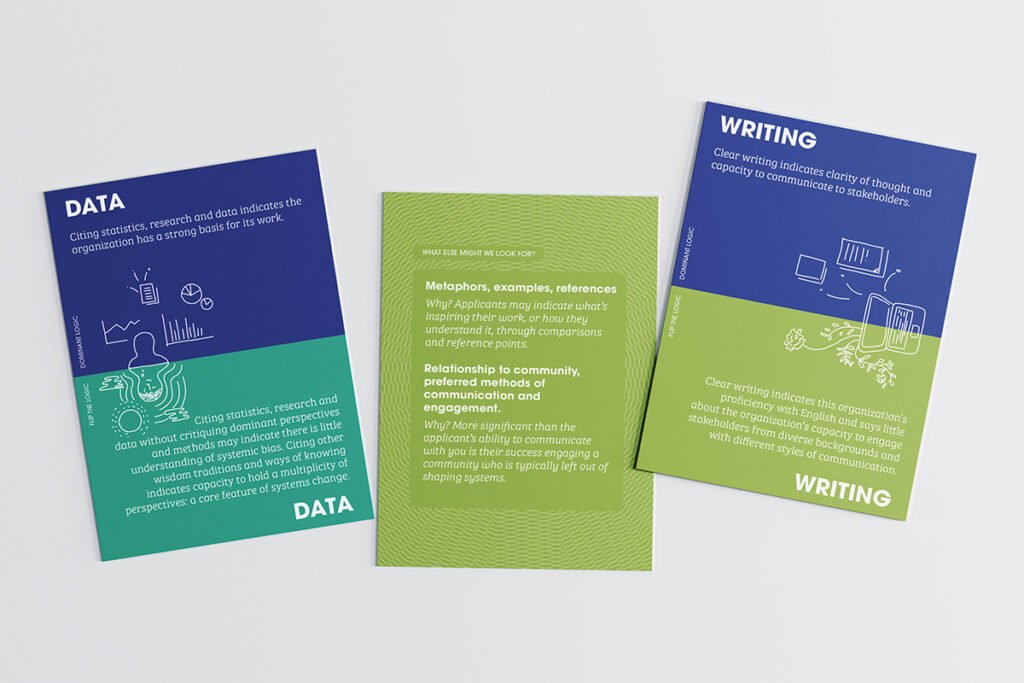
Jain worked on a team with Sarah Schulman, Natalie Napier, and Valentina Branada to create a card deck called “Flippin’ Logics Cards.” These cards identify eight “dominant logics,” or recurring assumptions and ways of thinking that can shape how reviewers interpret an application. Each card pairs that logic with a “flip logic,” a prompt that invites the reviewer to consider the application from another perspective.
“It doesn’t call anyone out, it just allows them to reflect and reconsider.”
One card, for example, surfaces the assumption that a well-written grant application indicates an organization that knows what it is doing. The flip asks reviewers to consider whether grant writing is actually a core requirement for doing the work well. The distinction is small enough to fit on a card, but its implications can reach much further.
A reviewer may be equitably evaluating every application according to the same standards while those very same standards inequitably favor organizations with greater access to money, professional networks, English-language fluency, or familiarity with institutional expectations. Putting that assumption in front of a reviewer makes it visible.
The cards also leave room for complexity. Dominant Logic and Flip Logic do not offer a simple answer about which perspective is correct. The juxtaposition simply challenges reviewers to examine the assumptions influencing their decisions and consider what might change if they looked at the application differently.
“This allows people to catch themselves during the process of reviewing,” Jain noted. “It doesn’t call anyone out, it just allows them to reflect and reconsider.”
Reflection, not accusation
Jain and the team were especially interested in designing a system that allowed people to recognize bias without turning reflection into accusation. “That’s important,” Jain said, “because calling someone out can shut down a conversation.”
Sign up for our free newsletters
Subscribe to NPQ's newsletters to have our top stories delivered directly to your inbox.
By signing up, you agree to our privacy policy and terms of use, and to receive messages from NPQ and our partners.
When feeling accused, people often become defensive or focus their attention on proving they are a good person. As NPQ previously reported, “shaming, blaming, and guilting someone shuts down the center of their brain responsible for learning and growth.”
In contrast, a reflective prompt doesn’t call anyone out. It calls them forward, giving them space to recognize an assumption and adjust their thinking while the decision is still being made. That distinction matters in a grant review process, where bias may appear through ordinary habits rather than explicit intent.
Biased thinking can be difficult to grasp, but a card sits nicely in the palm of a hand.
Format matters
“The physical format of the tool must create the space for reflection,” Jain pointed out.
She went on to explain why the team didn’t design a checklist. Sure, checklists are useful for consistency, but they just become another task to complete. A reviewer moves down the page, checks the appropriate boxes, and keeps going without stopping to think.
However, a deck asks for interaction. Reviewers pick up a card, they read a question, and they turn an idea over in their minds before bringing it into conversation with the people around them. The playful format introduces a moment of interruption into a process that can easily become routine.
And that playfulness is intentional. Jain explained, “Gamification makes reflection easier, because the invitation feels exploratory.” The participant is asked to engage with a question and see where it leads. That small shift can create enough distance for people to examine their own thinking with curiosity, instead of blame.
Not to mention, they are holding a literal deck of cards. Suddenly, an invisible idea has a physical form, making real-time reflection possible while there is still an opportunity to change an outcome.
Biased thinking can be difficult to grasp, but a card sits nicely in the palm of a hand.
Designing for the decision
Equity work inside institutions often begins with broad commitments about who an organization wants to serve. The Flippin’ Logics Cards bring that commitment into a much more intimate space: the moment one person reviews an application and decides if they like it.
That moment is shaped by lived experience, expectations, and ideas about what competence and credibility look like. But thoughtful and creative design can make some of those influences easier to see.
A deck of cards will not erase bias from philanthropy, and as Jain warns, the cards are only effective as “one intervention alongside wider changes to process and practices.”
But the cards can ask decision makers to slow down and reflect in the moment of a consequential decision. A thoughtful design can allow a reviewer to recognize the logic they have inherited, flip a card upside down, and ask themselves what else might be possible.
—-
To learn more about the deck of cards or download a version, click here.