
This article was originally published in Data & Society.
Pennsylvania is a state of many firsts: It was the nation’s first capital, the “birthplace of oil production,” home to “America’s first superhighway,” and the state that monopolized the production of steel in the 20th century. More recently, it has been positioned as one of the leading states in “AI readiness,” a term that loosely refers to how equipped companies and governments are to adopt and integrate AI into their systems and daily operations. In driving through the state as part of our ethnographic fieldwork, we observed how such efforts are playing out and whether accompanying promises of prosperity are coming to fruition.
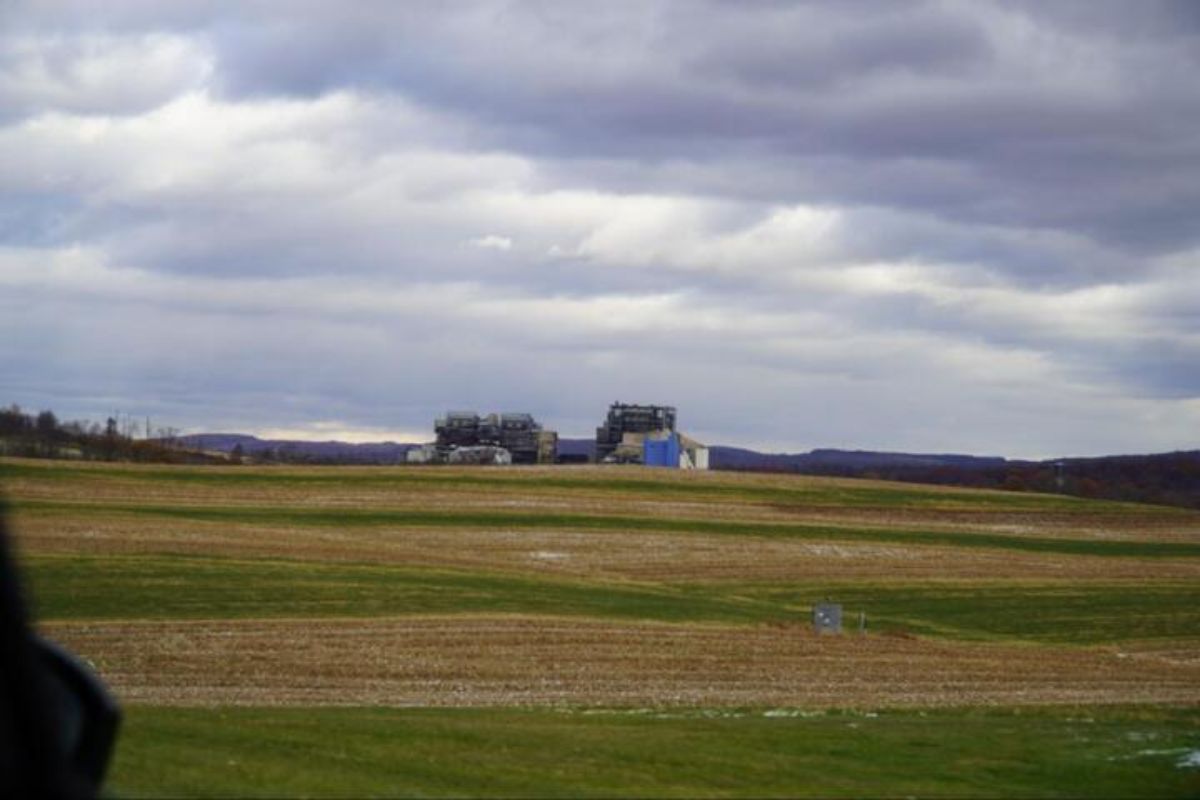
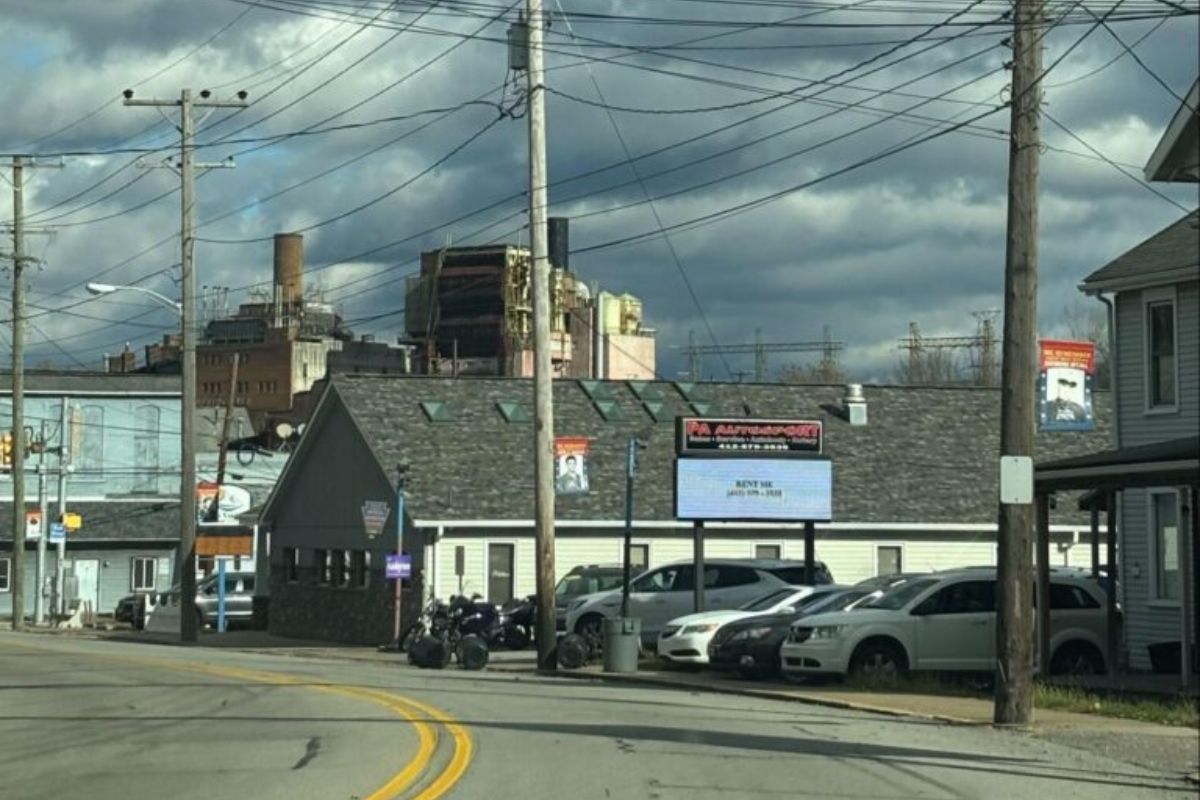
Our team was in Pennsylvania to collect data for our ongoing research on data centers. Ana had recently completed her dissertation about industrial development in Oregon’s Columbia River Basin from the 1930s to the data centers of today; Cella grew up in central Pennsylvania and is currently studying the labor and community impacts of AI as a PhD student at Carnegie Mellon University. So both of us were familiar with the history of the industry, as well as with more recent stories about industrialization and the repurposing of old infrastructure to power technological development, including the cloud. Still, we were struck by the visible layers of industrial development we witnessed in Pennsylvania: first in Pittsburgh, and then east as we traveled through Harrisburg and northeastern Pennsylvania to explore data center and AI infrastructure development on the ground. Behind modest mill towns and stretches of open farmland, smoke stacks and cooling towers loomed in the distance. One of our first stops was at the Homer City Generation Station, about 50 miles east of Pittsburgh. Once the largest coal-fired power plant in the state, it was decommissioned in 2023, but is now slated to transform into a massive 3200-acre natural gas-powered data center campus — the largest in the nation.
In trying to understand the data center industry in Pennsylvania, it made sense to look at how one of the states’ famous cities has been framed as a natural hub for progress and innovation over time. Pittsburgh is known as the “Steel City,” attesting to a rich industrial past when the region’s rivers, mills, and labor powered America’s steel industry in the late 19th century. Today, this legacy remains most visibly in popular symbols like the Pittsburgh Steelers logo. Adopted from the American Iron and Steel Institute’s (AISI) “Steelmark,” the diamonds represent the three elements used to make steel: yellow for coal, orange for iron ore, and blue for steel scrap. Yet much of the physical evidence of the city’s mighty industrial past has faded after years of deindustrialization and economic decline. Today, “Steel City” seems more like a cultural representation of the city’s grit and resilience amid adversity.
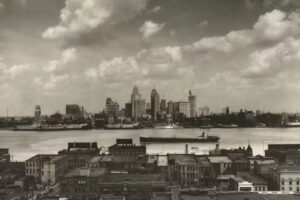
In his book From the Steel City to the White City, Pittsburgh archivist Zachary L. Brodt writes about the “ideal view of Pittsburgh,” in which “middle and upper class Western Pennsylvanians” displayed their wealth through extravagant architecture, and presented the city in world fairs as advanced and forward-facing, responsible for much of the development and progress across the country. According to Brodt, western Pennsylvania’s participation in the World’s Columbian Exposition, which took place in Chicago in 1893, was also a way to demonstrate that “Pittsburgh was more than simply America’s crucible; it was, rather, a region of developing culture and innovation.”

That ideal of Pennsylvania as a place of innovation can still be observed today, as it is seized on by tech companies and others invested in framing the state as a natural home and obvious fit for hyperscale and colocation data centers. The AI industry is promoting a narrative that the state’s industrial past makes it well-positioned to receive these factories, where data is the new commodity.
At the inaugural Pennsylvania AI and Energy Summit at Carnegie Mellon University on July 15, 2025, President Trump touted over $90 billion in private investments in data center and AI infrastructure development, positioning Pittsburgh and the surrounding state at the forefront of the AI revolution. Companies including BlackStone, Palantir, EQT, Amazon Web Services, BlackRock, ExxonMobil, Anthropic, Alphabet also had a presence at the event.
Sign up for our free newsletters
Subscribe to NPQ's newsletters to have our top stories delivered directly to your inbox.
By signing up, you agree to our privacy policy and terms of use, and to receive messages from NPQ and our partners.
Earlier that same year, a coalition of industry and academic leaders was formed with the goal of positioning Pittsburgh “as a global leader in artificial intelligence.” Calling themselves the “AI Strike Team,” one of the coalition’s initiatives included informally rebranding a one-mile stretch of East Liberty — a historically Black neighborhood in Pittsburgh that has undergone significant gentrification in the last few decades — as “AI Avenue,” a marketing effort meant to highlight the area’s growing tech and innovation sector. In September 2025, for the second year in a row, the Strike Team hosted its own AI Horizons Summit to further advance the city and state’s image as an AI hub. This second conference, considerably larger than the first iteration held the year before, opened with a cinematic promotional video that stitched together imagery of lab-coated scientists, robot dogs, and factory automation with archival footage of steelworkers and smokestacks, before concluding with a sweeping shot of a packed Steelers stadium and aerial views of Pittsburgh’s bridge-filled skyline. In a voiceover, a narrator explained why Pittsburgh and Pennsylvania were uniquely positioned to lead the AI economy:
“We carry a legacy where grit meets energy. From the first sparks of steel to the steady pulse of nuclear to the all-time high demand of natural gas. Why here? Because Pittsburgh and Pennsylvania offer what others can’t: direct access to the toughest real world problems in energy, healthcare, manufacturing, and defense. Problems worth solving. Problems that forge billion dollar companies and the next generation of industry titans, just as Andrew Carnegie once did. This is the summit where vision meets muscle, where top researchers collide with top makers, doers, and deployers. Welcome to Pittsburgh, where championship grit collides with the intelligence of AI. The new AI economy starts here.”
Joanna Doven, AI Strike Team’s CEO, echoed this vision of innovation, industrial legacy, and championship grit in her opening remarks. “Because the future once happened here,” she declared, “this is our game to win.”
Yet this glamorized montage of Pittsburgh’s past and imagined future into a seamless story of progress flattens the lived realities that have accompanied industrial transformations. Absent are the environmental damage, labor exploitation, and stark inequalities produced by industrial growth, as well as the long period of economic abandonment that followed its decline — all realities our team observed as we drove through the state. The endurance of communities forced to survive the boom and bust cycles of other industrial times is now recast as “grit,” transforming hardship and loss into a marketable virtue rather than a condition that demands redress.
Within that narrative, becoming a “global AI leader” is understood as a kind of destiny for a state that has earlier been essential to the nation’s industrialization and modernization. The economic promises associated with data centers, while overstated, offer this once prosperous part of the country hope for a financial and reputational comeback. The industry’s material impacts — immense resource extraction, limited jobs, and few community benefits — are largely obscured by a story of progress that has become essential to the region’s identity.
But while Pennsylvania’s storied industrial past is used by some to legitimize an uncertain future that risks reproducing familiar patterns of extraction, exploitation, and unequal development, there are also community members who have questioned and opposed linear rhetorics of progress. In Pennsylvania, this has been happening as far back as when the first steel mills started to populate the state. We met with and continue to learn from some of the groups that are fighting data centers, whose work is tied to the legacy of 19th-century steelworkers as well as to more recent local battles against fracking and other pollutants. It is clear that the framing of Pennsylvania as a place where the future once happened, and is poised to happen again, must also reflect these voices of resistance.