
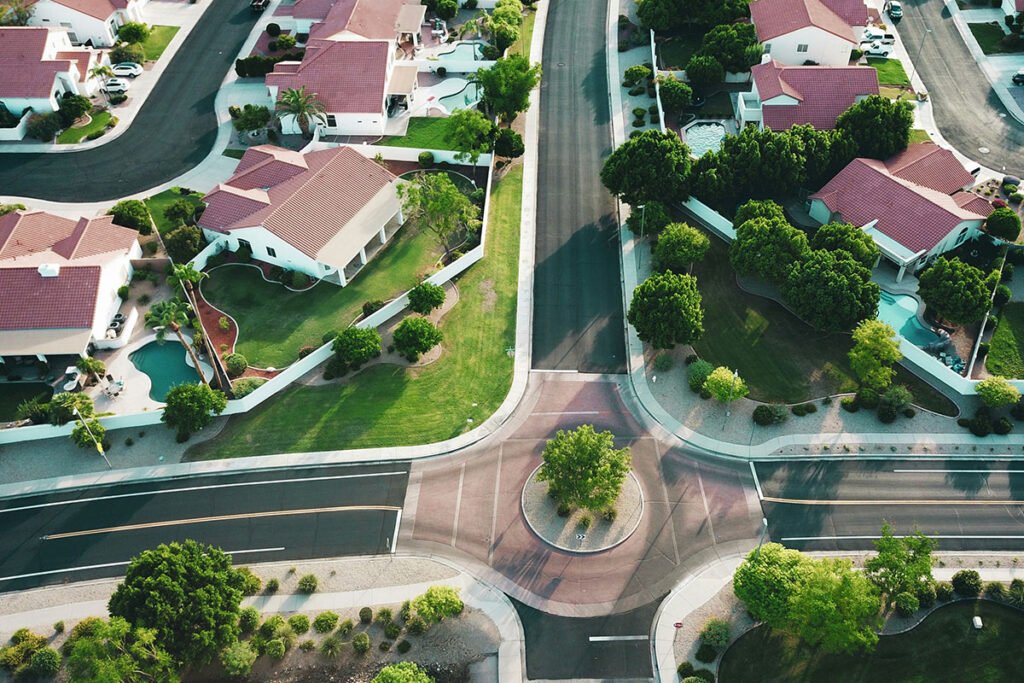
It was a mild summer evening on a Monday when my wife and I drove past our neighborhood pool on the way to Costco. Chairs arranged in orderly rows inside the pool fencing. A black box on a white table, waiting for votes. Another homeowners association (HOA) meeting—this time to decide whether to remove the board’s secretary, accused by the three White men on the five-person board of creating fake accounts to harass residents.
What we were about to witness wasn’t neighborhood gossip. It was democracy fracturing in real time.
We couldn’t attend. Even if we could, we couldn’t vote. Like 36 percent of the US population, we are renters. Across the United States, as homeownership declines and HOA governance expands, millions of renters live under private governments with no say in the rules that shape their daily lives. We pay HOA dues through our landlord and are subject to every decision—pool rules, landscaping codes, which management company collects our fees—but have no representation. HOAs aren’t required to grant equal voting rights to all residents, only to property owners. The stakes for us are lower than for homeowners who could face fines or foreclosure. But renters are still forced to watch governmental proceedings unfold from a distance, despite actually living in the community. Thus was our plight. We pulled up the Facebook livestream.
What we were about to witness wasn’t neighborhood gossip. It was democracy fracturing in real time: board members making executive decisions, invoking “community standards” and “character,” while the two members who’d pushed for transparency, the board’s secretary and treasurer (both women, one of whom is Black), were being accused of being the problem. This is what happens when governance becomes private enough to escape accountability but powerful enough to determine who belongs and who doesn’t. And HOAs are a form of government. They levy what amount to taxes, enforce rules that function as laws, and operate with less oversight than the city council down the road.
Neighborhood Politics, Larger Implications
In the realm of hyperlocal politics, the rhetoric of the Trump administration and its enablers has empowered people across the United States to be the worst versions of themselves, all in the name of freedom. As I listened to the livestream, I could hear the idea of liberty getting twisted to normalize bigoted beliefs, instead of, say, the ability to talk with your neighbor without fear of retribution and agreeing to disagree without violence—physical or verbal.
The trouble started months earlier with cameras installed overnight at the community pool. The three White men—two board members and the board president—defended them as necessary to curb the rise in “poor behavior” and mistreatment of “pool privileges.” The secretary and the board’s treasurer opposed the cameras, raising concerns about access to the footage and the lack of community input before installation. It’s the kind of conflict that could happen anywhere: security versus privacy, process versus efficiency. But the language was telling. “Poor behavior.” “Pool privileges.” The same kind of coded speech that has accompanied attempts to police who belongs in a space and who doesn’t.
By this second meeting, the dysfunction was undeniable. Through the livestream, we heard residents compare the board to Trump: decisions by fiat, no consultation, personal bias masquerading as policy. Someone noted the board president’s repeated “Make [Neighborhood] Great Again” Facebook posts. He shrugged it off as a joke. The treasurer called out the presence of racist and misogynistic language in meeting notes.
The secretary and treasurer brought documentation. They were met with deflections and the defensive language Trump and his allies deploy as they run roughshod over American democracy.
The vote came. The motion to remove the secretary failed. The board remained unchanged.
What unfolded wasn’t just about pool cameras or board elections. It was about power: who has it, who doesn’t, and what happens when community isn’t considered in governance. When one group ignores the others, there will be dissatisfaction. When one group refuses to level with the others, they are left in a vacuum to draw their own conclusions. It creates an echo chamber of beliefs that becomes loud, drowning out others who might be able to help. Left long enough without intervention, it can cultivate potentially harmful movements.
A Harmful Echo Chamber
The dysfunction in neighborhoods like ours can be attributed partly to the loss of third spaces—places where people across difference encounter each other. Without them, civic engagement weakens, replaced by silos that lead to groupthink. Community events can bring people together and open the door to exchange. But when the HOA board that approves and plans such events appears to be working against certain groups (reductively speaking, White men against everyone else), participation declines. So, too, does local civic engagement. We are—and have been—seeing this play out on a larger scale across the United States through racialized gerrymandering and voter restriction laws.
Perhaps it’s no surprise that HOAs, at least what is known of their history, were racist by design.
In October 2023, according to reporting by The Conversation, a group calling itself Return to the Land established a “Whites Only community” in the Ozark Mountains of Arkansas. Self-described as a “private membership association,” the group believes it can legally exclude people based on race by operating on private land. Eric Orwoll, a cofounder of the group, has been explicit: “You want a white nation? Build a white town…it can be done. We’re doing it now.” In response, Arkansas Attorney General Tim Griffin’s office is reviewing whether they have legal standing to do such a thing, but added, “from a legal perspective, we have not seen anything that would indicate any state or federal laws have been broken.”
Sign up for our free newsletters
Subscribe to NPQ's newsletters to have our top stories delivered directly to your inbox.
By signing up, you agree to our privacy policy and terms of use, and to receive messages from NPQ and our partners.
This may seem extreme to fold into a conversation about HOAs, but it’s not far from what that structure has always offered: the promise of exclusion dressed up in the language of private property rights.
The Architecture of Exclusion
Perhaps it’s no surprise that HOAs, at least from what is known of their history, were racist by design. They rose to prominence as a response to the Fair Housing Act of 1968—a legal workaround to continue exclusion after explicit racial discrimination became illegal.
The Redress Movement, a nonprofit aiming to, well, redress racial segregation, wrote a research brief about HOAs. In it, the authors explain that the modern HOA was standardized in the 1920s by Kansas City developer Jesse Clyde Nichols, who created the template: mandatory-membership associations and neighborhood-enforced racially restrictive covenants. The 1947 Federal Housing Administration directly encouraged HOAs to adopt racially restrictive covenants to receive government-backed mortgage insurance. The federal government wasn’t just tolerating segregation; it was incentivizing it.
After the 1948 Supreme Court decision in Shelley v. Kraemer declared racial covenants illegal—followed by school segregation in the 1950s and 1960s—HOAs jumped in popularity. By using a variety of mechanisms, such as credit requirements, background checks, and prohibitively expensive design codes, they allowed racial segregation in neighborhoods to continue despite the court rulings. As HOA scholar Evan McKenzie told the authors of the Redress Movement brief, “There is no question that a large part of the reason for creating HOAs in the first place was to practice racial segregation.”
The numbers bear this out. A Florida study cited in the research brief found that a 10 percent increase in HOA-governed units led to a 2 percent increase in Black-White segregation. The authors wrote, “As of 2022, roughly one-quarter of Americans (74 million) lived in community associations, which are privately governed, planned residential communities that include homeowners associations (HOAs), condominiums, and housing cooperatives.” This isn’t a niche phenomenon. This is how America houses itself now.
Because of their private governance, HOAs are insulated from fair housing enforcement. Barbara Coyle McCabe, whose research focuses on urban governance, is quoted in the brief: “[a]s private enterprises, HOAs’ managers and elected decision makers are free of many procedures and practices that apply to government officials, and within HOA jurisdictions, individuals are not necessarily guaranteed the rights that governments are compelled to protect.” HOAs can ban renters, circumvent local zoning laws, and operate without the transparency requirements that bind public officials. This had led some legal activists, as the brief described, to challenge HOA rules that ban Section 8 vouchers—in one case in Texas, Black households make up 93 percent of voucher holders being excluded.
The other reason for the growth of HOAs, the Redress Movement brief laid out, is that they “allowed local governments to offload costs of infrastructure maintenance and provision” to homeowners who paid via assessments. This gave those who were able to afford it (wealthier, generally Whiter households) access to the newest and best infrastructure in communities. And when there are issues within the housing market, households of color bear the brunt of the fallout.
The erosion of civic engagement, the fragmentation of communities into self-segregating enclaves—none of this is small.
Our neighborhood is diverse—Black families, White families, Latine families, Asian families. Trump supporters and progressives trying to share a zip code. But that diversity exists despite the HOA structure, not because of it. And when conflict comes, the old architecture reasserts itself. Three White men on a board, making executive decisions behind closed doors, invoking “standards,” expecting those eligible to cast a vote with limited information. Meanwhile, the rest of us, unable to attend for any number of reasons or simply unable to vote due to our residency status, watch through screens.
What Remains
Since that meeting, nothing has changed in our neighborhood. There’s been no follow-up or transparency reforms. No accountability. Just the strange intimacy of living among people who made decisions about our home while we remain voiceless.
It would be easy to dismiss what happened as small-bore local politics. But the 74 million Americans living under HOA governance aren’t small. Return to the Land in Arkansas isn’t small. The erosion of civic engagement, the fragmentation of communities into self-segregating enclaves—none of this is small.
This is how democracy dies—not just in dramatic coups or contested elections, but in a long series of localized exclusions. In meetings where some people get votes and others get livestreams. In “character of the neighborhood,” invoked like an incantation against change. In the particular silence that falls when everyone knows what was said but nobody knows yet how to challenge it.