logo logo
giving banner
Donate
    • Membership
    • Donate
  • Social Justice
    • Racial Justice
    • Climate Justice
    • Disability Justice
    • Economic Justice
    • Food Justice
    • Health Justice
    • Immigration
    • LGBTQ+
  • Civic News
  • Nonprofit Leadership
    • Board Governance
    • Equity-Centered Management
    • Finances
    • Fundraising
    • Human Resources
    • Organizational Culture
    • Philanthropy
    • Power Dynamics
    • Strategic Planning
    • Technology
  • Columns
    • Ask Rhea!
    • Ask a Nonprofit Expert
    • Economy Remix
    • Gathering in Support of Democracy
    • Humans of Nonprofits
    • The Impact Algorithm
    • Living the Question
    • Nonprofit Hiring Trends & Tactics
    • Notes from the Frontlines
    • Parables of Earth
    • Re-imagining Philanthropy
    • State of the Movements
    • We Stood Up
    • The Unexpected Value of Volunteers
  • CONTENT TYPES
  • Leading Edge Membership
  • Newsletters
  • Webinars

Don’t Blame Rural Residents for a Broken Political System

Spencer Wells
February 21, 2018
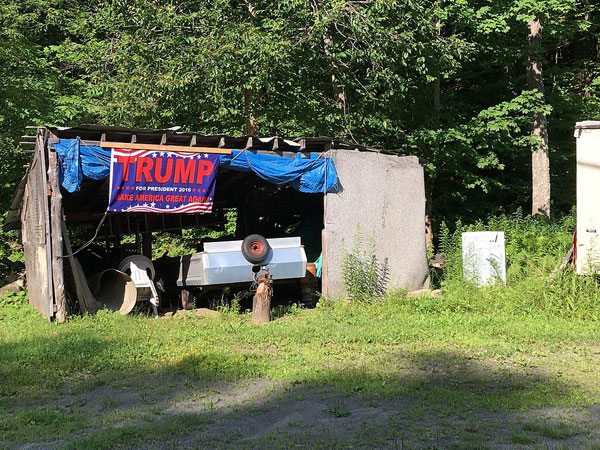
By buddawiggi (Trump Shed) [CC0], via Wikimedia Commons

February 16, 2018; New York Magazine

New York magazine offers a truly offensive view of rural America’s role in Congressional gridlock. Since President Trump’s surprise victory, coastal journalists have “discovered” rural America and have wrestled to try to “understand” these backwaters and how they can impact US politics. Sadly, old myths die hard.

“Why Rural America Controls the Debates Over Guns and Immigration” purports to explain that rural voters hold the key to both immigration reform and gun control because rural voters are backward yahoos. According to the article, it’s not the National Rifle Association or the Koch Brothers that have bought Congress and state legislators; it’s not cynical legislative machinations that hold Dreamers as hostages to exchange for “the wall.” It’s people who live in rural communities.

While noting the decades of gerrymandering to enhance the power of rural officials, author Ed Kilgore concludes, “Underlying it all are real differences in outlook between different parts of the country, made more important by the distinct institutional features of a constitutional system designed to protect the interests of small, largely nonmetropolitan states.”

Sign up for our free newsletters

Subscribe to NPQ's newsletters to have our top stories delivered directly to your inbox.

By signing up, you agree to our privacy policy and terms of use, and to receive messages from NPQ and our partners.

Sorry, Ed; the values of citizens of rural areas have as much to do with school violence and immigration resistance as do video games. In fact, Kilgore undermines his own argument by citing Ronald Brownstein’s analysis in the Atlantic of the red-blue divide. Alas, the same Ronald Brownstein reported on CNN just one week later that a prosperity gap was the source of the split between Democrats and Republicans. “Observers in both parties agree that the sense of economic displacement in recent years has intensified the long-standing movement toward the GOP among small-town and rural communities initially rooted in unease over cultural and demographic change.” It’s fair to observe that gun-loving nativists did not create the dismal economic prospects that drove them to vote for candidate Trump.

It is true that after years of civic disengagement, rural voters turned out in record numbers to elect the only coastal elitist who showed up in their communities and asked for their votes. So, Trump won and Clinton lost. Beyond that, any generalization about the impact of rural citizens on national politics is just horsepucky. Rural citizens didn’t create the electoral system that permits unlimited campaign donations to state officials who draw Congressional districts to favor entrenched wealth. In fact, rural citizens are the victims of gerrymandering as much as any disenfranchised cohort that ends up in a noncompetitive legislative district.

The Daily Yonder reminds us that rural Americans seem to be the last minority that can be impugned with impunity. In “Review: New Book on Appalachia Takes J.D. Vance Behind the Woodshed,” Jim Branscome welcomes Elizabeth Catte’s new book-length essay written in response to J.D. Vance’s Hillbilly Elegy. Branscome cites a basic fact missed by coastal experts. “Truth be told, large parts of the mountains, and especially towns in the coalfields, are as cosmopolitan demographically as places like New York City with Germans, Hungarians, Poles, Italians, and Greeks, to name a few. Vance doesn’t know it, but all over the Kentucky counties bordering ‘Bloody Breathitt’ there are large populations of African Americans who have lived and worked there since the beginnings of the industrial era. [Author Elizabeth Catte] points out that the fastest growing demographic in Appalachia today are blacks and Hispanics.”

Imagine if Kilgore had decided to blanket-blame African Americans or Latinx persons for school violence and rampant nativism. The liberal readers of New York magazine would be outraged.—Spencer Wells


Our Voices Are Our Power.

Journalism, nonprofits, and multiracial democracy are under attack. At NPQ, we fight back by sharing stories and essential insights from nonprofit leaders and workers—and we pay every contributor.

Can you help us protect nonprofit voices?

Your support keeps truth alive when it matters most.
Every single dollar makes a difference.

Donate now
logo logo logo logo logo
About the author
Spencer Wells

Since his retirement in 2013, Spencer Wells volunteers as the Community Manager of the Rental Housing Information Network in Ohio (RHINO) and as financial secretary of Cleveland Lead Advocates for Safe Housing (CLASH). As a community organizer for 45 years, Spencer’s professional work focuses on tenant rights and community development issues. Spencer, Janet and three cats live on 10 acres in rural Western Pennsylvania where Spencer tends a big garden and a small woodlot while Janet audits, blogs, quilts, and photographs.

More about: Gun ControlNonprofit NewsRural VoicesTrump Administration
See comments

You might also like
Damn the Torpedoes! Trump Ditches a Crucial Climate Treaty in Latest Move to Dismantle America’s Climate Protections
Gary W. Yohe
Trump Lawsuits Seek to Muzzle Media, Posing Serious Threat to Free Press
Kathy Kiely and Lyrissa Barnett Lidsky
Staff Picks for 2025: Isaiah Thompson
Isaiah Thompson
Staff Picks for 2025: Steve Dubb
Steve Dubb
Staff Picks for 2025: Alison Stine
Alison Stine
The People Say No: MediaJustice’s Advocacy Against AI Data Center Expansion
Iris M. Crawford

Upcoming Webinars

Group Created with Sketch.
January 29th, 2:00 pm ET

Participatory Decision-making

When & How to Apply Inclusive Decision-making Methods

Register
Group Created with Sketch.
February 26th, 2:00 pm ET

Understanding Reduction in Force (RIF) Law

Clear Guidance for Values-centered Nonprofits

Register

    
You might also like
A coal burning power plant pluming smoke, representing fossil fuel burning that has caused increased levels of greenhouse gases in the atmosphere.
Damn the Torpedoes! Trump Ditches a Crucial Climate Treaty...
Gary W. Yohe
A graphite drawing of people with their mouths sewn shut with red thread.
Trump Lawsuits Seek to Muzzle Media, Posing Serious Threat...
Kathy Kiely and Lyrissa Barnett Lidsky
Senator Elizabeth Warren speaks into a microphone in front of a sign reading "We are the Supermajority" while an audience listens.
Supermajority, Group Organizing Women Around Politics, Is...
Jennifer Gerson

Like what you see?

Subscribe to the NPQ newsletter to have our top stories delivered directly to your inbox.

See our newsletters

By signing up, you agree to our privacy policy and terms of use, and to receive messages from NPQ and our partners.

  • About
  • Advertise
  • Careers
  • Contact
  • Copyright
  • Donate
  • Editorial Policy
  • Funders
  • Submissions

We are using cookies to give you the best experience on our website.


Nonprofit Quarterly | Civic News. Empowering Nonprofits. Advancing Justice.
Powered by  GDPR Cookie Compliance
Privacy Overview

This website uses cookies so that we can provide you with the best user experience possible. Cookie information is stored in your browser and performs functions such as recognising you when you return to our website and helping our team to understand which sections of the website you find most interesting and useful.

Strictly Necessary Cookies

Strictly Necessary Cookie should be enabled at all times so that we can save your preferences for cookie settings.