
In this column with NPQ, LandBack for the People, NDN Collective builds on their podcast of the same name, sharing stories from Turtle Island and beyond about Indigenous people organizing in community, advocating for social justice, and fighting for the return of Indigenous lands.
The beautiful and painful thing about organizing is that sometimes you’re part of multigenerational fights that you don’t see won in your lifetime. For many, freeing Leonard Peltier was one of those fights.
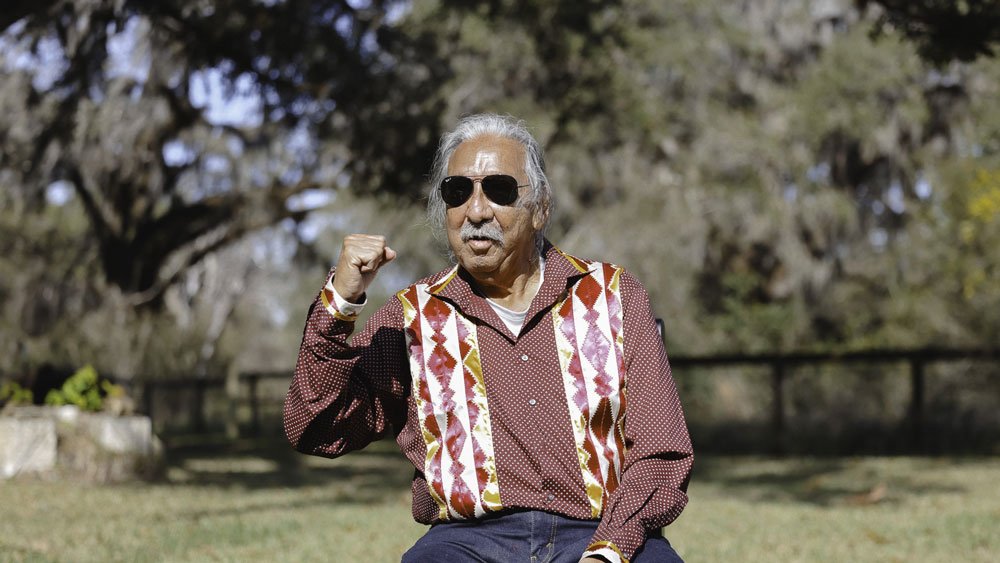
Five decades ago, Indigenous leader, activist, and revolutionary Leonard Peltier was illegally convicted of killing an FBI agent and wrongfully imprisoned for 49 years and two months. Many people who fought for his freedom passed on to the spirit world before the remainder of his sentence was finally commuted by President Biden on January 20, 2025, before Biden left office. It is one of the greatest privileges of my life that I got to see Leonard’s freedom and help carry him home.
“Thank you…for being able to fight for my freedom. But what’s more important than that is that you continue to fight for your land and to continue to fight for your people and all people.”
On December 1, 2025, NDN Collective’s LANDBACK for the People podcast released an episode on Leonard Peltier. In that episode, I interviewed Leonard himself and reflected on my lifelong relationship to his freedom—from writing him a letter at age 13 promising to fight for him, to coordinating logistics and care to get him back to his homelands at the Turtle Mountain Band of Chippewa in Belcourt, ND. But like many Indigenous people, my connection to him extends to before I was even born.
My grandfather, Ken Tilsen, provided legal support to members of the American Indian Movement (AIM) in the early days of its organization, and my mother, JoAnn Tall, was part of the Oglala Lakota people who invited AIM to first come to Pine Ridge during the 1970s. My parents met at the occupation and siege at Wounded Knee in 1973, and my grandfather helped found the Wounded Knee Legal Defense Committee. And so, years before I was born, my grandfather was part of the people who helped assemble the legal team to fight for Leonard Peltier.
Leonard responded to my letter all those years ago. He wrote, “Thank you, young brother, for being able to fight for my freedom. But what’s more important than that is that you continue to fight for your land and to continue to fight for your people and all people.”
Peltier’s Impact on Indigenous Organizing
As I interviewed Leonard in person for the podcast last year (an honor of my lifetime), he was generous, sharing with us details about his life beginning when he was nine years old in a boarding school in Wahpeton, ND. He described the profound cruelty he and his schoolmates experienced there, where the children were beaten if they spoke their languages or practiced their cultures. Leonard described trying to escape the school at age 10, almost drowning in the attempt—a move that he describes as his first act of resistance.
Leonard shed light on the Termination Era and Indian Relocation Act days in the 1950s and 1960s, when the United States government was terminating the federal status of federally recognized tribes in order to cut off tribal resources. They called it relocation because they were taking people from the reservation and then relocating them, which is why 75 percent of the population of Native people today live in cities. Leonard described how his reservation, Turtle Mountain, successfully resisted Termination, and, in turn, inspired hundreds of tribes to fight back, resulting in the end of Termination altogether.
Later, Leonard talked about joining AIM in the 1970s in response to witnessing police brutality against a young Native woman. He talked about how the group would go into peaceful actions that involved things like sit-ins at the Bureau of Indian Affairs—to which the cops would respond by attacking the protesters and then characterizing them as dangerous. He described how AIM functioned as a security force for tribal leaders, chiefs, and elders there to minimize harm and act as a political muscle in fights for things like housing and broken treaties.
When I thanked Leonard for his commitment and sacrifice to helping the people, telling him we wouldn’t have the Indigenous organizing foundation we stand on today without it, his response was this:
Sign up for our free newsletters
Subscribe to NPQ's newsletters to have our top stories delivered directly to your inbox.
By signing up, you agree to our privacy policy and terms of use, and to receive messages from NPQ and our partners.
I wasn’t the only one though. I was just one of the people that took an oath to fight for the people. There was a lot of people that fought out there, gave their lives up and will probably never even be mentioned, but there was a lot of them. And I wanted to say to them people and their families, thank you. Thank you for standing up, showing me how to stand up.
“I want you to have a good life. I want you to have a better life than I had…I’m sorry to tell you this, but if you don’t get up and fight, it ain’t going to happen….You have to resist for your children and your grandchildren.”
The Generations Worth Fighting For
Leonard sees a clear connection between Native people of Turtle Island and the Palestinian people. In that same interview, he said:
Look what they’re doing in Palestine. They’re doing the same thing they did to us….So it hasn’t stopped and it won’t stop as long as we continue to deny these things happened. These things did happen. They did this to us. This is why we should be identifying with the Palestine people. What they’re doing to them is outrageous. It’s crimes against any kind of humanity there ever was in this world.
When I asked if Leonard had a message for young Indigenous people, he said, “If they terminate our treaties, we no longer exist. We no longer exist as a people. So, we have to make damn sure that we don’t get our treaties terminated.”
He added, “I want you to have a good life. I want you to have a better life than I had. And I want you to be able to live in freedom and everything like this. But I’m sorry to tell you this, but if you don’t get up and fight, it ain’t going to happen….You have to resist for your children and your grandchildren.”
Before the interview concluded, he offered a heartfelt message:
I won’t be around much longer, but I’m going to continue to speak this way because it’s going to be what’s going to save us from total extermination. But I know we can win….I know there’s a fighting generation behind me and I can die and pass on knowing that the resistance hasn’t stopped….That’s what I believe in my heart.
Throughout all my work, I hold gratitude for the generations before us close to my heart. For Leonard, and for all the ones who came before him. Leonard’s freedom is a testament that we have to continue to fight and rise up. I believe we can—and must—continue to resist with both love and fierceness held in our hearts.