
With over two decades of experience in the nonprofit sector, Venu Gupta has learned that key to building a strong democracy are strong connections—and, more specifically, strong friendships. Gathering in Support of Democracy is a recurring column exploring the essential connections between gathering, community, and democracy building.
“What prepares men for totalitarian domination in the non-totalitarian world is the fact that loneliness, once a borderline experience usually suffered in certain marginal social conditions like old age, has become an everyday experience,” wrote Hannah Arendt in her 1951 book, The Origins of Totalitarianism.
I was born and raised in Chicagoland. Even during stints of travel and education, I have always considered myself a Chicagoan. As Trump’s ire has increasingly turned on my city, I have never been more motivated to gather with my fellow Chicagoans to fight against loneliness, which is an integral part of the fight against totalitarianism and for democracy.
For months, Trump threatened to send US Immigration and Customs Enforcement (ICE) agents and the National Guard to “clean up” Chicago. On September 9, 2025, he deployed masked and heavily armed ICE agents who snatched and kidnapped people of all ages, regardless of their citizenship status. People were sometimes taken in the middle of the night and agents often used dangerous tactics both against those targeted and against those community members protesting these actions.
ICE tactics have been so atrocious, inhumane, and illegal that the head of the operation was required to meet with US District Judge Sara Ellis daily to ensure that no agents had broken the law. So far, the National Guard has been prevented from invading Chicago through a court order, which is now before the Supreme Court.
As Trump’s ire has increasingly turned on my city, I have never been more motivated to gather with my fellow Chicagoans to fight against loneliness, which is an integral part of the fight against totalitarianism and for democracy.
Chicago’s First Longest Table
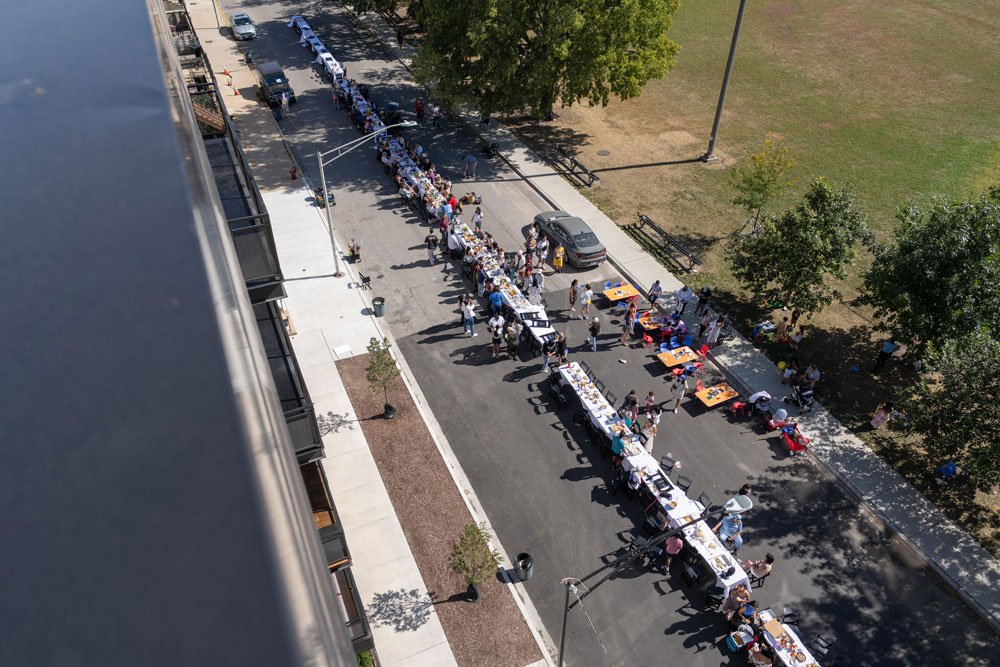
It is against this backdrop that my fellow organizers and I hosted Chicago’s first Longest Table—a free community event that brings neighbors together for a shared meal and conversation, creating connection and joy—on Chestnut Street between Noble and Elizabeth Streets, on Sunday, October 6, along with five other cities across the country.
A few months earlier, I’d been inspired (and firmly nudged) by my friend, Maryam Banikarim, a convener and award-winning storyteller. Founded by Banikarim in 2022, in the aftermath of the COVID pandemic and its ensuing social isolation, The Longest Table gives people the opportunity to gather with no agenda, no rally, no intentional “bridging conversations,” just food and conversation.
In the lead-up to our gathering, I was very anxious about the possibility that our event would somehow make it onto ICE’s radar, resulting in tragedy for the very people we were hoping to bring together. But I was buoyed by Banikarim and my co-organizers, one of whom said, “It’s okay, we’ll protect each other.” And another added, “What [totalitarians] want is for us to be afraid. We can’t give in to that.”
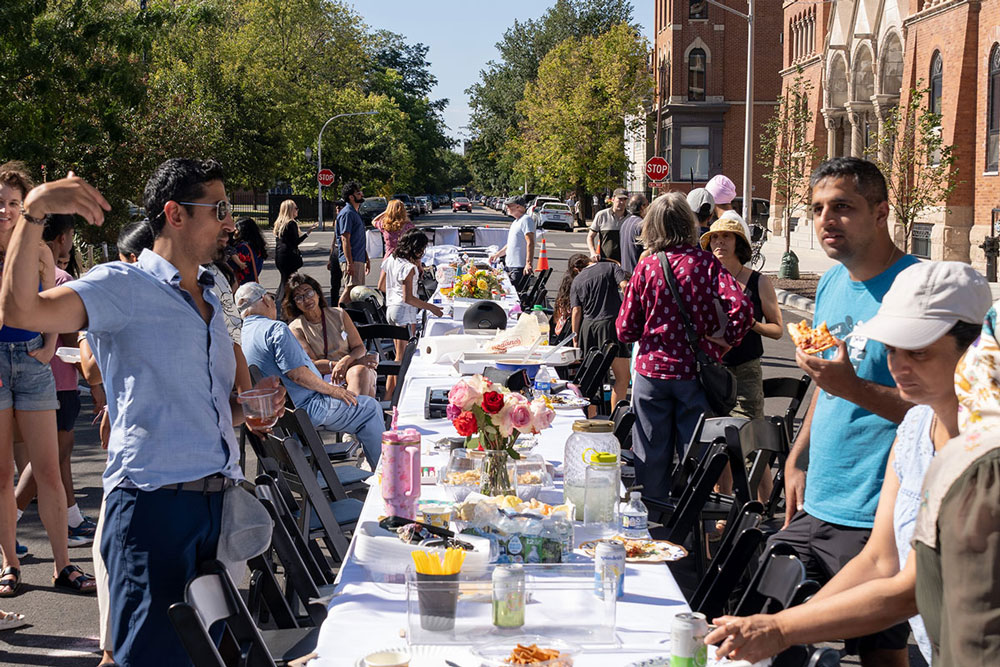
In the end, our October 6 gathering took place on a glorious, sunny afternoon, on a street next to a beautiful park, with 150 neighbors and friends sharing introductions, stories, and, of course, food. I ordered Chicago-style pizza for any folks who didn’t bring food; my friend Litcy made a three-course Indian meal for her table guests; and a new friend, Susan, had a French-food-inspired table.
“It’s a grassroots potluck—organized by neighbors for neighbors—with no agenda other than to connect, create community, eat, and have fun.”
At one point, I yelled, “There is extra chicken tikka masala at this table,” and people started to come from everywhere. One of the organizers arranged for kids’ tables with crayons and assorted activities. There were so many kids. Kids eating, running around in a park, unafraid because their people were there.
Sign up for our free newsletters
Subscribe to NPQ's newsletters to have our top stories delivered directly to your inbox.
By signing up, you agree to our privacy policy and terms of use, and to receive messages from NPQ and our partners.
Democracy Through Community
Banikarim is the kind of person who, once she identifies a need and has the power to address it, works persistently and tirelessly to fill it. During the fear and confusion of lockdown, she knew that people needed to see each other.
As she put it, “I saw a picture of neighbors sharing a meal together outside, down a long table, and it inspired me to ask, ‘What if we did that? What if we got to know our neighbors?’ So, we tried it. The idea was simple: We would bring tables and chairs, and neighbors would bring friends and food. It’s a grassroots potluck—organized by neighbors for neighbors—with no agenda other than to connect, create community, eat, and have fun. It’s a way to remind each other of our shared humanity.”
From that insight and a lot of persistence, the most welcoming picnic the country has ever seen was born. In its first year, The Longest Table was held in the Chelsea neighborhood of New York City, with over 500 people attending. This year, the New York City table had over 2,000 attendees. Over 50 Longest Table events took place across the country, including six on October 6, the same day as ours.
ICE never did show up. They never seem to show when people are gathered and looking out for each other. And on that day, the sense of belonging grew stronger. I built better relationships with the people in my building, met new neighbors, and got to know friends of friends. Almost everyone exclaimed, “I’d love to help next year.”
And then I would remember that saying, “Democracy is a verb.”
While we were setting up, a young man walked by and asked what we were doing. After we explained, he said, “I’ll help you set up.” When we were finished, he said he’d come back later with some food. And he did. This seemingly small act of kindness can have a domino effect that amounts to a longstanding impact—a perfect example of what The Longest Table inspires and what democracies depend upon.
Organizing and experiencing Chicago’s first Longest Table reminded me that building loose connections is the bedrock of democracy and an antidote to authoritarianism. And it reminded me that gathering people can also be a lot of work—none of this was difficult, but it was time-consuming and often tedious. Some days it was hard to get motivated. I didn’t know how many people would show or who they would be. We were doing all of this work for people we didn’t know, and for no other purpose than to have the opportunity to gather.
And then I would remember that saying, “Democracy is a verb.” (And I had already told Maryam I would do it.)
Of course, chipping away at loneliness and authoritarianism will take work. There are many forces pulling us apart—social media, the primacy of productivity, a weak and disappearing social safety net, an authoritarian government, and more. It will take time and courage to combat these forces, and we, individually and collectively, must create the to-do lists, invite the people, and share our food.
Making sure people are fed might be the best place to start rebuilding our democracy.
If you are interested in holding a Longest Table in your neighborhood, visit the community website for more information. I promise it’s worth every minute of your time.