
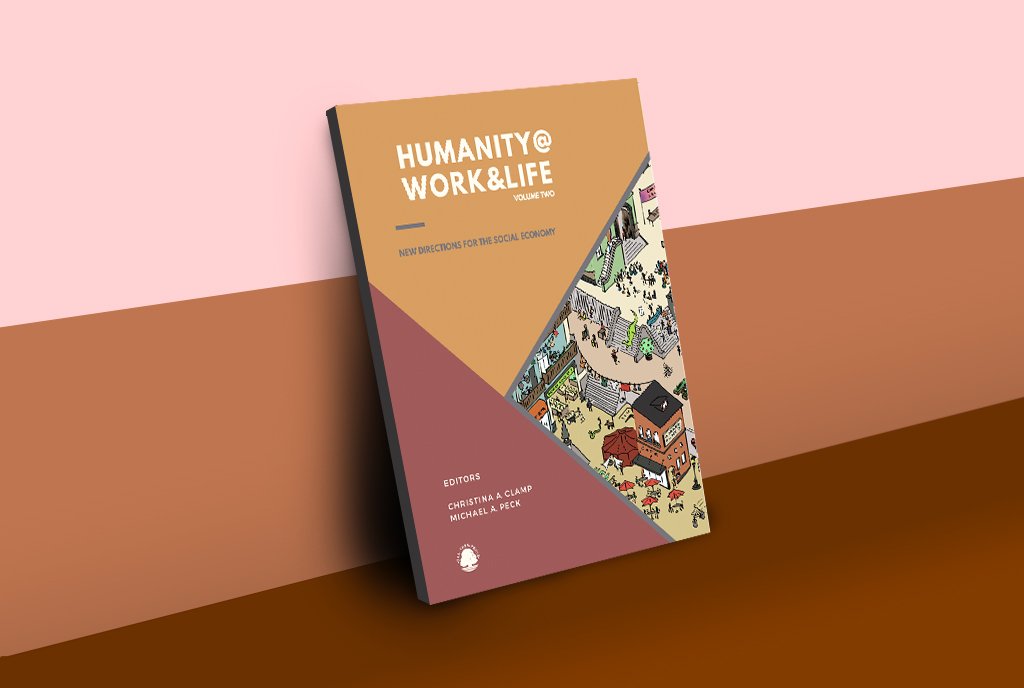
This excerpt originally appeared in Humanity@Work&Life Volume Two: New Directions for the Social Economy (Oak Tree Press, 2025. Distributed in the United States by Worx), edited by Christina Clamp and Michael A. Peck. Reprinted here with permission.
As we move beyond 2030, it is crucial to rethink how we measure progress and development.
This excerpt, from the chapter “Shaping a New Development Strategy Beyond 2030: The Transformative Potential of the Social and Solidarity Economy,” accompanies an interview with Clamp by NPQ’s Steve Dubb.
Hyperlinks have been added for clarity.
As we move beyond 2030, it is crucial to rethink how we measure progress and development. The current relevance of GDP [gross domestic product] as the dominant indicator of economic performance has been widely criticized for its inability to capture the full dimensions of human well-being, social equity, and environmental sustainability. Recent policy discussions and research, including the OECD’s [Organization for Economic Cooperation and Development’s] “Beyond GDP” initiatives, highlight the urgent need to develop alternative metrics.
These new measurement frameworks should account for non-market activities, the quality distribution of economic growth, environmental sustainability, and subjective well-being. Metrics such as the Human Development Index (HDI), Multidimensional Poverty Index (MPI), Better Life Index (BLI), Gross National Happiness (GNH) and Social Progress Index (SPI) offer examples of human-centric well-being indicators. Additionally, sustainability-oriented indicators such as the Genuine Progress Indicator (GPI), Inclusive Wealth Index, and Green GDP provide essential adjustments to reflect environmental and social costs.
The post-2030 agenda must also reaffirm the centrality of human rights as a fundamental value underpinning development.
Sign up for our free newsletters
Subscribe to NPQ's newsletters to have our top stories delivered directly to your inbox.
By signing up, you agree to our privacy policy and terms of use, and to receive messages from NPQ and our partners.
Notably, the sustainable development performance indicators developed by UNRISD (United Nations Research Institute for Social Development) provide an innovative and authentic framework specifically designed to measure the sustainable performance of SSE [social and solidarity economy] entities. The SDPI framework integrates economic, social, and environmental dimensions, grounded in the values of equity, solidarity, and democratic governance. Unlike conventional indicators, SDPI reflects the collective and territorial impacts of SSE initiatives, providing policymakers, practitioners, and communities with a comprehensive tool to assess how SSE organizations contribute to sustainable development and the well-being of people and the planet.
For the SSE, the development of new measurement tools is essential to capture its full contribution to social progress. Conventional indicators often fail to account for the social, environmental, and collective value created by SSE initiatives. Moving forward, efforts should be made to co-construct measurement methodologies that reflect the unique values and principles of SSE, integrating well-being, equity, and sustainability. Establishing such metrics will not only validate the importance of SSE in development but also help in formulating policies that support and scale its impact.
Strengthening Fundamental Values for Development: Human Rights
The post-2030 agenda must also reaffirm the centrality of human rights as a fundamental value underpinning development. Neoliberal economic policies and market-oriented approaches have often led to the violation or neglect of economic and social rights, particularly for marginalized groups. In this context, the social and solidarity economy presents an alternative economic model grounded in the protection and realization of human rights.
As elaborated in recent research by UNRISD, the SSE prioritizes principles of redistribution, reciprocity, and ecological sustainability. These principles directly address the structural inequalities and negative externalities of neoliberal economic systems, which have historically undermined human rights. By organizing economic activities around collective well-being, social purpose, and environmental care, the SSE provides an enabling framework for realizing economic and collective rights.
Moreover, the SSE actively contributes to protecting the rights of marginalized groups, including women, children, ethnic minorities, indigenous peoples, persons with disabilities, and informal workers. Through its democratic governance, solidarity-based finance, and grassroots economic initiatives, the SSE empowers these groups to participate in economic decision-making and improve their socioeconomic conditions. In doing so, the SSE operationalizes human rights in economic activities and builds relevant, inclusive, and rights-based communities.