
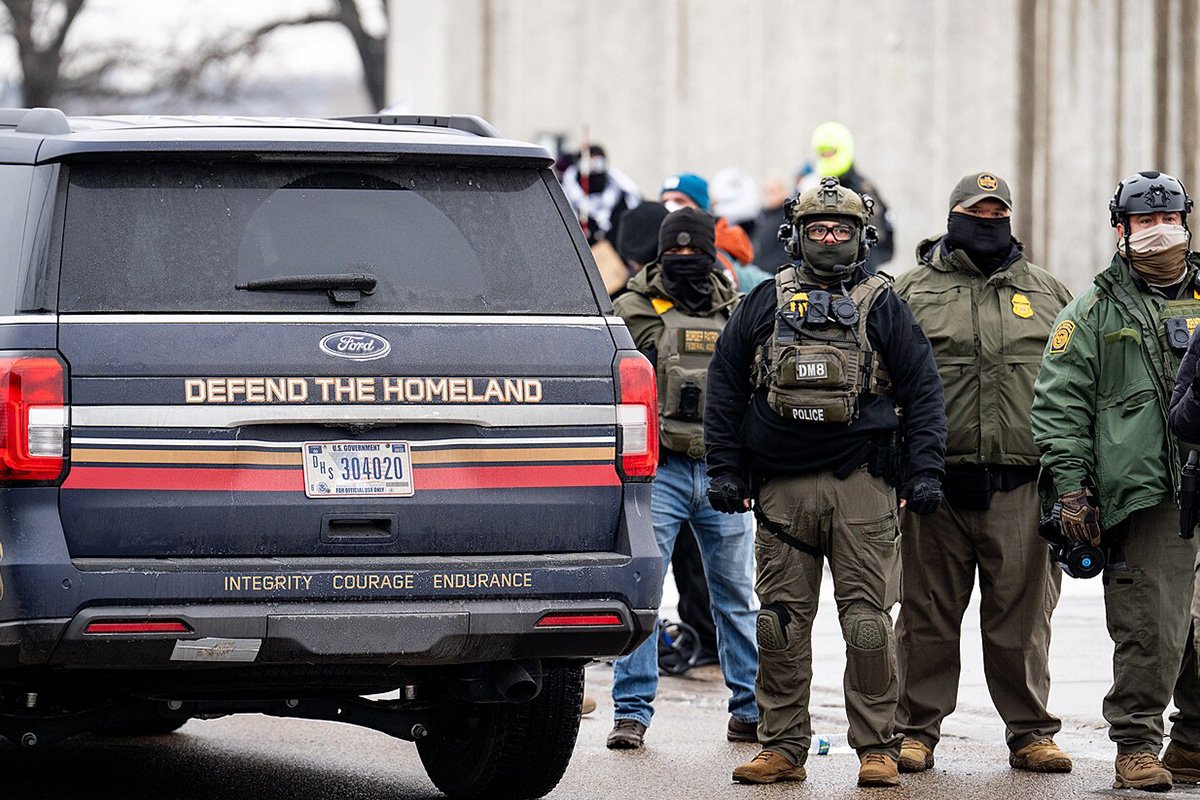
US Immigration and Customs Enforcement (ICE) agents first entered Minneapolis in December 2025, followed by a larger federal surge earlier this month, setting off a rapid escalation that now includes multiple fatal shootings, aggressive enforcement tactics, and open conflict between federal authorities and local officials.
What’s happening goes beyond individual tragedies for the families involved, raising fundamental questions about constitutional protections, the lawful use of force, and whether basic accountability mechanisms are being bypassed.
Two fatal shootings are now central to those questions.
Renee Good, a 37-year-old wife and mother, was fatally shot in her vehicle on January 7 by agent Jonathan Ross while attempting to drive away from the scene. The violence by ICE agents against civilians escalated from there, with reports describing an expanded federal presence in Minneapolis and mounting confrontations between agents and residents.
Then, on January 24, Alex Pretti, a 37-year-old ICU nurse, was fatally shot on the street while helping a woman who had been shoved to the ground by an ICE agent. Pretti was shot by federal agents, with 10 shots fired in five seconds. As of this writing, the officers involved have not been publicly identified, but DHS reported that two who were involved have been put on leave. Pretti was lawfully carrying a gun that did not appear to have been used against officers, based on multiple videos released from the scene.
When speaking about Good’s death, Jill Habig, founder and CEO of Public Rights Project (PRP), a nonpartisan nonprofit that works with local governments to protect civil rights, told NPQ that the shooting “was not just a tragedy—it was a violation of constitutional protections that are supposed to apply to every American.”
Habig stressed that what the country and world are witnessing in Minneapolis, one cell phone video at a time, “is not ‘normal.’ When federal agents operate without accountability, and states are blocked from investigating, we’re seeing a fundamental breakdown in the rule of law.”
Use of Force and the Role of Escalation
Federal law enforcement officers are bound by clear legal and ethical standards governing the use of force, including a duty to de-escalate whenever possible. Situations that breed fear and confusion are more likely to lead to harm.
“People are being harassed by armed, masked agents who are difficult to identify as law enforcement,” said Habig. “But it’s not just the masks—it’s the tactics. Aggressive, violent enforcement creates fear and chaos, and as we have seen over and over, makes people less safe.”
Standards governing the use of force exist to prevent violence against everyone involved, officers and civilians alike.
“It’s important to be clear about this: Fear or the instinct to leave a dangerous situation is not, on its own, a justification for deadly force,” said Habig. “The legal and ethical standard is de-escalation and preservation of life whenever possible.”
“When federal agents operate without accountability, and states are blocked from investigating, we’re seeing a fundamental breakdown in the rule of law.”
What we’re witnessing now are the consequences of failing to meet those standards. In both shootings, released cell phone footage shows ICE agents not only failing to de-escalate but actively escalating violence in situations where little to no immediate threat appeared to exist.
In the aftermath of Pretti’s killing, Trump administration officials and allies were quick to publicly praise the ICE agents involved, while portraying Pretti as a dangerous threat—despite video evidence from multiple angles that contradicts those claims. Border Patrol Chief Greg Bovino praised the agents’ actions before any investigation, a move that undermines accountability and makes it harder for an investigation to move forward. It’s been reported that Bovino may be removed from Minneapolis and return to his prior position.
As Habig explained, “Legal questions don’t arise only from a single trigger pull. They also arise from choices that heighten fear and escalation.” In the cases of Pretti and Good, those choices were evident in the physical actions of the agents and the Trump administration’s subsequent framing of the incidents, before any investigation.
The Collapse of Policing Norms and the Duty of Care
At the core of lawful policing in accordance with the Constitution is the ability for people to understand who is exercising authority over them and under what legal basis. Without that clarity, lawful arrest can blur into something else entirely.
“At a fundamental level, people need to be able to distinguish between an arrest and a kidnapping,” said Habig. That distinction becomes harder to make when agents are heavily armed and difficult or impossible to identify.
Habig told NPQ that this “can create confusion and panic, and it can increase the risk of volatile encounters.” She emphasized that clear identification and transparency are not optional features of lawful policing. They are foundational to democratic oversight.
Beyond individual incidents, violent enforcement actions—like what we’re seeing in Minneapolis between protestors and ICE agents—ripple outward into the community, placing strain on public safety systems and deepening fear.
Habig described emergency resources being overwhelmed “because people don’t know what to do when armed, masked agents tackle and injure innocent US citizens and immigrant neighbors. Many call 911, because they’re afraid.”
In the case of both recent fatal shootings, civilians who identified themselves as physicians report being prevented from providing medical aid to the victims, Renee Good and Alex Pretti.
Federal use-of-force policies emphasize not only de-escalation and preservation of life, but also expectations that officers request or provide medical assistance after force is used. Failing to provide aid—or preventing aid from being given—undermines the legal and cultural norms that distinguish lawful policing from unchecked violence.
This amplifies fear and confusion in the moment and contributes to a broader breakdown of trust in the systems meant to protect life and uphold the rule of law.
Sign up for our free newsletters
Subscribe to NPQ's newsletters to have our top stories delivered directly to your inbox.
By signing up, you agree to our privacy policy and terms of use, and to receive messages from NPQ and our partners.
Federal Overreach and the Limits of State Power
The scale and tactics of federal enforcement in Minneapolis have intensified legal conflict between federal authorities and state and local governments. This escalation started with Operation Metro Surge in December 2025, an immigration enforcement operation in the Minneapolis-Saint Paul region that’s now expanded throughout the state of Minnesota. The Trump administration called this “the largest immigration enforcement operation ever carried out,” though the administration offered no clear data to justify such drastic steps or for targeting Minneapolis. Administration officials initially pointed to federal fraud investigations—dating back to 2021, of largely Somali-run day care centers in the state—as grounds for the operation. But that justification has not held up in light of ICE’s aggressive actions on the ground.
Instead, according to Habig, the surge of federal agents into the Twin Cities “is an invasion with the purpose of terrorizing the community, crushing dissent, and forcing local governments to give in to the administration’s policy demands on immigration and so much more.”
This escalation is not just happening in Minnesota. ICE activity is occurring to varying degrees around the country, and Minneapolis is quickly becoming a blueprint for how a city can be destabilized through fear and intimidation. These dynamics are unfolding alongside broader federal pressure on local governance.
“At the same time the Department of Justice is suing Minneapolis and Minnesota for prioritizing local public safety over being commandeered for federal immigration enforcement, the Trump administration is sending hundreds of agents to conduct immigration raids while also attempting to cut off funding for basics like child care,” said Habig.
Beyond individual incidents, violent enforcement actions…ripple outward into the community, placing strain on public safety systems and deepening fear.She added, “This is a legal, physical, and financial attack on cities and states for having lawful policies this administration doesn’t like.”
While federal agents operate under federal authority, states are not without constitutional power or responsibility. Under the anti-commandeering doctrine, grounded in the Tenth Amendment, the federal government cannot force states to enforce federal immigration policy. This means states and cities retain the authority to decide how to prioritize public safety and can’t be forced to align those priorities with federal agendas.
However, states also can’t simply block federal agents from acting under federal authority. Instead, they must rely on judicial processes, which take time.
The state of Minnesota, joined by the cities of Minneapolis and Saint Paul, is now suing the Department of Homeland Security and ICE on the grounds that Operation Metro Surge unlawfully interferes with the state’s authority over public safety and therefore violates the Constitution. PRP filed an amicus brief in this case, alongside a coalition of more than 80 mayors and local governments, supporting the challenge.
In the meantime, individuals, families, and entire communities bear the consequences.
Accountability and the Role of Nonprofits
What is unfolding in Minneapolis has implications beyond any single city. When federal enforcement actions sidestep normal systems of oversight and accountability, residents and local governments are left navigating uncertainty, and nonprofits and activist groups often step in to fill the gaps.
NPQ spoke with a Minneapolis resident under the condition of anonymity who lives just blocks from where Renee Good was killed: “Rather than express professionalism or remorse for the death of Renee Good, ICE tells us to not use our constitutional rights like free speech or film them or we will end up like her. To us, it is not resistance action, it is survival. There is no way to pretend we can go about our everyday lives.”
This account underscores what is at stake when fear and intimidation replace transparency. In these conditions, accountability depends not just on individuals, but on investigations being allowed to lawfully proceed and on legal standards being consistently enforced and followed.
“From a legal perspective, there are a few key things to look at,” said Habig. “When federal agents operate in a local community, there must be real oversight. This is exactly why state and local leaders in Minnesota are calling for a full, fair investigation—because public trust depends on a credible process that establishes the facts and assesses whether the conduct and tactics were lawful.”
When federal agencies decline to participate in those processes, the damage compounds.
“Federal authorities not cooperating with the state’s normal officer-involved shooting review process raises serious transparency concerns,” Habig said. “When a federal agency declines to participate in the standard fact-finding procedures that communities rely on after a deadly shooting, it makes it harder to seek accountability and can deepen mistrust.”
This is where nonprofits play a critical role. When official channels are rushing to shape the narrative before investigations are complete—or even begun—nonprofits and advocacy groups are often where people turn to understand their rights and what steps are available to them.
The role of PRP, for example, Habig said, is to “work with local leaders around the country who are trying to protect their residents and uphold the rule of law in moments like this.”
At the state level, organizations like the Minnesota Council of Nonprofits (MCN) are speaking out about the fear, disruption, and unnecessary violence caused by ICE, stating “federal immigration officials through Operation Metro Surge are terrorizing our communities, violating constitutional rights, and so far have seen very little accountability.”
Nonprofits and advocacy groups are often where people turn to understand their rights and what steps are available to them.
At the national level, the Lawyers’ Committee for Civil Rights Under Law condemned not only the fatal shooting of Alex Pretti but also the federal government’s use of the term “domestic terrorist” to describe him, a move that compounds harm and undermines accountability.
“Administration officials are…playing Americans for fools, telling us to trust their words and ignore the painful images we have seen with our own eyes,” Damon Hewitt, president and executive director of the Lawyers’ Committee, said in a statement. “Rather than confront their agents’ conduct, the Department of Homeland Security has responded with reflexive, distorted defenses that excuse violence and evade accountability.”
Alongside public statements, MCN offers tangible ways people around the country can help Minnesotans, including donating to organizations on the ground, sharing stories online, and calling representatives when important votes are on the floor, such as the Senate vote on a funding bill that would give $10 billion to ICE.
Nonprofits and community advocacy groups each have different but often interconnected roles in moments of crisis. From documenting harm and providing legal information to helping people access much-needed resources and understand what options remain, their work helps communities survive and respond when institutional safeguards fail.