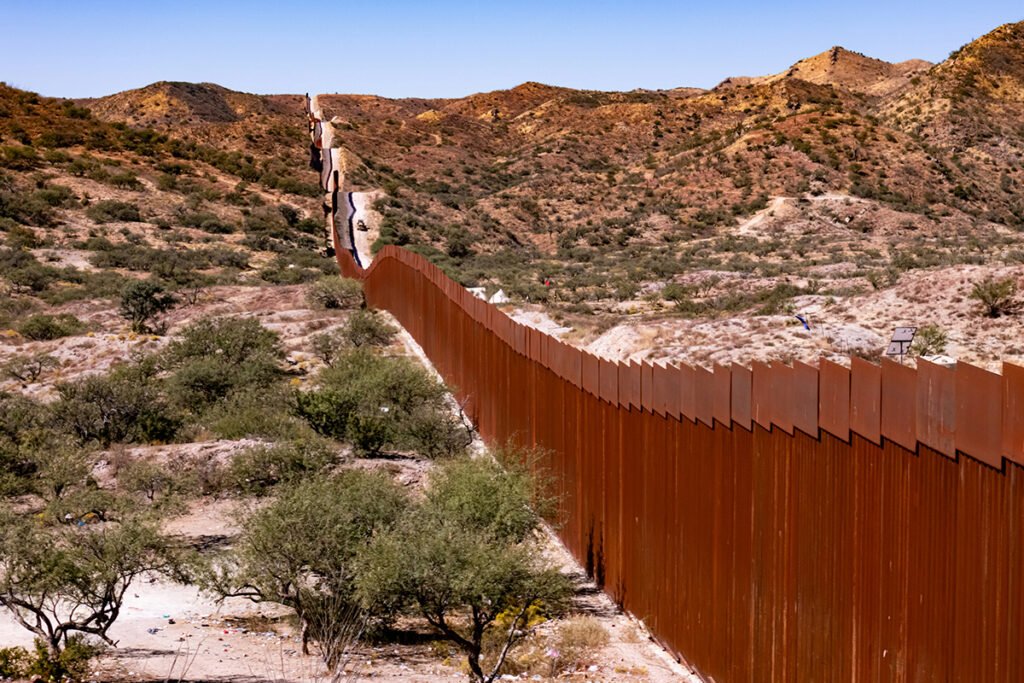
The desert borderlands between the United States and Mexico are home to one of the largest and most biodiverse ecosystems in North America. The habitats here are critical for an array of rare, threatened, and endangered species including jaguar, Sonoran pronghorn, lesser long-nosed bat, and more. But human activity in the area is devouring more and more land through farming, urban sprawl, and data centers. Recently, the expansion of a physical United States-Mexico border wall and all the infrastructure required to support it has caused particular disruption and damage to the borderlands ecosystem and the wildlife that call it home.
Border walls are located along imaginary geopolitical boundaries. They slice arbitrarily through critical ecosystems that know only natural boundaries, cutting wild animals off from the resources they need to live—food, water, a diverse selection of mates—and the ability to migrate for survival.
As of 2022, there were 74 border walls around the world. According to WOLA (Washington Office on Latin America), a research and advocacy organization for human rights in the Americas, “three miles of new border wall are now being built every week.” These walls reflect the immigration policies of human governments on either side and are often dangerous zones for people living around them and attempting to cross. But border walls threaten other life as well.
It’s Not Just the Walls
The kind of disruption a border wall presents to wildlife would be problematic under any circumstance, but climate change has exacerbated the issue. In a warming world, wild animals must move beyond their typical ranges or leave their natural habitat entirely to access cooler climates in more northern latitudes.
In the United States, Customs and Border Protection (CBP) is, according to its website, currently “utilizing funds from the ‘One Big Beautiful Bill Act (H.R. 1)’ to construct a border barrier system, or a ‘Smart Wall’, which includes a combination of primary and secondary steel bollard wall, waterborne barriers, patrol roads, and the technology required to tie it all together, such as cameras, lights and other detection technology.”
While the current Trump administration is making a big border wall push, plenty of infrastructure went up during the Clinton, George W. Bush, Obama, and Biden administrations, too—it’s hardly a partisan threat.
Russ McSpadden, Southwest conservation advocate at the nonprofit Center for Biological Diversity, works in the San Rafael Valley, a high-elevation rural grassland in southern Arizona that’s home to the headwaters of the Santa Cruz River. “The San Rafael Valley is probably the most critical wildlife corridor left between Arizona and Sonora,” McSpadden explained in an interview with NPQ. “The [government’s] intention is to seal that off like a wall. In some of those areas that are particularly important to wildlife, they plan to build double walls.”
McSpadden noted that it’s not just the walls themselves that are the issue; it’s the supporting infrastructure, too. The presence of artificial light at night disrupts the cycle of night and day, impacting reproduction, navigation, sleep, and protection from predators for amphibians, birds, mammals, insects, and plants.
Across the Organ Pipe Cactus National Monument, sacred land that has been home to the Tohono O’odham people for thousands of years, CBP has installed nearly 2,000 stadium-bright light fixtures along the border—ignoring community opposition and at times persecuting Tohono O’odham people who protest.
“They built that in 2020,” McSpadden said of the light array. While the lights have yet to be used—it’s unclear what the specific plan or timeline is—“if they ever flipped this system on…it would create a secondary wall of light in the night sky.”
Nonprofits’ Role
A 2024 study co-led by Sky Island Alliance, a binational nonprofit working to protect the biodiversity of the Sky Island region along the US-Mexico border, found that just 9 percent of interactions between wildlife and the border wall resulted in successful crossings for the animals.
Minor wildlife passages, each the size of a sheet of paper, were built sporadically into the wall. These openings help smaller animals cross, like badgers and coyotes, but do nothing for larger or medium-sized species like black bear, deer, and wild turkey.
Eamon Harrity, wildlife program manager at Sky Island Alliance, explained to NPQ that the study compared newer sections of the border wall that have just four-inch gaps between 18- or 30-foot steel posts, with older sections where barriers often have more space between them. Those barriers were designed to impede vehicles crossing, rather than people on foot.
“The study is continuing. We’ve had cameras in sections without wall for the past six years and now they’re building the wall. It’ll take a couple of years, but we’re hoping to do a big before-and-after comparison of the wildlife community and its shifts once the wall is completed,” Harrity said.
Sign up for our free newsletters
Subscribe to NPQ's newsletters to have our top stories delivered directly to your inbox.
By signing up, you agree to our privacy policy and terms of use, and to receive messages from NPQ and our partners.
Nestled in the REAL ID Act of 2005 is a clause that has allowed the Department of Homeland Security Secretary to waive federal, state, and local laws that might impede border wall construction, including environmental laws that would otherwise require environmental impact assessments.
“Nonprofits can take on this role of impact assessment, as the federal government is under no obligation to do any sort of mitigation,” Harrity added.
At the Center for Biological Diversity, McSpadden said, “we take legal action to try to stop the border wall,” noting that the organization has sued to challenge the waivers outlined in the REAL ID Act. But that’s not where solutions stop.
A 2025 literature review offered a range of recommendations to reduce the damage border walls cause to wildlife, from creating peace parks—cross-border conservation areas—to using technological surveillance rather than physical walls, and incorporating wildlife-friendly openings. Many of these can be accomplished with minor adjustments or have already been done successfully in the past.
Harrity’s study showed that in many cases, adding just another inch and a half between the steel bollards can mean that many more animals, including bobcats and javelinas, would be able to cross through the wall itself rather than rely on scarce wildlife openings.
The National Border Patrol Council, the union representing US Border Patrol agents, published a webpage in 2012 which—until its deletion in 2019—argued that physical barriers don’t address the root causes of illegal immigration and that building them amounts to “wasting taxpayer money.”
The Trump administration’s plans for the wall at the US-Mexico border will ultimately leave approximately 535 miles of the border to be monitored with technology alone. “Most of the border is extremely well-surveilled and that was long considered all that was needed,” Harrity says.
He encourages doing what can be done to mitigate the harm of the physical structure that is already here, and likely will be for some time. Continuing to add wildlife openings helps smaller species. Simply opening the existing floodgates in the wall could allow larger species to make the crossing.
Still, he emphasized, “The simplest solution is to just not build it.”
For More on This Topic:
Listening to Chalchiuhtlicue Through the Río Grande’s Flow
How Wolves Mitigate the Effects of Climate Change
Climate Conservationists Push for People to Live with Nature Rather Than Against It