

This November marks the first Conference of the Parties (COP) meeting since we learned the planet has likely already warmed beyond the 1.5-degree-Celsius post-industrial global heating threshold. That number represented a pledge made by the Paris Climate Agreement a decade ago, a benchmark to curb greenhouse gases in the hope of slowing the rise of the Earth’s temperature.
COP, a gathering of countries working in tandem for concrete actions to slow climate change, was hosted by Brazil this year: a crucial Global South country when it comes to climate justice, but one whose record on the subject is mixed at best.
Brazil has a fossil fuel–based economy, a pattern of violence against land defenders and environmental activists as well as Indigenous peoples, and a history of land exploitation.
This year’s COP also marked an absence: The United States, under the fossil fuel–friendly and anti–climate action policies of the Trump administration, did not send a delegate to the conference.
Against the backdrop of such resistance to urgent action on the climate crisis, how are nonprofits and grassroots groups championing climate justice during COP30 in Brazil?
Brazil’s Record
The choice for Brazil as a host country for COP follows the decision to host last year’s conference in Azerbaijan, an extraction-heavy country where a Kuwaiti oil executive and secretary general of the Organization of the Petroleum Exporting Countries (OPEC) called oil and gas “a gift from god” while giving a speech on the COP stage.
As NPQ wrote in 2024, “A climate conference with a goal of decreasing reliance on fossil fuels whose most recent host countries plan to increase fossil fuel production by 32 percent over the next decade? That is becoming difficult to swallow for many who care about climate justice.”
Latin America is considered the deadliest region for land defenders; in Brazil, that includes unjust imprisonment, violence, even death.
A similar argument could be made about Brazil, whose government is expanding fossil fuel extraction. Just last month, the country granted a license for the oil company Petrobras to drill in the Amazon. As Amnesty International wrote, drilling “poses a direct threat to local water and soil and to the ecological balance. This oil extraction will also cause serious harm to the Indigenous People and traditional communities in the region, like the Karipuna, Palikur-Arukwayene, Galibi Marworno and Galibi Kali’na peoples, who have not been consulted about the project at all.”
In addition to the extraction in the Amazon, Brazil also has considerable offshore drilling operations, leading to high levels of pollution and emissions. And the country’s conservation efforts continue to fall short of their promised goals. Only 12 percent of the marine environment of Brazil’s protected areas is actually fully protected, according to the nonprofit Marine Conservation Institute.
In tandem with failing to protect the environment, Brazil’s record of human rights is also worsening, with eroding digital rights and freedom of speech, and an increase in gender violence and the denial of the rights of Indigenous peoples to their traditional lands. Latin America is considered the deadliest region for land defenders; in Brazil, that includes unjust imprisonment, violence, even death.
Action in Brazil
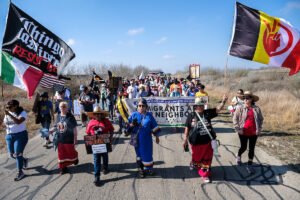
Groups have taken action in Belém, the Brazilian city hosting COP30. Tens of thousands of people marched in the city, known as the gateway to the lower Amazon. Named the “Great People’s March,” the event was the first large-scale protest at COP this year.
“We are the ones who protect the climate, and the Amazon cannot continue to be destroyed to enrich large corporations.”
Led by Indigenous peoples, many in traditional garb, groups also peacefully blocked the entrance to the conference multiple times. As the AP reported, the blockade “required conference participants to detour through a side door, leading to long lines to get in for the day’s events.” Brazil’s military prevented activists from entering the conference.
Protestors were asking for an audience with the President of Brazil, Luiz Inácio Lula da Silva, according to members of the Munduruku Indigenous group who blocked the main entrance.
Sign up for our free newsletters
Subscribe to NPQ's newsletters to have our top stories delivered directly to your inbox.
By signing up, you agree to our privacy policy and terms of use, and to receive messages from NPQ and our partners.
In a written statement from the Munduruku Ipereg Ayu Movement, the group wrote: “We refuse to be sacrificed for agribusiness. Our forest is not for sale. We are the ones who protect the climate, and the Amazon cannot continue to be destroyed to enrich large corporations.”
Demands from the group included for the Brazilian government to reject deforestation carbon credits, and cancel river development projects and a railway project that would cause further deforestation.
“Mayors across the country are doubling down to fill the current void of leadership at the federal level.”
Conversations, Not Action
For the first time since the 1995 inaugural COP, the United States did not send a delegate to the conference, but a coalition of 100 Americans did travel to Brazil this year. The US Climate Alliance included mayors, governors, and other state and city officials. Members of the group attended events and hosted community leaders.
As US Climate Alliance Co-Chair and Wisconsin Governor Tony Evers said in a statement, “We’ll make sure the world knows that no matter the obstacles, we’re charging forward….We are determined to deliver on the promises we made to the American people and our international partners.”
Another member of the alliance, Phoenix Mayor Kate Gallego, said in a statement, “Mayors across the country are doubling down to fill the current void of leadership at the federal level.”
This frustration over a lack of government action was felt keenly at the conference, expressed by protestors like Harjeet Singh, who told the AP that previous COPs “have not delivered” on their promises of change.
Singh said, “We should look at this as a message and signal from Indigenous people, who have not seen any progress over the past 33 years of COP, that all these conversations have not led to actions….They are the custodians of biodiversity and climate and clearly, they are not satisfied with how this process is doing.”\
For More on This Topic:
Can a COP Held in Oil Countries Stay Relevant?
How Can We Keep Pace with a World Warming Past 1.5 Degrees Celsius?
Who Gets to Talk About Climate Change?